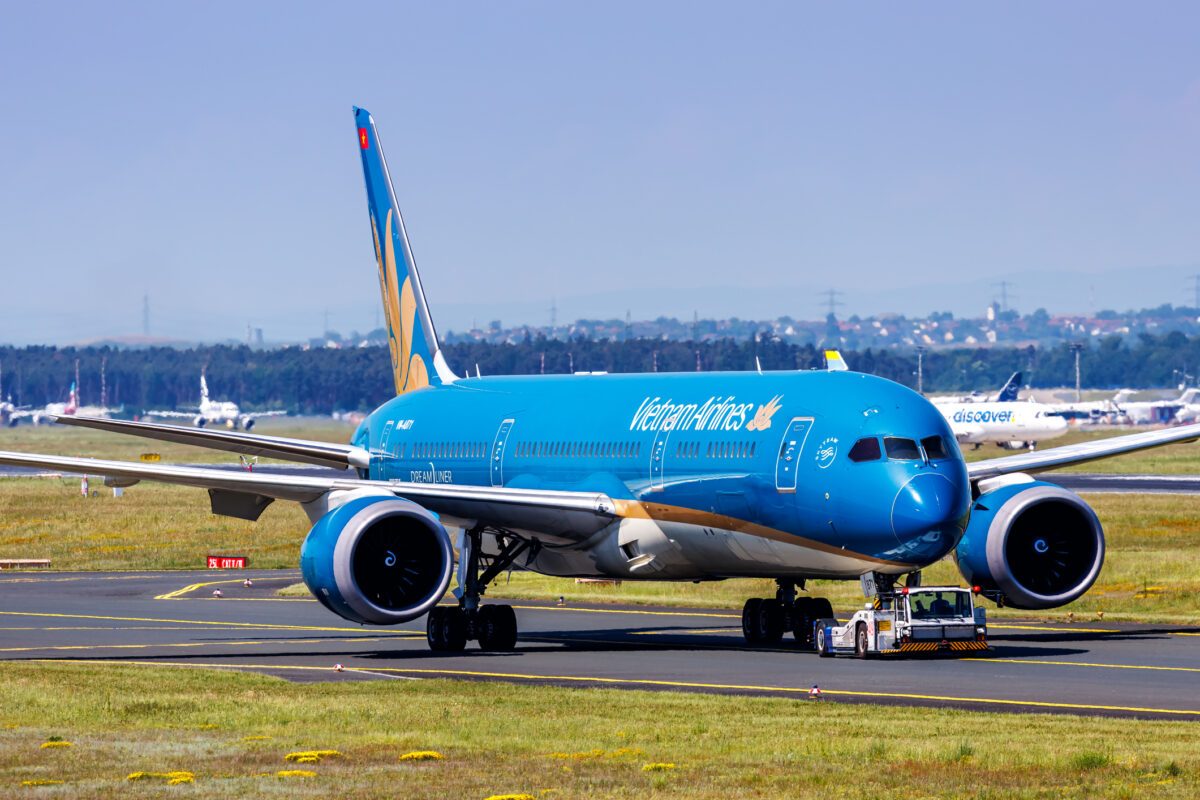
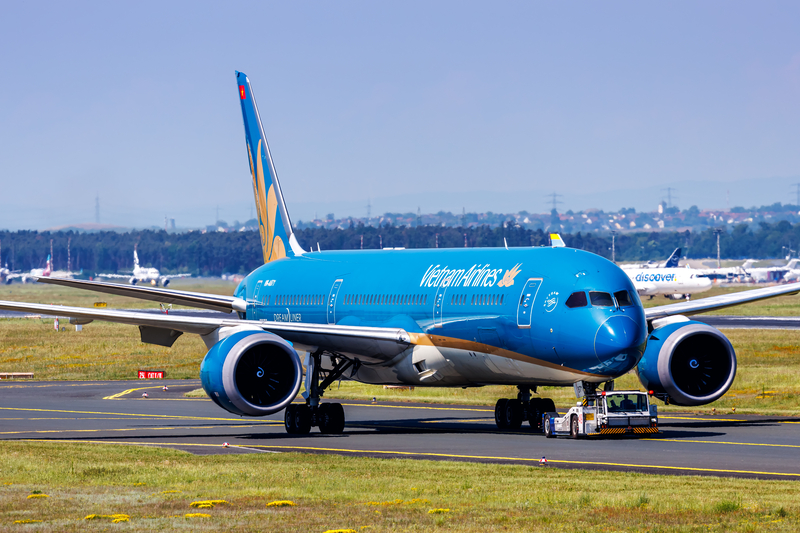
A Vietnam Airlines Boeing 787-9 Dreamliner suffered a tail strike and multiple tire failures during a highly abnormal departure from Munich Airport (MUC), forcing the Hanoi-bound aircraft to dump fuel and return to Germany approximately two hours later.

Flight VN34 was operating from Munich Airport (MUC) to Hanoi Noi Bai International Airport (HAN) on August 15, 2026, with 271 passengers and 16 crew members aboard. The aircraft involved was Boeing 787-9 VN-A867.
According to the Civil Aviation Authority of Vietnam’s preliminary account of the incident, VN34 departed Munich at 1:57 p.m. local time. Shortly after becoming airborne, the crew received warnings indicating that the aircraft’s tail had contacted the runway and that tire pressures were abnormal.
Read our stories in your inbox
Two aviation newsletters. Zero fluff.
The pilots elected to return to Munich Airport (MUC), but first had to reduce the heavily fueled Dreamliner’s landing weight. The aircraft remained in the Munich area, dumped fuel and conducted low approaches so the landing gear could be inspected from the ground before landing safely on Runway 26R at approximately 3:57 p.m.
All 287 people aboard escaped injury.
VN34’s Problems Began During the Takeoff Roll
Details released since the incident show that the technical problem was considerably more serious than an indication that appeared after takeoff.
According to a preliminary pilot report summarized by VnExpress from information provided by Vietnamese aviation authorities, VN34 began its takeoff roll on Munich Airport’s (MUC) Runway 26L with an estimated aircraft weight of approximately 240 metric tons.
Weather was reportedly favorable, with visibility of at least 10 kilometers, light winds of around three knots and a temperature of 33 degrees Celsius.
About halfway down the runway, however, the pilots noticed that the Boeing 787-9 stopped accelerating for approximately two seconds.
The aircraft then resumed accelerating and eventually reached V1, the critical takeoff decision speed. After passing V1, the crew reported that the aircraft’s speed decreased again.
At that point, the pilots determined that there was insufficient runway remaining to reject the takeoff safely. They continued the departure and advanced the engines to maximum thrust.
The pilot flying reportedly began rotating the aircraft with only about 300 feet, or 91 meters, of runway remaining.
That sequence will be central to the investigation. Investigators need to determine why a Boeing 787-9 that had been calculated and configured for departure apparently failed to accelerate normally during two separate portions of its takeoff roll.
Tail Strike Confirmed After the 787 Became Airborne
After leaving the ground, VN34’s onboard systems generated a warning indicating that the rear fuselage had contacted the runway.
That was not simply a faulty cockpit message. Initial inspection after the aircraft returned to Munich found extensive scraping along the underside of the rear fuselage, with damage to portions of the aircraft’s outer skin.
Germany’s Federal Bureau of Aircraft Accident Investigation, or BFU, has also confirmed that the Dreamliner suffered a tail strike.
A tail strike occurs when the rear portion of an aircraft’s fuselage contacts the runway during takeoff or landing. On departure, it can happen if the nose is rotated too aggressively, if the aircraft rotates before sufficient speed has been achieved or when an abnormal performance condition changes the aircraft’s expected takeoff behavior.
The presence of a tail strike does not establish which of those factors occurred on VN34. Investigators still need to determine why the aircraft was traveling so far down Runway 26L before becoming airborne.
Video recorded at Munich Airport (MUC) shows the 787 disappearing into a substantial cloud of dust and debris near the departure end of the runway. Some early reports described images as showing the aircraft’s tail “smoking,” but there is no evidence of an onboard fire. The visible cloud during departure appears associated with the aircraft reaching or passing the paved runway environment rather than smoke from the fuselage.
Four of Eight Main Landing Gear Tires Lost Pressure
The tail strike was only one of the problems facing the crew.
VN34 also received tire-pressure warnings after takeoff. Preliminary inspection ultimately found that four of the Boeing 787-9’s eight main landing gear tires had lost pressure.
Vietnamese authorities identified the affected tires as numbers 1, 5 and 6 on the left main landing gear and number 3 on the right.
That created a difficult situation for the pilots. Even though the aircraft was safely airborne, they now had to prepare to land an aircraft with suspected damage to both the rear fuselage and landing gear.
The 787 had also departed Munich carrying fuel for the roughly 12-hour flight to Hanoi Airport (HAN). Returning immediately would have meant landing at a substantially higher weight than intended.
The crew therefore remained near Munich and dumped fuel to bring the aircraft down to a more appropriate landing weight.
During the return, the pilots performed two low approaches over Runway 26R so air traffic controllers and airport personnel could visually examine the landing gear from the ground.
After being advised that no obvious additional landing gear abnormalities could be seen externally, the crew proceeded with the landing.
Boeing 787 Lands Safely but Cannot Taxi From Runway
VN34 touched down safely on Munich Airport’s (MUC) Runway 26R at approximately 3:57 p.m., roughly two hours after departing.
The damaged tires became particularly apparent after touchdown. Video from the arrival showed smoke around the main landing gear, while the aircraft was unable to taxi normally away from the runway under its own power.
Munich Airport temporarily closed the north runway while emergency and ground crews attended to the aircraft. Traffic was redirected to the airport’s other runway while VN-A867 remained disabled.
Passengers were ultimately removed from the aircraft using mobile stairs and transported to the terminal.
The presence of smoke around the landing gear after touchdown should also be distinguished from claims that the aircraft itself was on fire. With multiple damaged or depressurized tires and a heavily loaded widebody returning under abnormal conditions, tire and brake heating can produce substantial smoke without an aircraft fire.
Investigators Are Looking Closely at the Takeoff Performance
The most important unanswered question is why VN34 did not accelerate as expected.
Photos from the runway show significant tire marks extending toward the departure end. The marks, combined with the pilots’ account of an aircraft that stopped accelerating and later lost speed, have led to speculation that a braking-system problem may have played a role.
That remains unconfirmed.
A review of the preliminary evidence by AeroTime notes that investigators are examining the possibility but that there has been no official determination of a brake malfunction.
The Boeing 787 uses an electrically controlled braking system rather than the conventional hydraulic brake architecture found on many older airliners. Investigators will be able to compare commanded braking, actual brake operation, engine thrust, wheel speeds, aircraft acceleration and other recorded parameters.
Germany’s BFU has secured the flight data recorder and cockpit voice recorder and taken them to its facilities in Braunschweig for analysis.
Those recorders should provide a second-by-second reconstruction of the takeoff roll and help determine whether the abnormal acceleration resulted from an aircraft system problem, braking, engine performance, aircraft configuration, takeoff calculations, crew actions or another factor.
Until that analysis is complete, assigning a cause would be premature.
Experienced Four-Pilot Crew Was Aboard
Vietnam Airlines had four pilots assigned to the long-haul flight: three captains and one first officer.
According to information released by Vietnamese authorities, the four pilots had accumulated a combined 63,938 flight hours, including 19,675 hours on the Boeing 787.
That level of experience will not remove crew actions from the investigation. Aircraft accident investigations routinely examine human factors, operating procedures, aircraft systems, performance calculations, maintenance history and environmental conditions regardless of crew experience.
One particular area of interest will be the decision-making around V1.
Before V1, crews can generally reject a takeoff for serious abnormalities and stop within the calculated runway distance. Once V1 has been passed, continuing the takeoff is normally the safer course because there may no longer be sufficient pavement available to stop.
The preliminary crew account says the second reduction in speed occurred after V1 and that the pilots concluded they no longer had enough runway to safely abort. Investigators will use the recorded aircraft data to determine the precise speeds, locations and system indications involved.
VN-A867 Is a 10-Year-Old Boeing 787-9
The aircraft involved, VN-A867, is a Boeing 787-9 Dreamliner delivered new to Vietnam Airlines in April 2016.
The aircraft is powered by two GE Aerospace GEnx-1B turbofan engines and is configured for 274 passengers. Its cabin contains 28 Business Class seats, 35 Premium Economy seats and 211 Economy seats.
Vietnam Airlines’ official Boeing 787 fleet information lists the Dreamliner as one of the airline’s primary long-haul aircraft, operating services between Vietnam and destinations in Europe and Northeast Asia.
The 787-9 is designed specifically for long-range missions such as Munich Airport (MUC)–Hanoi Airport (HAN). Boeing currently publishes a range of up to 8,300 nautical miles for the type.
Vietnamese authorities said VN-A867 weighed approximately 240 metric tons for the Munich departure, below the 247.2-ton maximum takeoff weight applicable to the aircraft’s approved configuration.
The aircraft has remained out of passenger service at Munich while inspections and the investigation continue.
All Passengers Were Rebooked
Vietnam Airlines initially described the event simply as a return for technical reasons.
In a subsequent formal statement on Flight VN34, the airline confirmed that all passengers and crew were safe and said it was cooperating with authorities to determine the cause.
The carrier arranged hotel accommodations, meals and ground transportation for affected travelers while alternative flights were organized.
By the afternoon of August 16, Vietnamese aviation authorities said all 271 passengers had been provided with alternative travel arrangements on Vietnam Airlines or other carriers.
The incident therefore did not involve a replacement VN34 simply departing later that afternoon, as some early accounts suggested. Passengers were distributed across available alternative itineraries while the damaged Dreamliner remained in Munich.
German Authorities Are Leading the Investigation
Because the event occurred in Germany, the BFU is responsible for the investigation under the framework established by Annex 13 of the International Civil Aviation Organization.
The Civil Aviation Authority of Vietnam confirmed that Vietnamese investigators are coordinating with their German counterparts and participating in the process.
Vietnam’s Ministry of Construction has separately instructed the aviation authority and Vietnam Airlines to review flight operations, maintenance and training procedures while the German investigation proceeds.
The aircraft’s significant tail and tire damage makes the investigation particularly important. While the safe landing demonstrated the 787’s ability to tolerate the damage that occurred, investigators must establish why a normally performing long-haul jet apparently used nearly the entire available runway before becoming airborne.
Bottom Line
Vietnam Airlines Flight VN34 suffered a serious takeoff incident at Munich Airport (MUC) on August 15, 2026, while operating to Hanoi Noi Bai International Airport (HAN).
The Boeing 787-9, registered VN-A867, experienced abnormal acceleration during its takeoff roll on Runway 26L. According to the preliminary crew account, the aircraft briefly stopped accelerating about halfway down the runway, later reached V1 and then experienced another reduction in speed.
With insufficient runway remaining to reject the takeoff, the crew applied maximum thrust and began rotating with approximately 300 feet of runway left.
After becoming airborne, the aircraft generated tail-strike and tire-pressure warnings. Four of its eight main landing gear tires ultimately lost pressure, while inspection found substantial scraping and skin damage beneath the rear fuselage.
The pilots dumped fuel, performed two low approaches for a visual landing-gear inspection and returned safely to Munich Airport (MUC) at 3:57 p.m. All 271 passengers and 16 crew members were unharmed.
Germany’s BFU is now analyzing the cockpit voice and flight data recorders. A braking problem is one possibility being discussed, but no cause has been established.
What initially appeared in early reports as a routine technical return was considerably more significant: VN34 experienced a highly abnormal takeoff, confirmed tail strike and multiple tire failures before completing a safe return to Munich.