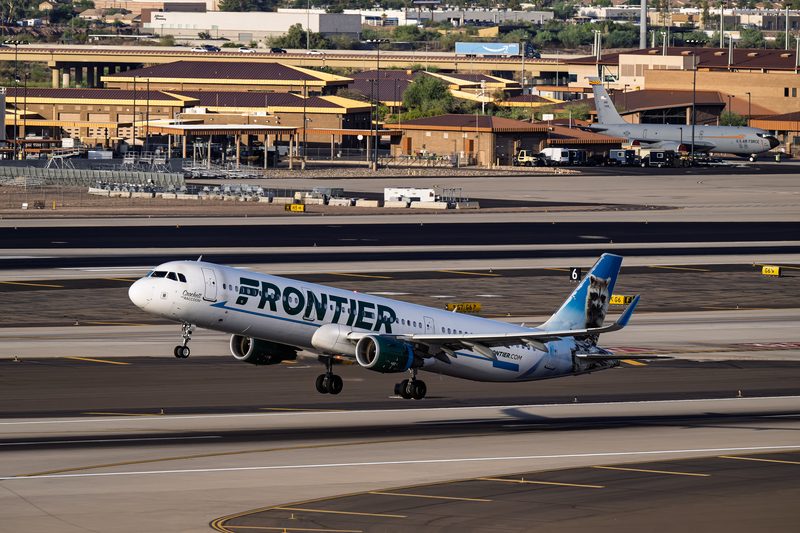
Frontier Airlines is preparing to add inflight internet for the first time in its history, selecting SpaceX’s Starlink system for installation across its all-Airbus fleet.

The Denver-based ultra-low-cost carrier expects its first Starlink-equipped aircraft to enter passenger service in early 2027. Frontier will become the first U.S. ultra-low-cost carrier to commit to the satellite-based connectivity platform, although several larger American airlines are already operating or installing Starlink.
The decision represents a major change for an airline that has historically avoided onboard Wi-Fi, seatback entertainment, and electrical outlets to reduce aircraft weight and operating costs. Frontier has not disclosed how much internet access will cost, whether it will be complimentary for loyalty members, or how quickly the remaining fleet will be modified.
Read our stories in your inbox
Two aviation newsletters. Zero fluff.
The announcement is therefore significant for what Frontier confirmed—and for what it left unanswered.
What Frontier Has Confirmed
Frontier announced the Starlink agreement on July 14, 2026, saying its first connected aircraft is planned for early 2027.
The airline said passengers will be able to use the service for activities including streaming, online gaming, web browsing, and work applications. It also expects the system to provide gate-to-gate connectivity, meaning internet access should remain available during taxi, takeoff, cruise, landing, and the arrival at the gate rather than beginning only after the aircraft reaches 10,000 feet.
Frontier has provided the following basic details:
| Starlink rollout detail | Current status |
|---|---|
| First equipped aircraft | Planned for early 2027 |
| Aircraft family | Frontier’s Airbus A320-family fleet |
| Fleetwide completion date | Not announced |
| Passenger pricing | Not announced |
| Complimentary access | Not announced |
| Loyalty-member benefit | Not announced |
| Aircraft installation order | Not announced |
| Gate-to-gate connectivity | Planned |
| Operational connectivity | Planned for crews, maintenance, and ground teams |
Frontier’s wording says it will introduce Starlink across its fleet, but the airline has not published a month-by-month installation schedule.
That means passengers should not expect every Frontier aircraft to offer Wi-Fi immediately when the first equipped jet enters service. Fleetwide connectivity programs generally require aircraft to be removed from normal flying for installation, inspection, testing, and regulatory approval.
Frontier Is the First U.S. ULCC to Choose Starlink
The distinction between an ultra-low-cost carrier and the broader U.S. airline industry is important.
Frontier is positioned to become the first American ULCC to operate Starlink, but it will not be the first U.S. airline to offer the system.
Hawaiian Airlines began operating free Starlink service in 2024 and completed installation across its Airbus A321neo and A330 fleets. Hawaiian does not plan to install it on the Boeing 717s used for short inter-island services.
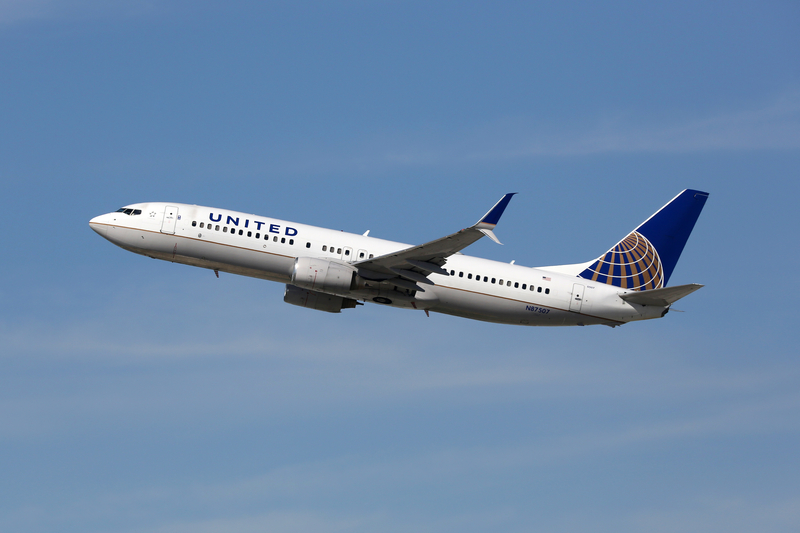
United Airlines began its Starlink rollout in 2025. By June 2026, more than 400 United aircraft had been equipped, with the airline expecting to approach 1,000 installations before the end of the year. Access is complimentary for members of United’s free MileagePlus program.
Alaska Airlines has completed installation across its Embraer 175 regional fleet and is modifying its Boeing 737 mainline aircraft. The carrier plans to have its broader fleet connected by the end of 2027, with complimentary access available to Atmos Rewards members.
Southwest Airlines announced its own Starlink agreement in February 2026. The carrier planned to place its first equipped Boeing 737s into service during the summer and have at least 300 Starlink aircraft by the end of 2026. Southwest provides free Wi-Fi to Rapid Rewards members, although Starlink will gradually replace or supplement its existing connectivity systems.
| U.S. airline | Starlink status in July 2026 | Published access model |
| Hawaiian Airlines | Available across its primary Airbus fleet | Free |
| United Airlines | More than 400 aircraft equipped | Free for MileagePlus members |
| Alaska Airlines | Regional fleet complete; mainline installation underway | Free for Atmos Rewards members |
| Southwest Airlines | Initial rollout underway | Free for Rapid Rewards members |
| Frontier Airlines | First aircraft planned for early 2027 | Not announced |
Southwest is generally classified as a low-cost carrier rather than an ultra-low-cost airline. Spirit and Allegiant are Frontier’s closer U.S. ULCC comparisons.
Frontier Makes a Narrower “First U.S. Airline” Claim
Frontier’s official announcement also describes the carrier as the first U.S. airline to offer Starlink through a “new system managed directly by Starlink.”
That claim should not be confused with being the first American airline to install or operate Starlink. Hawaiian, United, and Alaska already had equipped aircraft in service before Frontier’s announcement.
Frontier has not explained how the new Starlink-managed access system differs from the portals, authentication systems, and commercial arrangements used by existing airline customers.
The wording could involve how passengers authenticate, purchase, or receive access. It could also reflect a broader platform through which Starlink manages the customer relationship instead of leaving the complete portal and pricing structure to the airline.
Until Frontier or Starlink provides additional technical and commercial details, the exact significance of the “managed directly by Starlink” system remains unclear.
Frontier Currently Offers No Internet or Electrical Power
The new system will eliminate one of the largest product gaps between Frontier and most major U.S. carriers.
Frontier’s existing onboard policy states that its flights do not offer Wi-Fi, television, movies, or other inflight entertainment. The airline’s aircraft also do not have passenger electrical outlets.
Frontier has historically defended that approach as part of its low-cost strategy. Removing entertainment systems, connectivity equipment, electrical wiring, and related maintenance requirements can reduce weight and expenses, allowing the airline to sell a basic transportation product at a lower advertised fare.
Starlink reverses part of that philosophy.
Once the system is available, Frontier passengers will no longer need to download every movie, document, or podcast before departure. The airline will also gain an entertainment option without installing seatback screens because customers can stream content directly to their own phones, tablets, and laptops.
However, the lack of electrical outlets may become more noticeable after Wi-Fi arrives.
Streaming video, participating in video calls, gaming, or working online can rapidly consume device batteries. Frontier has not announced plans to add USB ports or AC power as part of the Starlink retrofit.
Passengers on longer Frontier routes could therefore have high-speed internet but no way to recharge the device being used to access it.
Starlink Uses Low-Earth-Orbit Satellites
Traditional satellite internet systems used by airlines have generally relied on satellites positioned in geostationary orbit approximately 22,000 miles above Earth.
Starlink uses a large constellation of satellites in low-Earth orbit. Because the satellites are much closer to the planet, signals travel a shorter distance between the aircraft, satellite, and ground network.
That reduces latency—the delay between a user sending a request and receiving a response—and makes applications such as video calls, gaming, cloud software, and real-time collaboration more practical.
Starlink markets its aviation platform as capable of supporting speeds of as much as one gigabit per second at the aircraft level, although individual passenger performance will depend on the number of connected devices, satellite capacity, geographic coverage, network congestion, and the airline’s onboard configuration.
An electronically steered antenna installed on the upper fuselage tracks satellites without the large mechanically rotating equipment used by some older systems.
As the aircraft moves, the terminal automatically transfers its connection from one satellite to another. Satellite-to-satellite optical links can also carry data across the constellation before routing it to a ground station.
For passengers, the intended result is an internet experience closer to a home or office broadband connection than the slow, intermittent service historically associated with aircraft Wi-Fi.
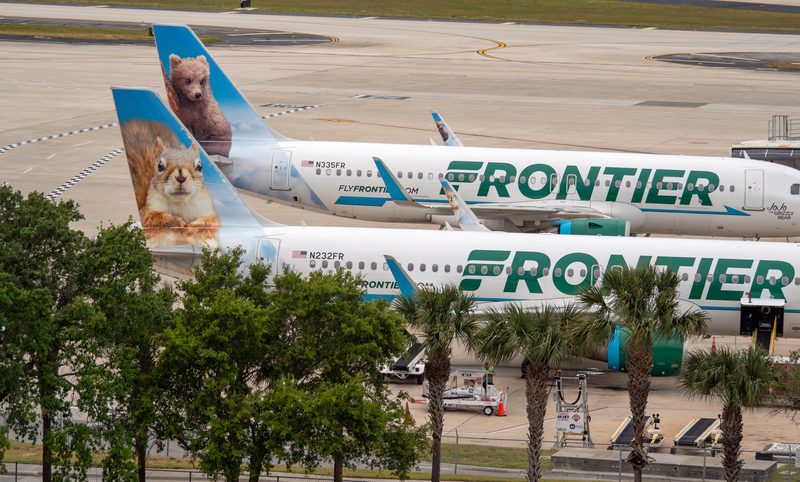
Frontier Operates an All-Airbus Fleet
Frontier’s single-manufacturer fleet should make the installation program less complicated than a rollout involving regional jets, widebodies, and multiple unrelated aircraft families.
As of December 31, 2025, Frontier operated 176 Airbus narrowbody aircraft:
| Aircraft type | Aircraft | Seats |
| Airbus A320ceo | 6 | 180 or 186 |
| Airbus A320neo | 89 | 186 |
| Airbus A321ceo | 21 | 230 |
| Airbus A321neo | 60 | 240 |
| Total | 176 | — |
Approximately 85% of the fleet consisted of newer A320neo-family aircraft at the end of 2025. Frontier continued accepting additional A320neos and A321neos during early 2026 while also planning the return of 24 leased A320neos as part of a separate fleet-rightsizing agreement.
The exact fleet count at the beginning of Starlink installation may therefore differ considerably from the year-end 2025 figure.
Frontier’s A320s and A321s share a common basic design, cockpit philosophy, and operating family. That commonality can simplify crew procedures, spare-parts planning, technician training, and the development of installation packages.
The aircraft are not identical, however. Different fuselage lengths, cabin layouts, electrical configurations, and equipment locations can require separate engineering work or approved modifications.
The A321neo Will Place the Greatest Demand on the System
Frontier’s Airbus A321neo is configured with 240 seats, making it one of the highest-capacity A321neos operated by a U.S. airline.
A nearly full aircraft could have more than 200 passengers attempting to connect phones, tablets, and laptops at the same time. Some customers may use more than one device.
That creates a very different network load from a 50-seat regional jet or a premium-heavy long-haul aircraft carrying fewer than 200 passengers.
The system must distribute available bandwidth among those users while maintaining adequate performance for streaming, browsing, messaging, gaming, and operational applications.
Starlink’s capacity is considerably greater than that of many older inflight systems, but no satellite network has unlimited bandwidth. Performance can vary with geography, satellite density, weather, and the number of nearby equipped aircraft using the same network resources.
Frontier and Starlink will need to determine whether access should be unrestricted, divided into service tiers, or managed through limits on activities such as high-resolution streaming.
The airline has not announced any restrictions.
Starlink Could Improve More Than the Passenger Experience
Frontier says the system will also connect pilots, flight attendants, maintenance teams, and ground operations.
Those operational applications may eventually be as valuable as passenger internet.
A connected aircraft can transmit maintenance information while it is still airborne, giving technicians time to review fault messages, obtain parts, and prepare troubleshooting procedures before the airplane arrives.
If a component requires attention at Denver International Airport (DEN), Orlando International Airport (MCO), or another Frontier station, maintenance control may be able to coordinate the response while the flight remains en route.
Cabin crews could potentially receive updated passenger information, connection details, operational notices, or instructions during the flight. Pilots may gain access to updated weather and operational information through approved applications, subject to certification and airline procedures.
During disruptions, better communication could allow Frontier to begin rebooking passengers or arranging gate changes before landing.
Frontier’s announcement did not identify the specific crew and maintenance applications it will use. It said only that the connection is expected to improve operational performance and support more seamless customer service.
Pricing Is the Largest Unanswered Question
Frontier did not say that Starlink will be free.
The announcement consistently refers to providing passengers with “access” to the service rather than complimentary connectivity. It does not identify a price, data allowance, subscription, loyalty benefit, or free messaging option.
That omission does not prove that Frontier intends to charge.
The airline may still offer free Wi-Fi to every passenger, require membership in Frontier Miles, include connectivity with premium bundles, provide it to elite members, or sell access on an individual-flight basis.
Frontier could also adopt multiple tiers. Basic messaging or browsing could be complimentary, while streaming-quality access is sold separately.
The decision will be closely watched because Frontier earns a substantial portion of its revenue from optional products. Checked baggage, carry-on baggage, seat selection, priority boarding, bundles, onboard food, and loyalty products allow the airline to advertise a low base fare while charging customers for the services they choose.
Paid internet would fit that commercial structure. Free internet could serve a different purpose by increasing Frontier Miles enrollment, improving customer satisfaction, and making the airline more competitive with carriers that include connectivity.
Copa Shows That Starlink Does Not Have to Be Free
Most major airlines introducing Starlink have made the service complimentary, sometimes requiring passengers to join a free loyalty program.
Copa Airlines has introduced a different model.
The Panamanian carrier began operating Starlink-equipped aircraft in July 2026 but limited complimentary access to qualifying groups, including Business Class passengers, higher-level ConnectMiles members, and customers with eligible Starlink Residential or Roam subscriptions.
Other passengers are expected to purchase internet access, although Copa had not published all pricing details at the beginning of the rollout.
Copa demonstrates that Starlink does not require one universal commercial model.
Frontier could use a similar approach by offering free access to elite members, First Class customers, credit-card holders, or passengers purchasing higher-priced bundles while charging travelers buying the most basic fare.
It could also use Starlink’s own subscriber relationships, particularly because Frontier’s announcement emphasizes a new platform managed directly by Starlink.
No such arrangement has been confirmed.
Free Wi-Fi Has Become a Competitive Tool
For many network airlines, complimentary internet is becoming less of a cabin amenity and more of a loyalty-acquisition strategy.
United requires passengers to sign into MileagePlus for complimentary Starlink access. Alaska uses a similar model with Atmos Rewards, and Southwest makes free internet available to Rapid Rewards members.
Joining each program is free, but the airline receives valuable customer information and can build a direct marketing relationship with the traveler.
The passenger receives internet without paying during the flight. The carrier gains another loyalty member who may later receive credit-card offers, fare promotions, vacation packages, and personalized marketing.
Frontier already places considerable emphasis on its Frontier Miles program and co-branded credit card. Offering Starlink to members could support the airline’s effort to build more predictable, higher-value customer relationships.
Charging every passenger could generate immediate ancillary revenue but may produce fewer loyalty sign-ups and make Frontier’s product less competitive against airlines offering free access.
The airline has not indicated which outcome it values more.
Starlink Is Part of Frontier’s Broader Product Shift
The Wi-Fi decision is not occurring in isolation.
Frontier has spent several years attempting to expand beyond the most basic version of the ULCC model. The airline introduced UpFront Plus seating with a blocked middle seat and has announced plans for a more conventional First Class product in the first two rows.
It has also expanded elite benefits, companion travel, bundles, and mileage-redemption options.
CEO Jimmy Dempsey directly connected Starlink with those initiatives, describing it as another step in Frontier’s effort to improve the travel experience while maintaining low fares.
The strategy reflects changes across the U.S. airline market.
Premium and loyalty revenue has grown more important, while airlines have found it difficult to rely entirely on selling the cheapest fare. Customers still respond to low prices, but many are willing to pay for additional space, priority treatment, baggage, flexibility, and reliable connectivity.
Frontier does not need to become a full-service airline to participate in that trend. It can continue selling a stripped-down base fare while creating more optional products for passengers who value them.
Starlink could function as another upgrade—or as a complimentary benefit intended to make the entire airline more attractive.
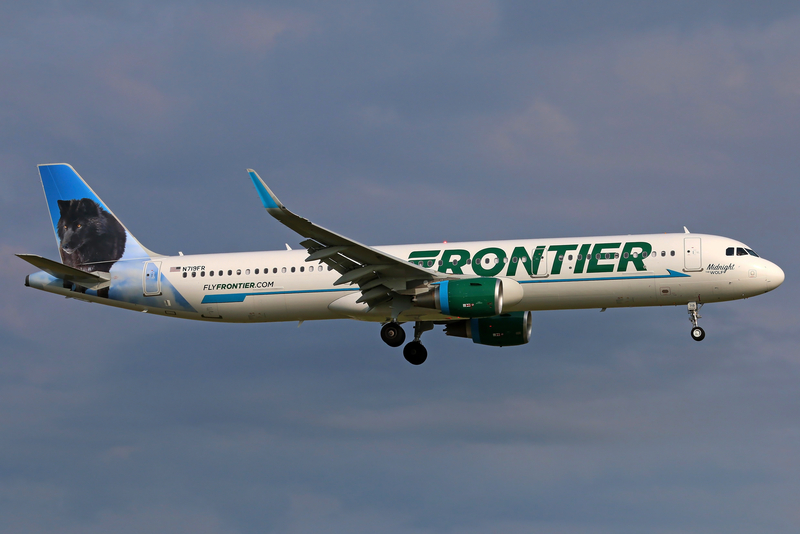
More Than 1,000 Indigo Partners Aircraft Are Included
Frontier’s agreement is part of a much larger Starlink commitment involving airlines associated with Indigo Partners.
The group says more than 1,000 aircraft across five airlines are expected to receive the system:
| Airline | Primary region |
| Frontier Airlines | United States |
| Wizz Air | Europe |
| Volaris | Mexico and Central America |
| JetSMART | South America |
| Cebu Pacific | Philippines and Asia |
The combined order is one of the largest inflight-connectivity commitments announced by a group of low-cost airlines.
It also provides a clear answer to whether other budget carriers will follow Frontier: several already have.
Wizz Air, Volaris, JetSMART, and Cebu Pacific share variations of the high-density, ancillary-revenue-focused model used by Frontier. Their participation suggests that Indigo Partners believes high-speed connectivity can be incorporated without undermining the core economics of low-cost flying.
The group-level scale may also reduce installation and procurement costs. Starlink can develop common technical, portal, and commercial solutions for a large number of A320-family aircraft rather than negotiating an entirely separate platform for each small airline.
Cebu Pacific also operates Airbus narrowbodies, although its fleet includes other aircraft types. Volaris, JetSMART, and Wizz Air rely heavily or entirely on the A320 family, creating considerable commonality across the agreement.
Spirit Already Offers Paid Wi-Fi
Spirit Airlines is not waiting for Starlink to provide internet.
The U.S. ULCC already offers gate-to-gate streaming Wi-Fi on equipped aircraft. Passengers can purchase connectivity separately, while certain upgraded products may include access as part of the fare package.
Spirit’s existing system means the airline faces a different decision from Frontier.
Rather than determining whether to offer internet for the first time, Spirit must decide whether its current technology remains competitive as Starlink and other low-Earth-orbit systems become more common.
Replacing an existing system carries costs involving contract terms, removal of installed equipment, aircraft downtime, new antennas, cabin networking, and certification.
Spirit may retain its current platform if the economics and performance remain acceptable. It could also adopt Starlink or another next-generation system during a later fleet upgrade.
No Starlink commitment has been announced by Spirit.
Allegiant Has Discussed Starlink but Made No Commitment
Allegiant Air remains one of the largest U.S. airlines without onboard Wi-Fi or entertainment.
Its current passenger information says internet is unavailable on Allegiant flights.
Allegiant CEO Greg Anderson said in 2025 that he expected the airline to offer Wi-Fi eventually and described connectivity as increasingly important to passengers. He also confirmed that the airline had held preliminary discussions about installing Starlink on its Airbus fleet.
Those discussions had not produced an announced agreement, provider selection, or rollout schedule as of July 2026.
Frontier’s decision may increase competitive pressure on Allegiant, particularly because the carriers overlap in numerous leisure markets.
Allegiant also has a growing Boeing 737 MAX 8-200 fleet in addition to its Airbus aircraft, potentially making a fleetwide installation more complicated than Frontier’s all-Airbus program.
The combined Allegiant–Sun Country organization will eventually have an even broader collection of aircraft and operating missions, including passenger, charter, and cargo flying. Management will need to decide whether connectivity should be installed throughout that operation or limited to selected passenger aircraft.
JetBlue Is Taking a Different Satellite Path
Not every U.S. airline is choosing Starlink.
JetBlue has offered free Fly-Fi across its fleet for years and plans to introduce Amazon’s Project Kuiper—now marketed as Amazon Leo—on part of its fleet beginning in 2027.
Like Starlink, Amazon’s system uses satellites in low-Earth orbit to reduce latency and increase available bandwidth. JetBlue intends to keep Fly-Fi free while upgrading older portions of its existing connectivity network.
That agreement shows that the future inflight-connectivity market may not belong to a single provider.
Airlines can choose among Starlink, Amazon Leo, Viasat, Intelsat, and other systems based on coverage, installation cost, contract structure, aircraft compatibility, and commercial control.
Frontier’s Starlink decision is therefore a major endorsement, but it does not establish that every low-cost carrier will select the same technology.
Installation Will Require Aircraft Downtime
Frontier has not said how long each retrofit will take.
Installing satellite internet generally involves adding one or more exterior antennas, creating or modifying the aerodynamic fairing above the fuselage, installing power and data equipment, adding cabin wireless access points, routing wiring, updating software, and completing operational checks.
The work must comply with an approved aircraft modification package. Engineers must confirm that the installation does not interfere with flight controls, navigation, communication, structural integrity, lightning protection, or other certified systems.
Aircraft may be modified during scheduled maintenance visits to reduce the amount of additional downtime. New Airbus deliveries could potentially arrive with parts of the installation completed or prepared, depending on the agreement among Frontier, Airbus, and Starlink.
Frontier’s large number of A320neo and A321neo aircraft creates a significant workload even if each individual installation is relatively quick.
The airline must balance the desire for a rapid rollout against the revenue lost whenever an aircraft is removed from service.
Connectivity Equipment Adds Cost and Weight
Starlink markets its aviation antenna as having a relatively low aerodynamic impact, but any connectivity system introduces costs that Frontier previously avoided.
The aircraft must carry antennas, wiring, routers, access points, servers, and associated equipment. The external installation can create additional aerodynamic drag, while the system consumes electrical power and requires maintenance.
Even small increases in weight and fuel consumption become significant when spread across thousands of annual flights.
Frontier will also pay installation, connectivity, support, and potentially licensing or portal-management costs. The exact economics of its agreement with Starlink have not been disclosed.
The airline evidently believes those costs can be recovered through some combination of higher customer satisfaction, ancillary sales, loyalty engagement, operational efficiency, and possibly direct internet charges.
That calculation will be closely watched by other ULCCs that have traditionally removed nonessential equipment to protect the lowest possible cost per seat.
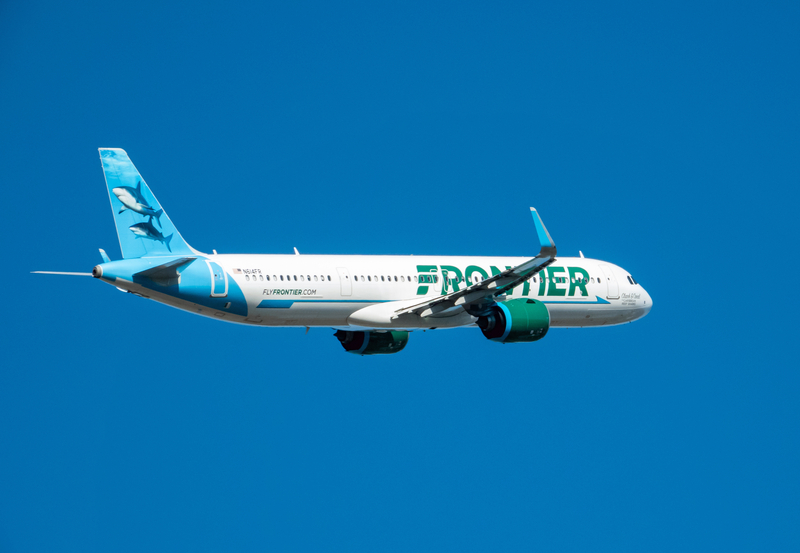
Frontier Could Become an Important Test of ULCC Economics
Full-service airlines can justify free Wi-Fi through premium fares, corporate contracts, credit-card partnerships, and loyalty-program economics.
Frontier must evaluate the product through a different financial structure.
Many customers choose the airline primarily because of price. Some may be unwilling to pay for internet on a two-hour flight, particularly after purchasing baggage and seat assignments.
Other travelers may welcome reliable connectivity and select Frontier over a competitor when the total trip price is similar.
Longer flights could produce stronger demand. A passenger traveling from Orlando (MCO) to Denver (DEN), San Juan (SJU) to Philadelphia (PHL), or across the continental United States may place considerably more value on streaming and working than someone taking a short one-hour segment.
Frontier could adjust pricing by flight length or include internet in selected bundles. It could also provide complimentary access to its new First Class cabin while selling it elsewhere.
The final model will reveal whether Frontier considers Starlink a revenue-generating ancillary product, a loyalty benefit, or a basic amenity required to remain competitive.
Will Other U.S. ULCCs Follow?
The broader low-cost market is clearly moving toward better connectivity, but each carrier begins from a different position.
Spirit already has a paid streaming-Wi-Fi system. Replacing it requires a different financial analysis from installing internet on an aircraft that has never offered it.
Allegiant has no onboard Wi-Fi and has acknowledged discussing Starlink, making it the most obvious U.S. carrier that could follow Frontier with a first-time installation.
JetBlue is not an ULCC and has selected Amazon’s competing low-Earth-orbit platform. Southwest is already deploying Starlink but operates a different low-cost model with a much larger loyalty base and fewer traditional ancillary charges.
Outside the United States, Wizz Air, Volaris, JetSMART, and Cebu Pacific are already included in the same 1,000-aircraft Starlink commitment as Frontier.
The question is therefore no longer whether low-cost airlines will adopt high-speed satellite internet. Several already have.
The remaining question is whether they will provide it free, use it to increase loyalty membership, or turn it into another source of ancillary revenue.
Bottom Line
Frontier Airlines will introduce Starlink inflight internet, with the first equipped Airbus aircraft expected to enter service in early 2027.
The airline will become the first American ultra-low-cost carrier to commit to Starlink, ending its longstanding policy of offering no onboard Wi-Fi, entertainment, or electrical outlets.
Frontier is not the first U.S. airline to use the technology. Hawaiian already offers Starlink across its primary Airbus fleet, United has equipped more than 400 aircraft, Alaska has completed its regional rollout, and Southwest began installing the system during 2026.
Frontier’s narrower claim is that it will be the first U.S. airline to use a new passenger-access system managed directly by Starlink. Neither company has explained how that platform differs from existing airline implementations.
The airline also has not announced pricing.
Starlink could be free for every passenger, complimentary for Frontier Miles members, included with First Class or bundles, or sold as a separate onboard product. Copa Airlines has demonstrated that carriers can charge most passengers for Starlink while offering complimentary access to premium customers, elite members, and qualifying Starlink subscribers.
Frontier’s decision is part of a broader Indigo Partners agreement covering more than 1,000 aircraft at Frontier, Wizz Air, Volaris, JetSMART, and Cebu Pacific. That scale confirms that high-speed internet is moving beyond network airlines and into the ultra-low-cost sector.
The installation will give Frontier a dramatically improved passenger product without requiring seatback screens. It could also provide operational benefits by connecting flight crews, maintenance control, and ground teams while aircraft are airborne.
The absence of onboard power remains a weakness. Frontier has not announced USB ports or electrical outlets, meaning passengers may gain streaming-quality internet without a way to recharge their devices on longer flights.
The most revealing announcement will come when Frontier publishes its pricing and access rules.
Free Starlink would show that Frontier views connectivity as a basic competitive requirement and loyalty tool. Paid service would establish the system as another optional product within the airline’s ancillary-revenue model.
Either way, the Starlink agreement marks one of the largest changes to Frontier’s onboard experience and provides a significant test of whether premium connectivity can coexist with the strict cost discipline of an American ULCC.