Southwest Airlines is moving closer to opening its first airport lounges, marking another significant departure from the stripped-down operating model that defined the carrier for more than five decades.

Speaking during Southwest’s second-quarter 2026 earnings call, President and CEO Bob Jordan provided the airline’s strongest public indication yet that lounge development is advancing.
“I know I’ve teased the lounges,” Jordan said. “Obviously, there’s work underway.”
Read our stories in your inbox
Two aviation newsletters. Zero fluff.
Jordan stopped short of announcing a launch date, confirmed locations, lounge access policies, or a formal name for the proposed network. However, he connected the project directly to Southwest’s plans to expand its co-branded credit card portfolio and provide customers with benefits they have increasingly come to expect from major airlines. Southwest’s latest comments suggest the question is becoming less about whether lounges will open and more about when the first facility will begin welcoming passengers.
Lounges Would Support a Larger Chase Credit Card Strategy
Southwest’s lounge strategy appears to be closely tied to its long-standing credit card partnership with Chase.
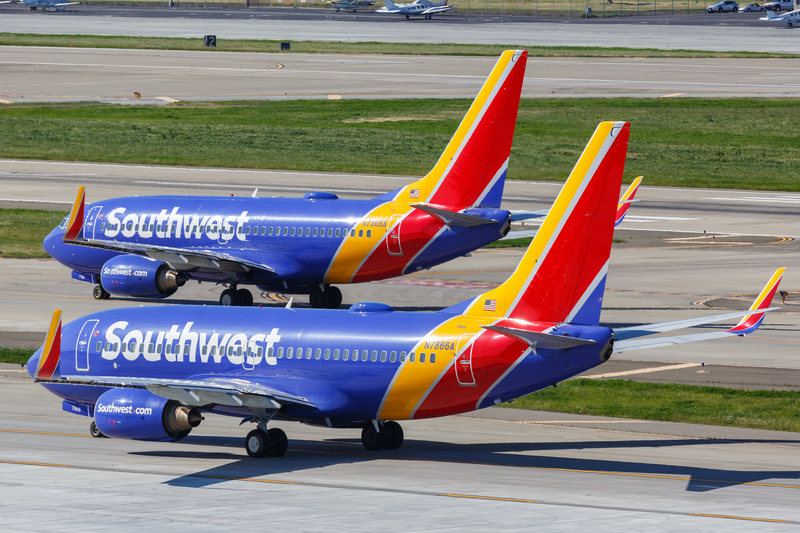
Jordan told analysts that the broader purpose is to expand Southwest’s co-brand opportunities and credit card lineup while adding a benefit customers actively want. That does not necessarily mean every lounge will carry Chase branding, but the facilities could become a central selling point for a future premium Southwest Rapid Rewards credit card.
Southwest reported that acquisitions of its Chase co-branded cards increased 28% year over year during the second quarter of 2026. New Rapid Rewards enrollments rose 35%, while the loyalty program approached 100 million members and recorded its highest-ever number of tier qualifiers. Managed business revenue also increased 30% to an all-time quarterly record.
Those figures explain why airport lounges have become strategically important. Lounges are not simply a passenger amenity. For the largest U.S. airlines, they help sell premium credit cards, encourage travelers to concentrate spending with one loyalty program, and create benefits that are difficult for competing cards to replicate.
Chase already operates a growing network of Sapphire Lounge by The Club locations. Its branded U.S. facilities include lounges at Boston Logan International Airport (BOS), Dallas Fort Worth International Airport (DFW), Harry Reid International Airport (LAS), John F. Kennedy International Airport (JFK), LaGuardia Airport (LGA), Philadelphia International Airport (PHL), Phoenix Sky Harbor International Airport (PHX), and San Diego International Airport (SAN).
A Southwest-specific network could give Chase another premium product positioned around one of the country’s largest domestic airline customer bases. Lounge access could be offered through a new high-annual-fee card, elite status, a qualifying fare, a paid membership, or some combination of those options. Southwest has not announced which model it intends to use.
Evidence Points to Lounges in Honolulu and Nashville
Although Southwest has not published a list of locations, airport filings and construction permits provide strong evidence that the airline is developing multiple facilities.
One of the most advanced projects appears to be at Daniel K. Inouye International Airport (HNL) in Honolulu. Documents approved by the Hawaii Department of Transportation describe a two-story VIP airline lounge containing approximately 12,241 square feet.
The proposed Honolulu Airport (HNL) facility would include about 9,577 square feet on its lower level and 2,664 square feet upstairs. The filing outlined a five-year lease and a minimum improvement investment of $20 million. If completed before other projects, Honolulu Airport (HNL) could become the home of Southwest’s first passenger lounge.
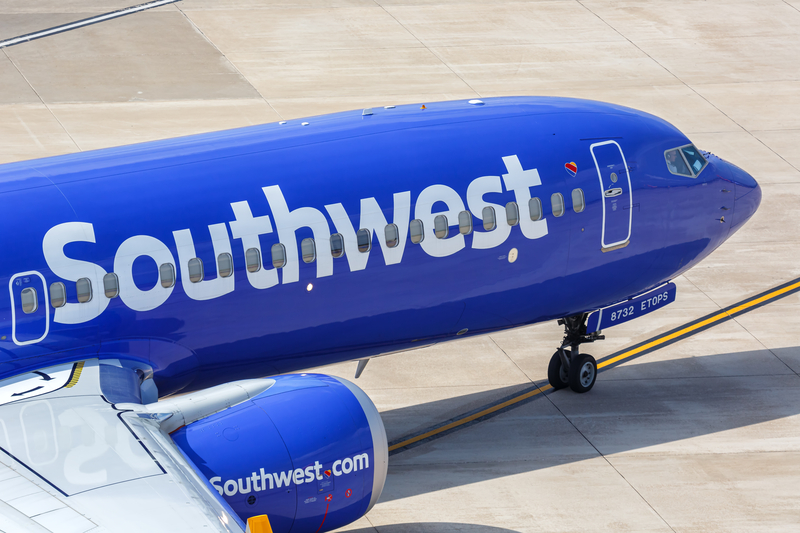
Honolulu would be a logical location. Southwest’s Hawaii flights are among the longest sectors in its network, and passengers frequently spend extended periods at Honolulu Airport (HNL) before traveling to the continental United States or connecting between islands.
A lounge could also support Southwest’s expanding international partnerships at Honolulu Airport (HNL), where the airline has opportunities to connect passengers between its domestic network and partner-operated flights across the Pacific.
An even larger project is advancing at Nashville International Airport (BNA). Southwest has secured a Metro Nashville building permit for a 30,000-square-foot lounge with a reported construction value of approximately $53 million.
The scale of the Nashville Airport (BNA) project suggests Southwest is considering something more substantial than a small business lounge. Nashville is one of the airline’s largest and most strategically important stations, making it a natural location for a flagship facility serving local passengers, connecting travelers, business customers, and Rapid Rewards members.
A 20,000-Square-Foot Austin Project Is Also Taking Shape
A separate permit at Austin-Bergstrom International Airport (AUS) describes a 20,000-square-foot lounge development under the code name “Project Oasis.”
The permit lists an estimated completion date of March 1, 2027, although major airport construction schedules frequently change. Southwest is not named directly in the document, but the project contact has also appeared on permits associated with Southwest facilities, creating a strong link between the airline and the Austin Airport (AUS) development.
Southwest has also positioned itself to become a major anchor airline in Austin Airport’s (AUS) long-term expansion. A premium lounge would complement the carrier’s growing schedule and help it compete more effectively for Austin’s technology, government, and corporate travel markets.
Industry reporting has additionally identified Dallas Love Field (DAL) and Denver International Airport (DEN) as potential lounge locations. Both would make strategic sense: Dallas Love Field (DAL) is Southwest’s home airport, while Denver Airport (DEN) is one of the airline’s largest connecting stations.
However, Southwest has not formally confirmed passenger lounges at Dallas Love Field (DAL) or Denver Airport (DEN), and fewer public construction details are available for those projects than for Honolulu Airport (HNL), Nashville Airport (BNA), and Austin Airport (AUS).
Southwest Is No Longer Selling Only a Basic Economy Experience
Lounges would be one part of a much broader transformation underway at Southwest.
The airline has replaced its traditional open-seating process with assigned seating, introduced extra-legroom sections, added a Basic fare, revised checked-bag policies, expanded distribution through online travel agencies, and strengthened its appeal to corporate travel departments.
Southwest is also installing Starlink connectivity and upgrading aircraft interiors with in-seat power, larger overhead bins, and differentiated seating zones. Its new onboard product continues to use a single economy cabin, but passengers can now choose among Extra Legroom, Preferred, and Standard seats.
The results have been financially significant. Southwest reported record second-quarter operating revenue of $8.4 billion, with adjusted operating revenue reaching $8.7 billion. Adjusted unit revenue increased 20.1% despite capacity rising only 0.2%, indicating that the airline is generating substantially more revenue from nearly the same amount of flying.
Lounges would extend that strategy from the aircraft cabin into the airport terminal. They would allow Southwest to compete for travelers who value a more complete journey rather than simply selecting the lowest available fare.
The All-Boeing 737 Fleet Remains Central to Southwest’s Model
Despite its growing interest in premium products, Southwest continues to operate one of the industry’s most standardized fleets.
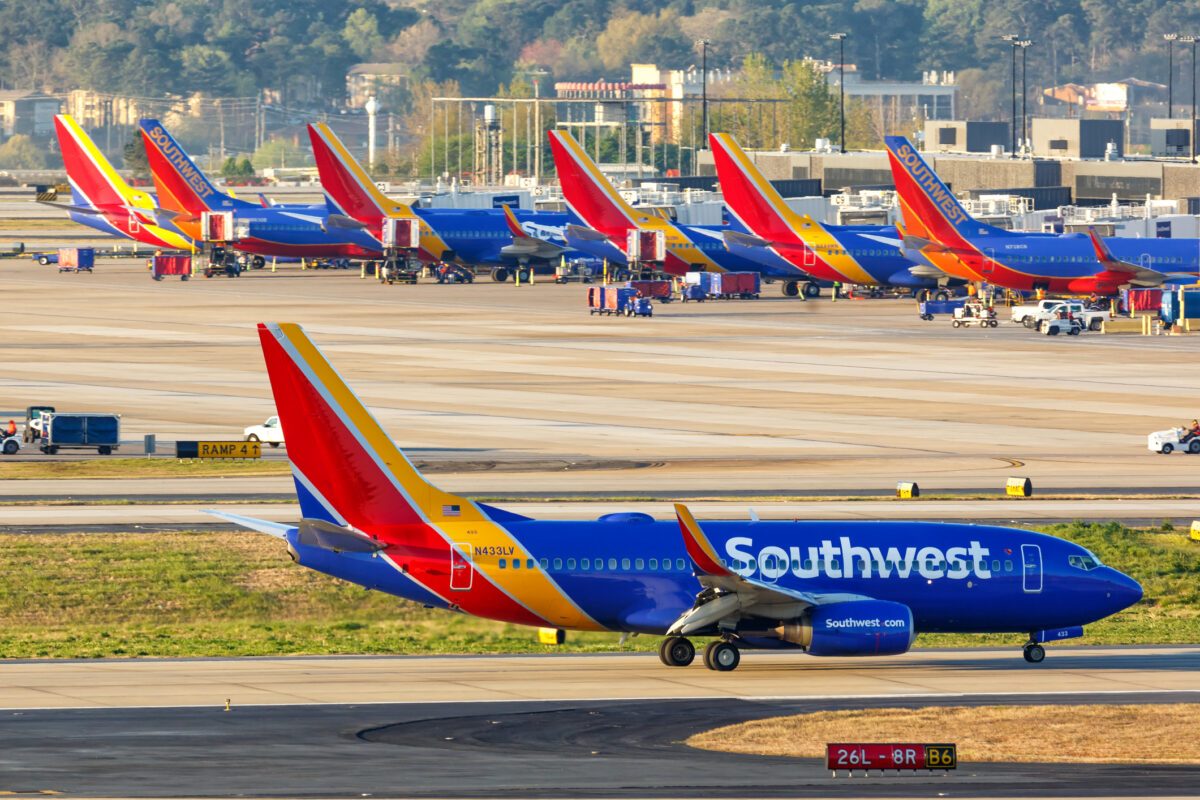
The airline ended the second quarter of 2026 with 803 aircraft, all from the Boeing 737 family. Its fleet includes the Boeing 737-700, 737-800, and 737-8, commonly known as the 737 MAX 8.
The smaller Boeing 737-700 carries 137 passengers under Southwest’s updated seating plan, while the Boeing 737-800 and 737-8 accommodate 175 passengers. Maintaining a single aircraft family simplifies pilot training, maintenance, spare-parts inventories, crew scheduling, and aircraft substitutions across the network. Southwest’s aircraft specifications show how the airline is now using different seating categories within that standardized fleet.
Southwest received 13 new Boeing 737-8s during the second quarter and retired 10 older aircraft. It expects to accept 64 Boeing 737-8 deliveries and retire approximately 60 aircraft during 2026, accelerating the transition toward the more fuel-efficient MAX generation.
That fleet structure still gives Southwest many of the cost advantages associated with a low-cost carrier. Lounges, assigned seating, premium credit cards, and extra-legroom products are designed to increase revenue around that efficient operating platform rather than replace it.
Lounges Could Face a Different Challenge at Southwest
Southwest’s network structure could influence where and how it develops lounges.
American Airlines, Delta Air Lines, and United Airlines operate traditional hub-and-spoke systems in which large numbers of passengers connect through a relatively small group of airports. That naturally concentrates lounge demand.
Southwest operates a more distributed network with a mix of nonstop, point-to-point, and connecting traffic. It has several very large stations, but it does not formally designate hubs in the same way as the three major legacy carriers.
As a result, Southwest will need to be selective. The strongest candidates are likely to be airports where it has substantial passenger volume, significant connecting activity, a large local Rapid Rewards membership base, and enough premium demand to support an expensive facility.
Nashville Airport (BNA), Austin Airport (AUS), Denver Airport (DEN), Dallas Love Field (DAL), and Honolulu Airport (HNL) all meet at least several of those conditions.
Bottom Line
Southwest Airlines has not yet formally unveiled its first airport lounge, but CEO Bob Jordan has confirmed that development work is underway.
Public documents provide the clearest evidence of projects at Daniel K. Inouye International Airport (HNL), Nashville International Airport (BNA), and Austin-Bergstrom International Airport (AUS). Dallas Love Field (DAL) and Denver International Airport (DEN) have also been identified in industry reporting, although Southwest has not confirmed its complete network.
The lounges are likely to be closely connected to Southwest’s Chase credit card strategy. With Rapid Rewards approaching 100 million members and co-branded card acquisitions increasing 28%, the airline has a powerful financial incentive to create a premium card offering with lounge access as a defining benefit.
For Southwest, the move is about much more than providing passengers with complimentary food and a quieter place to wait. Airport lounges would complete another stage of the airline’s transition from a highly standardized low-cost carrier into a broader travel brand capable of competing for premium leisure customers, corporate accounts, and high-spending credit card members.