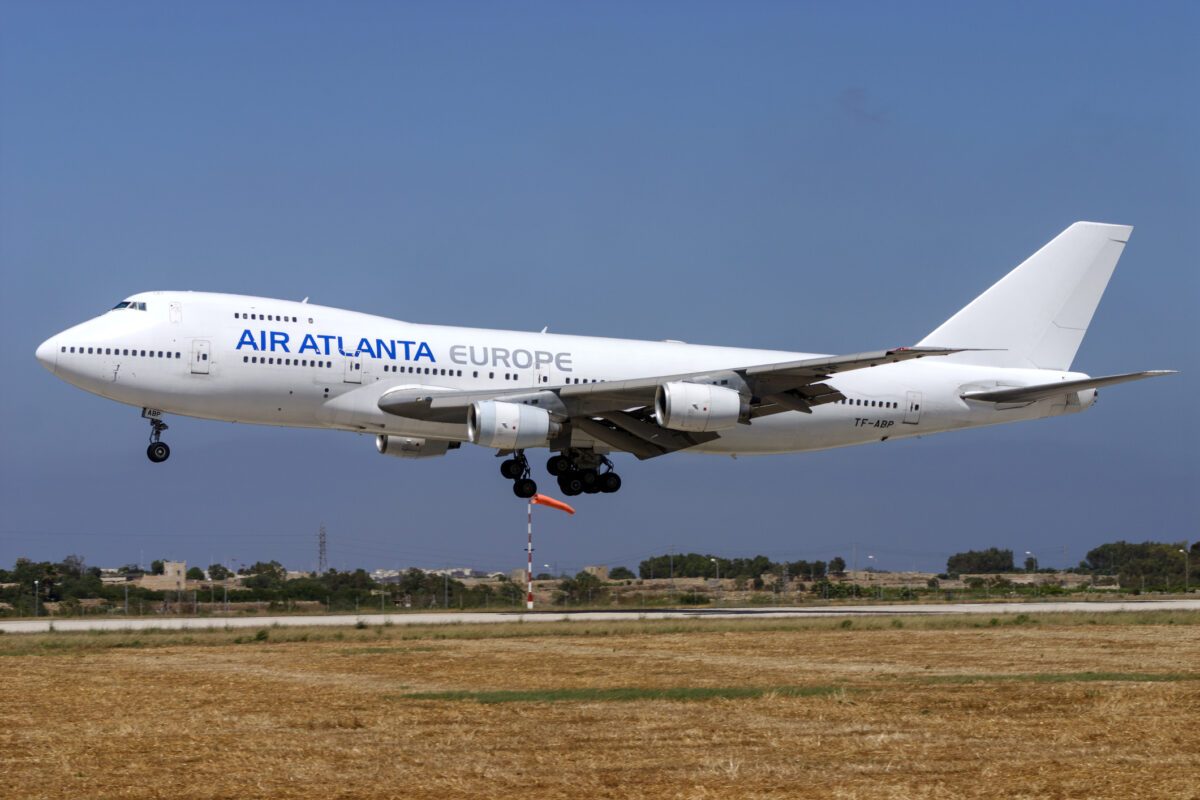
An Air Atlanta Europe Boeing 747-400 converted freighter diverted to Amsterdam Schiphol (AMS) on Thursday, August 27, after departing Liège (LGG) for Kinshasa (FIH).
The aircraft, registered 9H-AKA, was operating flight CC2615. Flight history for CC2615 records an actual departure at 18:36 UTC, against a scheduled time of 17:00 UTC, followed by a diversion to AMS rather than the planned flight to the Democratic Republic of the Congo.
Separate ADS-B records place the aircraft’s landing at approximately 20:55 UTC. The flight therefore remained airborne for more than two hours despite Liège and Amsterdam being only about 104 nautical miles apart, indicating that the crew did not proceed directly to the diversion airport after departure.
Read our stories in your inbox
Two aviation newsletters. Zero fluff.
The event occurred on August 27, three days before initial reports circulated on August 30.
Replacement 747 Continued From Amsterdam
Air Atlanta recovered the Kinshasa operation on Saturday, August 29, using a second Boeing 747-400 freighter. Icelandic-registered TF-AMU flew from LGG to AMS in 34 minutes, departing at 13:17 UTC and landing at 13:51 UTC.
The replacement aircraft then left Amsterdam as CC2615 at 20:10 UTC and reached Kinshasa at 04:05 UTC on August 30, according to TF-AMU’s recorded flight history. The eight-hour sector restored the original movement from the airport to which 9H-AKA had diverted.
That recovery sequence positioned another 747 at AMS rather than returning the operation to Liège. It also kept the original CC2615 flight number for both the short LGG-AMS positioning sector and the subsequent long-haul flight to FIH.
TF-AMU is operated by Air Atlanta Icelandic and is listed in flight-tracking databases as flying for Network Aviation. Its use demonstrates the operational flexibility available across the wider Air Atlanta group, which operates aircraft through both Icelandic and Maltese platforms.
9H-AKA Is a Converted Boeing 747-400
The diverted aircraft is a Boeing 747-45ESF with manufacturer serial number 27899. The Malta aircraft register identifies Air Atlanta Europe as the registered operator and lists the aircraft under the 9H-AKA registration.
The airframe was built as a passenger Boeing 747-400 before conversion for main-deck cargo operations. Converted 747-400s retain the type’s four-engine, long-range capability while adding the reinforced floor, cargo-handling systems and large main-deck side door required for palletized freight.
Boeing’s cargo-planning data for the 747-400 freighter provides for as many as 30 standard 96-by-125-inch pallet positions on the main deck. The manufacturer lists main-deck volume of up to 607.7 cubic meters, or 21,462 cubic feet, in that arrangement.
Those characteristics continue to make the 747-400 useful on sectors linking European cargo gateways with African markets. The type can combine dense freight with tall or outsized loads while operating a long sector such as Liège-Kinshasa without an intermediate fuel stop under normal payload and operating conditions.

The aircraft’s previous recorded assignments during August included services linking Liège with Nairobi, Entebbe, Lagos and Baltimore. Its schedule immediately before the diversion shows repeated long-haul cargo rotations rather than operation on a fixed passenger-style route pattern.
Liège Remains Central to Air Atlanta’s Africa Flying
CC2615 has appeared repeatedly between LGG and FIH during the summer schedule, establishing it as a recurring cargo operation rather than a one-off charter movement. Other recent 9H-AKA rotations connected Liège with East and West African airports, including Nairobi, Entebbe and Lagos.
Liège has long positioned itself as a gateway for dedicated freighter services to Africa. In an airport statement on its partnership with Network Airline Services, LGG described direct links carrying general freight and cargo for industrial customers into West Africa, along with perishables moving from East Africa to Europe.
The airport’s round-the-clock operating model and emphasis on dedicated cargo handling suit high-capacity aircraft such as the 747-400. They also allow operators to adjust departure times and aircraft rotations without the passenger connections and terminal constraints that shape schedules at mixed-use hubs.
Air Atlanta’s business is built around supplying widebody aircraft, crews, maintenance and insurance to airline and cargo customers. In May, Atlas Air Worldwide agreed to acquire a 49% minority interest in the company. The transaction announcement said Air Atlanta operated 14 widebody freighters across the Boeing 747 and 777 families, alongside four passenger 777s.
The group’s ability to bring TF-AMU from Liège to Amsterdam and send it onward to Kinshasa illustrates how that pooled widebody capacity can protect a customer operation when an assigned aircraft becomes unavailable away from its planned destination.
Bottom Line
The operationally important part of the incident is the recovery pattern. Air Atlanta did not simply cancel the Kinshasa movement or wait for 9H-AKA to return to service. It moved another 747 from the original cargo gateway to the diversion station and restarted the long-haul sector from Amsterdam, accepting an additional positioning flight to restore the shipment.
That flexibility is one reason established 747 operators remain valuable in the ACMI market. Replacement lift is difficult to source at short notice when a shipment requires main-deck pallet positions, outsized-cargo capability or a payload beyond the practical limits of smaller twin-engine freighters. Access to aircraft across Air Atlanta’s Icelandic and Maltese operations gives the group more recovery options than a single-aircraft charter operator would have.
The next indication will come from 9H-AKA’s return to commercial flying. Its absence required another high-capacity freighter to be removed from the group’s wider network for the Kinshasa recovery, showing how even a relatively deep 747 fleet can face knock-on pressure when an aircraft diverts during a tightly sequenced series of intercontinental rotations.
Keep reading FlyMag
Get the Daily Brief in the morning or the Route Watch weekly recap on Fridays. Or both.