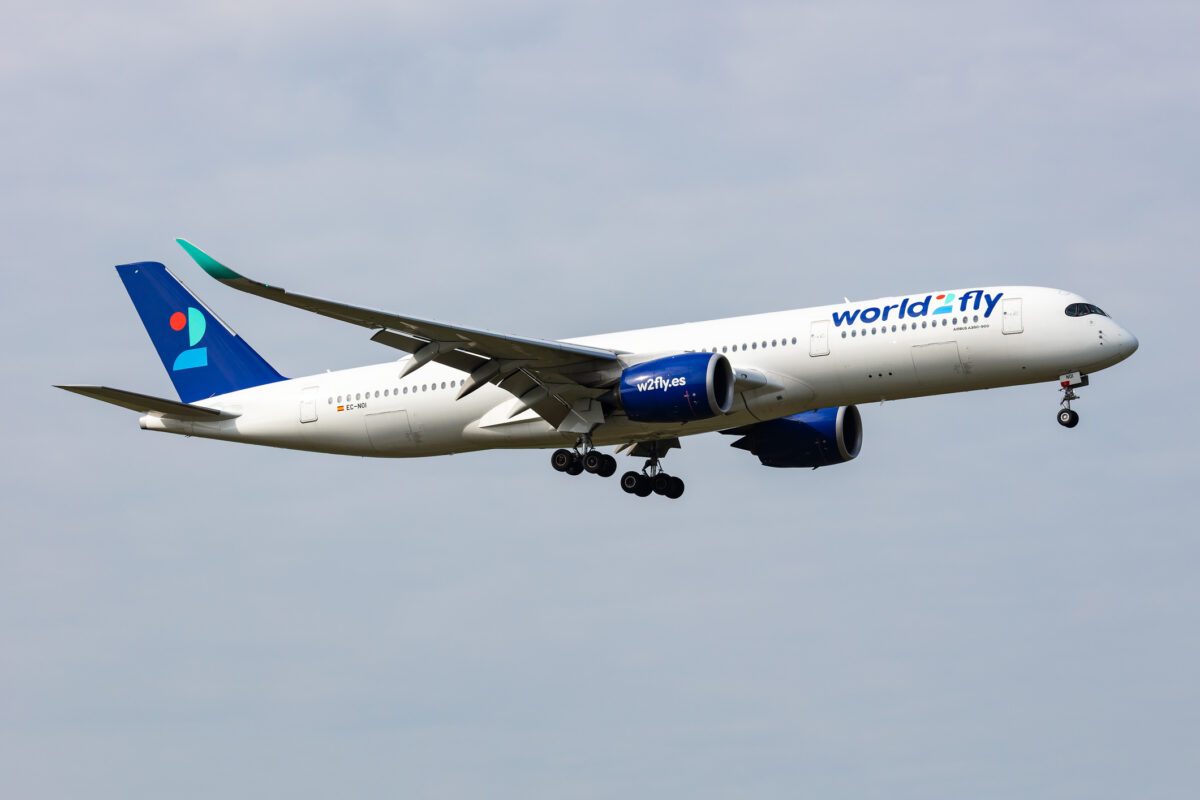
World2Fly has opened nonstop service between Rosario (ROS) and Madrid Barajas (MAD), giving Argentina’s third-largest city its first scheduled direct link with the Spanish capital and a new transatlantic gateway outside Buenos Aires.
The inaugural flight departed Madrid on Thursday, October 1, using a 432-seat Airbus A350-900. World2Fly said the route will operate year-round on Tuesdays and Thursdays, marking the Spanish leisure carrier’s entry into the Argentine scheduled market.
Argentina’s national government describes the service as the first regular, direct connection between Rosario and Madrid. World2Fly has framed it more broadly as Rosario’s first direct European route, while the provincial airport says the flight restores a regular nonstop European connection after more than four decades. The undisputed milestone is the opening of Rosario’s first scheduled Madrid service.
Read our stories in your inbox
Two aviation newsletters. Zero fluff.
Two Weekly A350 Flights
The published schedule varies by operating day. Tuesday flights leave Madrid at 1:30 p.m. and arrive in Rosario at 9:10 p.m. The return departs ROS at 11:10 p.m., reaching Madrid at 3:45 p.m. the following day.

On Thursdays, the aircraft leaves MAD at 10:25 a.m. and arrives at 6 p.m. The eastbound flight departs Rosario at 8 p.m. and lands in Madrid at 12:35 p.m. on Friday. All times are local. World2Fly places the nonstop flying time at approximately 12 hours and 30 minutes.
The two rotations provide 1,728 one-way seats each week, equivalent to almost 90,000 seats over a full year if the schedule is maintained. Earlier plans had envisaged three weekly frequencies, but the program placed on sale and launched operates twice weekly.
The timetable gives passengers from Santa Fe and the surrounding region an alternative to beginning a European trip with a domestic sector or a surface transfer to Buenos Aires. Madrid also provides a natural endpoint for the substantial visiting-friends-and-relatives market between Argentina and Spain, alongside leisure and business traffic.
High-Density Airbus A350 Operation
World2Fly has assigned the Airbus A350-900, the flagship of its small long-haul fleet, to the route. The airline’s aircraft use a high-density, single-class configuration with 432 seats, making the type particularly well suited to a long, price-sensitive leisure market where seat volume is central to the operating model.

When Airbus delivered World2Fly’s first example in 2021, the manufacturer described the cabin as a 432-seat single-class layout. The aircraft are powered by Rolls-Royce Trent XWB engines and use a carbon-fiber fuselage and wings. The A350’s payload-range capability allows World2Fly to operate the sector nonstop while carrying the large seat count on which its leisure-focused economics depend.
The configuration does not include a conventional business-class cabin. World2Fly instead sells optional products and bundled services around a dense economy layout. Meals, seatback entertainment, a blanket and a pillow are included across its fares on the Rosario service, according to the airline’s launch information.
At 432 seats, the A350 is also the highest-capacity passenger aircraft currently used on scheduled services in Argentina, according to the country’s transport authorities. That makes the twice-weekly pattern significant: World2Fly is concentrating capacity into a small number of large departures rather than building the route with more frequent, smaller-gauge aircraft.
Regulatory Approval and Airport Investment
Argentina authorized World2Fly in September 2025 to carry passengers and cargo on scheduled services between Spain and Argentina. Disposition 33/2025 granted broad traffic rights covering points in Europe, Spain and Argentina under the bilateral framework between the two countries.
The Rosario launch also followed extensive work at ROS. Santa Fe closed the airport in late 2025 for the rehabilitation and reconstruction of Runway 02/20 and related platform work. Provincial authorities said the investment exceeded 36 billion Argentine pesos and was intended to support larger aircraft and a higher level of airport operations.
Those works were followed by an expansion of Rosario’s international network, including additional South American and Caribbean services. The airport’s inaugural-flight account positions Madrid as the next step in developing ROS as a passenger and logistics gateway for Argentina’s central region.
World2Fly is using Jet Handling FBO for ground handling at ROS. The Argentine company was authorized in 2025 to provide ramp and operational airport services at Rosario and El Calafate, making the new route part of a broader opening of the country’s ground-services market as well as its airline sector.
Argentina-Spain Capacity Expands Beyond Buenos Aires
The route enters a large and growing country pair. Argentine government figures show 1.03 million passengers traveled commercially between Argentina and Spain during the first eight months of 2026, up 7% from the same period in 2025 and 54% from 2023.
Madrid was already linked nonstop with Buenos Aires and Córdoba before World2Fly’s arrival. Rosario now becomes another Argentine point with direct Spanish service and World2Fly becomes an additional operator in a market served by both network and leisure-oriented airlines.
The expansion also reflects increased international flying from Argentina’s interior. Between January and August 2026, 1.9 million passengers traveled abroad directly from airports outside Buenos Aires, a 29% increase year over year. The government counted 28 international routes bypassing the capital as of October.
Bottom Line
Rosario gains most immediately from removing the Buenos Aires connection from Europe-bound itineraries. The route expands the practical catchment beyond the city itself to Santa Fe and neighboring provinces, where travelers previously had to weigh a domestic connection against a lengthy surface journey before boarding a long-haul flight.
For World2Fly, Rosario is a different proposition from entering Argentina through the intensely competitive Buenos Aires market. The airline can deploy the A350’s capacity against a broad regional catchment while using a low initial frequency to limit weekly exposure. The trade-off is that 432 seats must be filled on each departure, leaving less room for weak individual flights than a smaller widebody would provide.
The next measure of the route will be whether two weekly services can generate consistent year-round demand rather than relying heavily on peak leisure periods. If the operation matures toward the three weekly frequencies originally contemplated, it would validate Rosario as a sustainable long-haul origin and give other carriers a clearer benchmark for serving Argentina beyond its established intercontinental gateways.