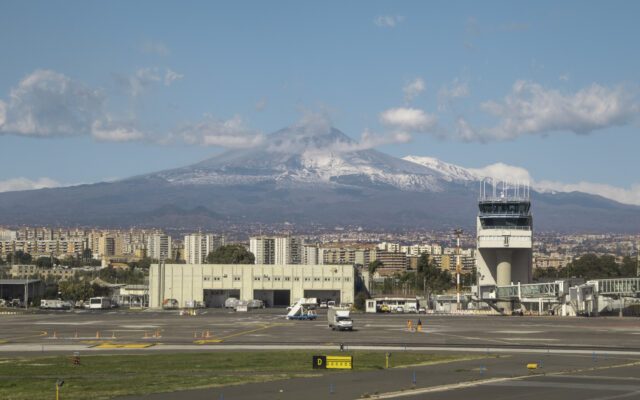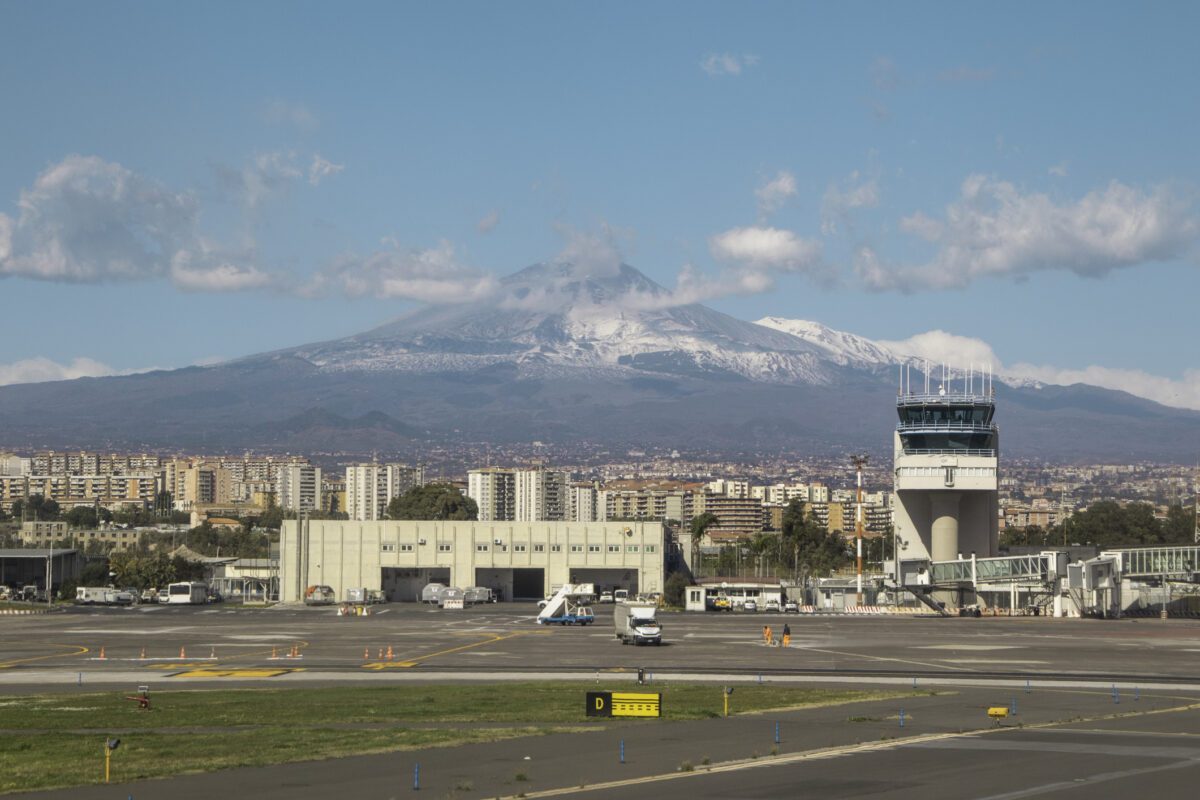
Catania (CTA) suspended all arrivals and departures again on Tuesday, September 15, after continued ash emissions from Mount Etna forced authorities to keep two sectors of airspace closed.
Airport operator SAC said the closure of sectors B3 and C1 would remain in effect until 10 p.m. local time. The decision extended a disruption that began on Monday and left airlines facing a second day of cancellations, diversions and displaced aircraft at one of Sicily’s principal gateways.
An earlier airport notice on Tuesday morning had suspended operations until 2:30 p.m. SAC later extended the shutdown through the evening as volcanic ash remained in the atmosphere around Catania.
Read our stories in your inbox
Two aviation newsletters. Zero fluff.
The operator advised passengers to confirm their flight status directly with their airline before traveling to CTA.
Closure Extended After Monday Disruption
The latest suspension followed a series of progressively tighter restrictions on September 14. SAC initially closed sector C1 and stopped arrivals until 4 p.m. while departures continued under the restrictions then in force.
By early afternoon, the response had widened. The airport closed both C1 and B3 and suspended arrivals and departures until 10 p.m. The restrictions then carried into Tuesday as ash continued to affect airspace used by traffic approaching and leaving CTA.
The sequence matters operationally. A restriction limited to inbound traffic can still allow airlines to clear aircraft and passengers from the airport, although the lack of arriving aircraft quickly disrupts later departures. Suspending both directions removes that limited flexibility and creates a larger recovery problem once the airport becomes available again.
Airlines must reposition aircraft and crews, accommodate passengers from canceled sectors and rebuild rotations around remaining duty time. An evening reopening also does not restore a full day’s schedule: carriers must decide which flights can still operate within airport, crew and destination constraints, and which aircraft need to be placed for the following morning.
Ash Cloud Moved South From Etna
The Etna Volcano Observatory raised its aviation color code to red at 04:43 UTC on September 14. In its Volcano Observatory Notice for Aviation, the observatory reported an ongoing ash emission reaching an estimated altitude of about 4,000 meters, with the cloud moving south.

That direction placed the plume on the side of the volcano occupied by Catania and its associated terminal airspace. CTA is approximately 18 nautical miles from Etna’s summit, according to Italy’s civil aviation authority, ENAC.
At 16:37 UTC on Tuesday, the observatory lowered the aviation color code from red to orange. The change did not mean that the ash emission had stopped. The updated VONA described a weak ash emission still in progress and again reported ash moving south. Visible and thermal surveillance cameras were being used to monitor the phenomenon.
The persistence of ash, rather than only the intensity of an eruptive episode, is critical for airport operations. Even a weaker emission can keep approach or departure sectors unavailable when winds carry contamination across the paths used by aircraft.
Etna Had Produced Near-Continuous Ash Emissions
The disruption came during an extended period of ash-producing activity at Etna’s summit. The observatory’s weekly monitoring bulletin issued September 15 said the Northeast Crater had generated almost continuous, pulsating ash emissions during the preceding week.
Those emissions varied in intensity, reached approximately 4,000 meters and dispersed into the eastern and southern quadrants. Bocca Nuova also produced ash on September 7 and 8, while activity at the Southeast Crater and Voragine was dominated by degassing.
The bulletin characterized fracture-related seismic activity as low, with volcanic tremor generally ranging between low and medium levels. Satellite observations showed generally low thermal activity around the summit. For aviation, however, the relevant issue was the repeated injection of ash into airspace rather than the broader energy level of the volcano.
Etna’s aviation history has led Italy to establish a specialized operating framework involving ENAC, air navigation provider ENAV, the Italian Air Force, civil protection authorities, INGV, airport operators and airlines. The ENAC framework for Etna-related operations uses local ash-dispersion information to identify contaminated portions of airspace and direct traffic through areas considered clear.
It also covers the assessment of ash on the airport movement area. Airspace contamination and runway or taxiway contamination are separate constraints: an airport may have usable pavement while essential arrival and departure sectors remain closed, or airspace conditions may improve while ash removal and inspections continue on the ground.
Recovery Depends on More Than the Reopening Time
SAC’s 10 p.m. deadline represented the next planned review point rather than a guarantee that the day’s remaining schedule would operate. Each carrier still needed to assess aircraft location, crew legality, passenger handling and conditions at the other end of its routes.
Catania’s traffic includes dense domestic and European short-haul flying, where an aircraft may operate several sectors in one day. Losing a CTA rotation can therefore affect later services elsewhere in an airline’s network, even when those flights do not touch Sicily.
The effect can carry into the following morning if aircraft scheduled to overnight at Catania are left at diversion airports or their previous stations. The first wave of departures is particularly dependent on airlines restoring those aircraft and crews before operations begin.
Bottom Line
Catania’s sector-based response is designed to preserve operations when ash dispersion permits, rather than defaulting immediately to a blanket regional shutdown. On this occasion, however, the southward movement of the plume removed the usable paths needed to sustain both arrivals and departures. The closure of B3 and C1 shows how a relatively localized ash cloud can effectively stop an airport when it overlaps the airspace essential to the runway operation.
The downgrade from red to orange late Tuesday was a useful indication that Etna’s activity had weakened, but the continued ash emission meant the operational problem had not disappeared. Airlines and the airport still needed a favorable combination of plume movement, clean airspace and an available movement area before a stable recovery could begin.
The next test is not simply when CTA accepts its first flight, but how quickly carriers can restore aircraft and crews without carrying a large cancellation program into the next operating day. With repeated ash emissions from Etna during September, airlines serving Catania will continue to need schedule flexibility and diversion plans that can be activated with little notice.
Keep reading FlyMag
Get the Daily Brief in the morning or the Route Watch weekly recap on Fridays. Or both.