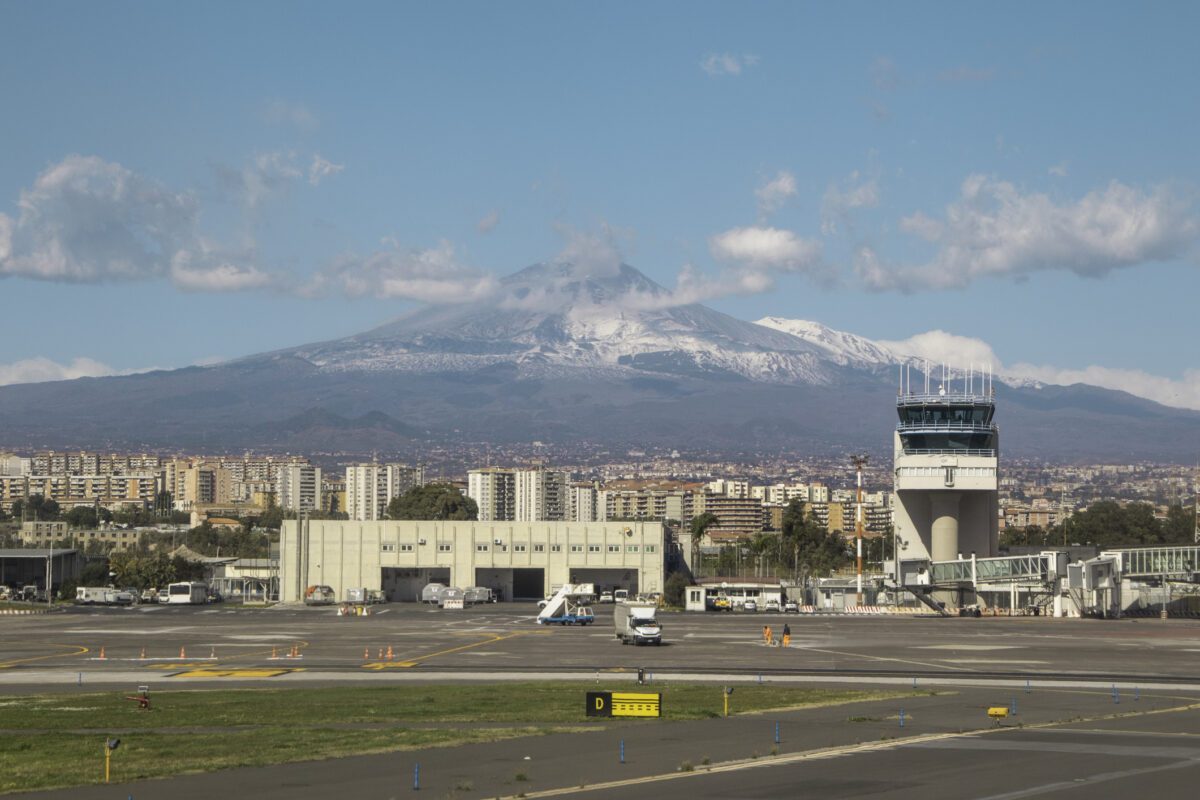
Catania Airport (CTA) restored full flight operations Monday after volcanic ash from Mount Etna forced a weekend shutdown and kept restrictions in place through much of September 28.
Airport operator SAC said the alert had ended, the affected airspace sectors had reopened and all previously imposed restrictions were canceled with immediate effect. The all-clear issued Monday followed more than two days of operational disruption at Sicily’s busiest airport.
The reopening did not mark an end to activity at Etna. Italy’s volcano observatory raised its aviation color code to red again early Tuesday before lowering it to orange later in the morning, illustrating how quickly conditions can change even after an airport resumes service.
Read our stories in your inbox
Two aviation newsletters. Zero fluff.
Flights Were Suspended Through the Weekend
The disruption began Saturday, September 26, when volcanic activity and weather conditions led SAC to suspend all arrivals and departures. The initial notice kept operations halted until noon Sunday.
Conditions did not improve sufficiently for that reopening. SAC subsequently extended the suspension through Sunday and then until noon Monday as ash remained in the atmosphere. The airport’s C1 airspace sector was among those affected, with the direction of the prevailing winds increasing the risk to traffic operating at CTA.
At 8 a.m. Monday, the operator said inbound operations remained suspended and temporary limits continued to apply to departures. The notice anticipated restrictions lasting through 11:59 p.m., but SAC lifted them early after the volcanic alert eased and the airspace sectors became available again.
Reopening the runway and surrounding airspace allowed airlines to begin rebuilding their schedules Monday evening. Recovery after a closure of that duration is not immediate: aircraft and crews may be out of position, while rotations canceled earlier in the day cannot necessarily be restored when the airport reopens. SAC continued to direct passengers to their airlines for individual flight information.
Ash Reached About 13,000 Feet
The Istituto Nazionale di Geofisica e Vulcanologia’s Etna Observatory had been tracking elevated activity before the airport closure. A Volcano Observatory Notice for Aviation issued September 24 placed Etna at red and estimated the top of the volcanic cloud at 4,000 meters, or roughly 13,100 feet, above sea level. The ash was moving toward the south-southeast.
Another red notice on Saturday morning reported continuing ash emissions, again reaching about 4,000 meters. On that occasion, the cloud was moving south — toward the area occupied by Catania and its arrival and departure paths.
The direction and concentration of ash matter as much as the alert color. A red aviation color code describes the state of the volcano and the potential for significant ash emissions; it does not automatically close an airport. Operational decisions depend on where the plume is moving, which airspace sectors are contaminated and whether ash is falling on airport infrastructure.
Italy’s civil aviation authority, ENAC, said during the broader Etna emergency that began in August that operational decisions are coordinated through a crisis committee involving ENAC, air navigation provider ENAV, INGV, the Italian Air Force and SAC. The direction of the wind and evolution of the eruption are central to determining whether Catania, Comiso or other Sicilian airports require restrictions.
That approach allows individual sectors to be closed without treating the entire surrounding airspace as a single block. It can also produce different restrictions for arrivals and departures, depending on the position of the plume relative to the procedures in use.
Conditions Improved Monday Afternoon
The volcanic picture became less severe Monday afternoon. At 16:22 UTC, INGV lowered Etna’s aviation color code from red to orange. The observatory reported that weak ash emissions were continuing but that ash was confined to the summit area and no defined ash cloud was being produced.

That change preceded SAC’s decision to end the airport alert and remove the remaining operating restrictions. It also highlights the separation between volcanic monitoring and airport management: the volcano remained at orange while CTA returned to normal operating status.
The improvement was short-lived at the volcano. INGV raised the code back to red at 05:25 UTC Tuesday after detecting another ash emission reaching about 4,000 meters and moving south. Just over two hours later, the observatory returned the code to orange, describing a weak emission and a dilute ash cloud observed by surveillance cameras.
The rapid red-to-orange sequence did not reverse Monday’s reopening announcement, but it reinforced the potential for further short-notice restrictions. Etna’s activity can change on a timescale shorter than an airline operating day, while wind shifts can move ash into or away from the sectors used by CTA.
A High-Impact Closure for Sicily
Catania handled more than 12.35 million passengers in 2025, according to ENAC’s annual traffic report. SAC separately recorded 81,003 commercial aircraft movements during the year, underlining the scale of the operation affected by the closure.
September alone accounted for more than 1.23 million passengers in 2025. A weekend suspension at that point in the season therefore affects a substantial volume of domestic and international flying, with consequences extending beyond Catania as airlines reposition aircraft and reroute passengers through other airports.
CTA’s exposure to Etna is a persistent operational constraint rather than an exceptional planning scenario. September’s sequence of orange and red notices, including repeated changes over periods of only a few hours, requires airlines and dispatchers to treat the airport’s published schedule as conditional whenever ash emissions are moving toward the southern or southeastern flank of the volcano.
Bottom Line
Monday’s reopening returned the main air gateway for eastern Sicily to service, but the Tuesday VONA sequence shows why recovery remains fragile. Airlines regain access to CTA when the relevant airspace sectors are clear; they do not gain certainty that those sectors will remain available for the rest of the operating day.
The most important signal is the speed with which the system moved from closure to reopening and then absorbed another volcanic pulse without treating every change in Etna’s color code as an automatic airport shutdown. That distinction gives operators more flexibility, but it also places a premium on current plume observations, wind forecasts and rapid coordination between INGV, ENAV, ENAC and SAC.
Further disruption will depend less on the presence of visible summit activity than on whether ash again intersects Catania’s procedures or contaminates the airfield. With Etna still at orange after Tuesday’s brief red alert, airlines will continue to need workable diversion, aircraft-positioning and passenger-recovery plans even while CTA operates normally.
Keep reading FlyMag
Get the Daily Brief in the morning or the Route Watch weekly recap on Fridays. Or both.