The union representing Transportation Security Administration screening officers has launched a public campaign seeking the return of chairs to airport checkpoint document-checking stations.
The American Federation of Government Employees said TSA management directed airports on September 25 to remove seating from Travel Document Checker positions, where officers verify a passenger’s identity and eligibility to enter the screening area. The union’s campaign asks travelers to contact TSA and demand that the chairs be restored.
The dispute is narrower than a ban on seating everywhere in the checkpoint. It centers on the fixed podium positions at the head of the passenger queue, although AFGE argues that removing the chairs has wider implications for fatigue, ergonomics and management’s ability to change checkpoint working conditions.
Read our stories in your inbox
Two aviation newsletters. Zero fluff.
A Change at the First Checkpoint Position
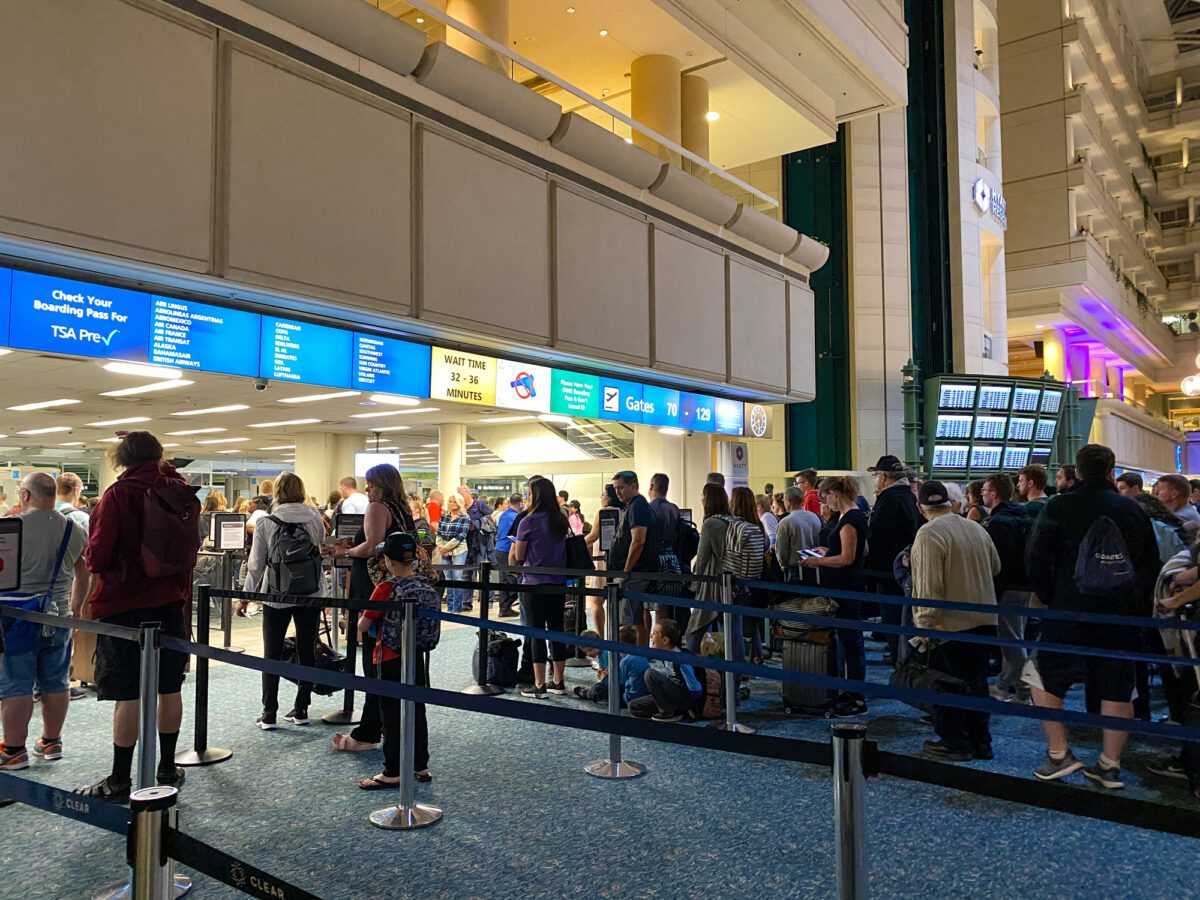
The Travel Document Checker, commonly shortened to TDC, is generally the first TSA officer a passenger encounters. The officer oversees the identity-verification process and resolves problems before the traveler reaches property and body screening.
At checkpoints equipped with Credential Authentication Technology, the machine authenticates the identification document, retrieves flight and Secure Flight information and presents the result to the officer. TSA’s own technical description says CAT is a fixed checkpoint system operated at the TDC podium, even when passengers insert their identification into the reader themselves.
That makes TDC a largely stationary assignment compared with positions involving bag searches, passenger screening or lane support. Officers rotate among checkpoint duties, but a TDC rotation can leave an employee working in one place for an extended period.
AFGE says TSA justified the standing requirement as a way to reinforce professionalism, attentiveness and active engagement with passengers. The agency has also framed the officer at the podium as part of its hospitality function, rather than only as an operator of identity-verification equipment.
The union rejects the premise that an officer’s posture determines security performance. It argues that officers can check credentials and engage passengers effectively while seated, and that the chair gives employees the option to vary their posture during a physically demanding shift.
TSA Previously Specified Chairs and Mats
The removal marks a significant departure from TSA’s own published equipment planning material. The agency’s Capability Acceptance Process equipment list includes chairs for TSO operations at both TDC stations and X-ray or computed-tomography scanners.
The same list identifies anti-fatigue mats as a separate checkpoint item, calling for sufficient coverage in areas where officers work. That distinction is operationally important: TSA’s equipment standard treated chairs and mats as different forms of support, rather than describing a mat as a direct replacement for seating.
The agency’s Checkpoint Requirements and Planning Guide likewise treats furnishings and ergonomics as elements of checkpoint design. The guide says layouts and furnishings are important to officers’ ability to perform screening effectively, efficiently and safely. It identifies TDC as the first component of a standard checkpoint module, ahead of X-ray or CT property screening and passenger-screening equipment.
The policy change therefore does not simply rearrange furniture supplied by an airport. It alters how TSA uses a workstation that the agency previously designed and equipped for seated or standing operation.
Ergonomics Become Part of the Security Argument
Workplace guidance does not support treating continuous standing as inherently preferable to sitting. The National Institute for Occupational Safety and Health found that prolonged standing is associated with fatigue, lower-back pain, muscle discomfort and leg swelling. Its review identified movement and the ability to switch between sitting, standing and leaning as useful ways to reduce those effects.
Occupational Safety and Health Administration guidance takes a similar approach. OSHA says extended standing places stress on the back and legs, and lists mats, adjustable chairs or stools and opportunities to change position among the available controls.
Anti-fatigue mats can reduce discomfort from hard flooring, but they do not provide the same posture change as a chair or sit-stand stool. That distinction matters at the document podium because the officer remains close to a fixed CAT terminal and passenger queue rather than walking continuously through the checkpoint.
TSA supervisors are already expected to rotate officers among assignments to maintain effective and vigilant screening. Rotation can limit the time spent at any single position, but removing the chair eliminates the officer’s ability to alternate posture during the TDC portion of that rotation.
The Dispute Also Raises a Bargaining Question
AFGE says TSA imposed the change without bargaining. The parties’ 2024 collective bargaining agreement establishes notice and bargaining procedures for non-security and non-emergency changes that may affect personnel practices or working conditions at the national level.
TSA can argue that checkpoint positioning and officer readiness concern security operations and management authority. AFGE’s position is that removing an established ergonomic support is a workplace change rather than a new screening procedure. The classification of the order will shape the union’s options beyond its public campaign.
The campaign is intended to move that dispute outside the labor-relations process by enlisting passengers. AFGE is asking travelers to tell TSA that restoring the chairs would not weaken screening and that employee working conditions should not be used as a visual signal of professionalism.
The operational scale gives even a small workstation change nationwide significance. TSA says its employees secure more than 440 federalized airports and screen about 2.2 million passengers daily. TDC positions operate across standard, TSA PreCheck and other checkpoint configurations, making the standing order a workforce issue rather than an isolated local experiment.
The change does not alter identification requirements or what passengers must do at the checkpoint. Its immediate effect is on the officer operating the document station. The larger question is whether a more rigid posture requirement improves attentiveness, or whether eliminating a basic ergonomic option adds fatigue without changing the quality of identity verification.
Bottom Line
The chair dispute is consequential because it shows how TSA is increasingly blending security operations with customer-service presentation. A document-checking officer must remain alert and engage with passengers, but those requirements do not automatically dictate a single posture. If the agency wants standing to become an operating standard, it will need to show that the requirement produces something more substantial than a different visual impression at the front of the checkpoint.
For airports, the order also highlights the limits of treating checkpoint furnishings as static infrastructure. TSA’s published planning material included both chairs and anti-fatigue mats because the work involves fixed stations, rotating assignments and long shifts on hard terminal floors. Removing one element changes the human-factors assumptions behind the workstation even if the CAT equipment and passenger process remain untouched.
The next development to watch is whether TSA modifies the order, negotiates an accommodation or allows the disagreement to move into a formal labor challenge. A compromise built around sit-stand seating, defined rotation intervals or local ergonomic assessments would preserve management’s emphasis on engagement while giving officers some control over fatigue. A nationwide standing-only rule leaves much less room for that operational judgment.
Keep reading FlyMag
Get the Daily Brief in the morning or the Route Watch weekly recap on Fridays. Or both.