MET – Montréal Metropolitan Airport (YHU) has officially opened its new passenger terminal.

The first commercial flights began on June 15, 2026, giving Greater Montreal a second airport for scheduled passenger service.
The first departure was a Porter Airlines flight from Montreal Metropolitan (YHU) to Vancouver International Airport (YVR). The flight received a traditional water-cannon salute from the airport fire service.
Read our stories in your inbox
Two aviation newsletters. Zero fluff.
The opening marks a major change for Montreal’s aviation market.
For decades, Montréal–Trudeau International Airport (YUL) has been the region’s main commercial airport. Now, MET gives travelers a second option on Montreal’s South Shore.

A New Airport Option For Greater Montreal
MET is located in Longueuil, at the former Montréal Saint-Hubert Airport site.
The airport is about 15 kilometers from downtown Montreal. That makes it convenient for many travelers on the South Shore and in parts of the Greater Montreal region.
The airport is not designed to replace Montréal–Trudeau (YUL).
Instead, it is meant to complement it.
Porter Adds Austin and Levels Up Chicago to O’Hare as Toronto Flying Gets More Choice
MET will focus on commercial flights using single-aisle aircraft. That gives airlines more capacity in the Montreal market and gives passengers another departure point.
This is similar to two-airport systems in other large cities. One airport remains the main international gateway. The second airport adds capacity, convenience, and choice.
Porter Operates The First Flights
Porter is the launch carrier at MET.
On opening day, Porter began flights to four airports: Vancouver (YVR), Toronto Pearson (YYZ), Billy Bishop Toronto City Airport (YTZ), and St. John’s International Airport (YYT).

Over the first week, Porter is introducing flights to 11 airports across Canada.
That is a large launch for a brand-new terminal.
It also shows how important MET is to Porter’s Montreal strategy.
The First Week Route List
Porter’s first-week MET schedule includes a mix of major cities and regional markets.
| Destination | Airport Code | Start Date | Frequency |
|---|---|---|---|
| St. John’s | YYT | June 15 | 7x weekly |
| Toronto City | YTZ | June 15 | 27x weekly |
| Toronto Pearson | YYZ | June 15 | 20x weekly |
| Vancouver | YVR | June 15 | 14x weekly |
| Edmonton | YEG | June 16 | 7x weekly |
| Calgary | YYC | June 17 | 7x weekly |
| Halifax | YHZ | June 17 | 14x weekly |
| Charlottetown | YYG | June 18 | 7x weekly |
| Winnipeg | YWG | June 18 | 7x weekly |
| Moncton | YQM | June 19 | 7x weekly |
| Hamilton | YHM | June 22 | 14x weekly |
This gives MET coast-to-coast reach from its first week of service.
It also gives Porter a second Montreal airport platform alongside its existing operations at Montréal–Trudeau (YUL).
Porter Will Use Dash 8s And E195-E2s
Porter will serve MET with two aircraft types.
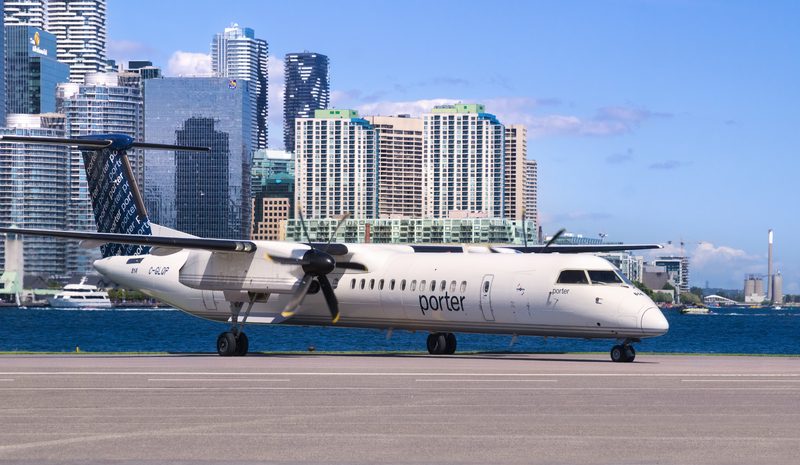
The first is the De Havilland Dash 8-400, which seats 78 passengers in Porter’s layout.
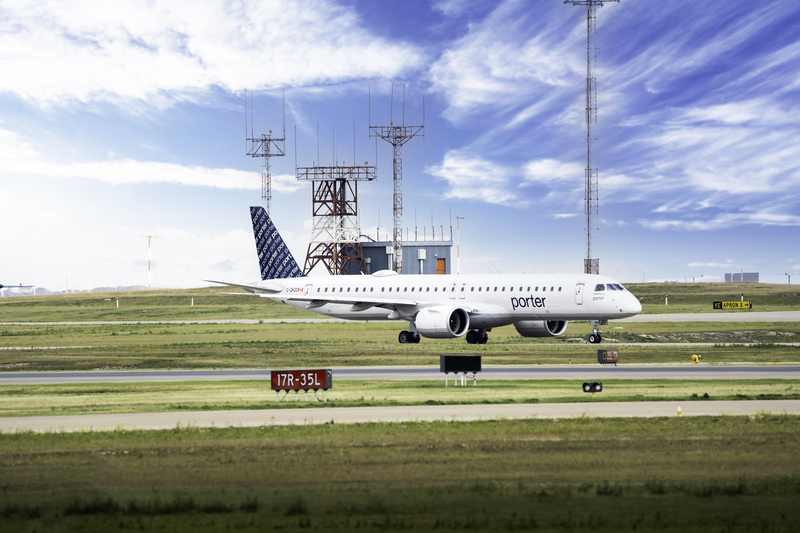
The second is the Embraer E195-E2, which seats 132 passengers.
Both aircraft use a 2-2 seating layout. That means there are no middle seats.
The E195-E2 will be especially important for longer routes from MET, such as Vancouver (YVR), Calgary (YYC), and Edmonton (YEG).
The Dash 8-400 is better suited to shorter regional routes, including Toronto City (YTZ) and some eastern Canadian services.
A Boost For Porter’s Montreal Strategy
Porter has served Montreal since the airline began flying in 2006.
Until now, that service was focused on Montréal–Trudeau (YUL).
MET changes the picture.
Porter says the new airport allows it to nearly double its Greater Montreal capacity this summer. The airline will operate up to 244 weekly departures from the city, split between MET (YHU) and Montréal–Trudeau (YUL).
That gives passengers more choice.
It also gives Porter more room to grow without relying only on YUL.
For an airline that has expanded quickly with the E195-E2, MET gives Porter a new way to build scale in Quebec.
Pascan Adds Regional Reach
The opening also strengthens Porter’s partnership with Pascan Aviation.
Pascan has been based at Saint-Hubert for more than 20 years. It connects Quebec regions, the Maritimes, and smaller communities.
The partnership allows passengers to book some trips on a single ticket across Porter and Pascan.
That is important.
It means MET can connect large Canadian cities with smaller Quebec communities more easily.
For regional travelers, the new terminal may reduce the need to connect through larger airports.
The Terminal Is Built For Simplicity
YHU Terminal was designed to be compact and efficient.
YHU Infrastructure Partners developed and operates the terminal under a long-term lease with MET.
The company is a partnership between Porter Aviation Holdings and Macquarie Asset Management.
The terminal is meant to offer a faster, calmer airport experience.
That includes a modern departure lounge, shorter walking distances, and a simpler passenger flow from curb to gate.
For travelers used to large airports, that could be one of MET’s biggest advantages.
Passenger Numbers Could Grow Quickly
Porter says MET passenger traffic is projected to reach one million passengers in its first year.
At full capacity, the terminal is expected to handle four million passengers annually.
Those numbers are not large compared with Montréal–Trudeau (YUL). But they are meaningful for a secondary airport.
A four-million-passenger terminal would give Montreal added capacity without placing all growth pressure on YUL.
It also gives airlines another place to develop domestic and regional flying.
Community Measures Were Part Of The Project
The airport opening followed years of community discussion.
Local officials highlighted several measures designed to address resident concerns.
Overnight flights are prohibited. Operating hours are regulated. Air-quality monitoring sensors have been installed.
The developer is also funding C$8.2 million in road improvements.
Longueuil Mayor Catherine Fournier said the airport is expected to generate more than C$6 million annually in property tax revenue.
That matters because airports can be controversial.
They create jobs and connectivity, but they also raise concerns about noise, traffic, and local impacts.
MET’s backers are trying to show that the project can grow while staying acceptable to the surrounding community.
The Airport Supports Quebec’s Aerospace Sector
The airport also has a larger economic role.
Saint-Hubert has long been connected to Quebec’s aerospace industry. The region includes flight schools, aviation services, aerospace companies, and technical expertise.
The new terminal adds scheduled passenger service to that ecosystem.
Officials say the airport will support tourism, business travel, regional connectivity, and economic development.
That fits Montreal’s wider aviation identity.
The city is already one of the world’s major aerospace centers, with companies such as Airbus Canada, CAE, and many suppliers active in the region.
MET gives that aerospace cluster another visible piece of infrastructure.
Why This Matters For Montreal
Montreal now has a more balanced airport system.
Montréal–Trudeau (YUL) remains the primary international gateway. It will continue to handle major long-haul, U.S., and international traffic.
MET (YHU) gives the region added domestic and regional capacity.
That can help reduce pressure on YUL over time. It can also give passengers more convenience, especially those living south and east of the city.
The airport may also attract travelers who value speed and simplicity over the larger-hub experience.
That is a real market.
Not every passenger needs a huge terminal, long-haul connections, or a large international airport. Some simply want a fast way to get to Toronto, Vancouver, Halifax, or another Canadian city.
A Big Bet On Secondary Airports
The opening also reflects a wider aviation trend.
Secondary airports can work when they have the right airline partner, the right location, and the right cost structure.
Porter has already shown this model at Billy Bishop Toronto City Airport (YTZ). It built a strong brand around convenience, short processing times, and a better passenger experience.
MET could become a similar opportunity in Montreal.
The difference is that Porter now has the E195-E2, which gives it longer range and more capacity than its original turboprop-only model.
That gives MET a broader national network from day one.
Bottom Line
MET – Montréal Metropolitan Airport (YHU) opened to commercial passengers on June 15, 2026.
Porter Airlines operated the first commercial departure, flight PD181 to Vancouver (YVR), which received a traditional water-cannon salute.
The new terminal gives Greater Montreal a second airport for scheduled passenger service. It is designed to complement Montréal–Trudeau (YUL), not replace it.
Porter is launching flights to 11 airports from MET during the first week, using De Havilland Dash 8-400 and Embraer E195-E2 aircraft.
The airport is expected to handle one million passengers in its first year and up to four million annually at full capacity.
For passengers, MET offers a simpler airport experience and another way to fly across Canada.
For Montreal, it creates a true two-airport system, adds regional capacity, supports tourism and business travel, and strengthens Quebec’s aviation and aerospace ecosystem.
Keep reading FlyMag
Get the Daily Brief in the morning or the Route Watch weekly recap on Fridays. Or both.