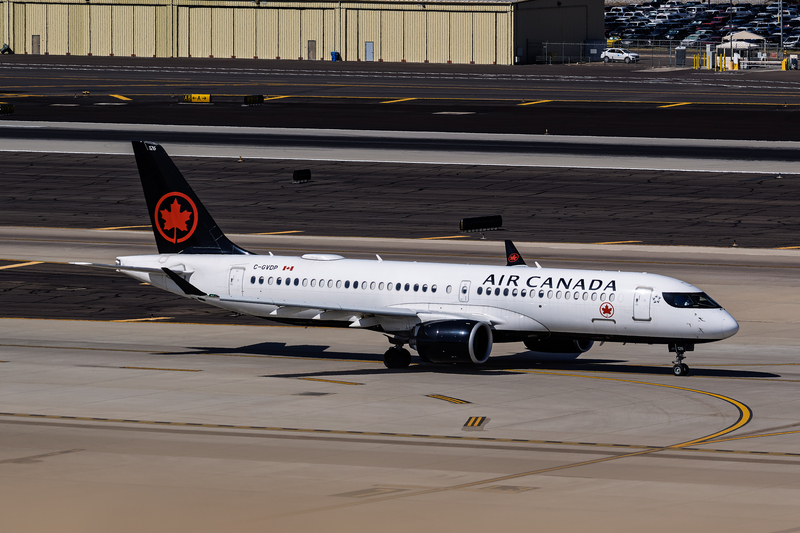
Air Canada has removed its planned seasonal nonstop between Montréal–Trudeau (YUL) and Seattle–Tacoma (SEA) from the summer 2026 schedule roughly two months before it was due to resume. The route had been slated to restart around May 1, 2026 and run through mid-October, but it is no longer available for sale as a nonstop—only connecting itineraries remain when booking through Air Canada.

For the Pacific Northwest–Québec market, this is a meaningful change: YUL–SEA is a long, “thin” transcontinental-style sector where nonstop service is less about volume and more about network relevance—especially for onward connections beyond YUL into Atlantic Canada and Europe, and beyond SEA into the Pacific Northwest tech corridor.
What was planned: A220-300 on a long, niche U.S. transborder sector
Air Canada had been operating the route seasonally using the Airbus A220-300, a particularly well-matched aircraft for this kind of flying. In Air Canada configuration, the A220-300 seats 137 passengers—12 in Business (2–2) and 125 in Economy (2–3). That lower gauge and strong economics are exactly why the A220 has become Air Canada’s tool of choice for longer, demand-variable transborder routes.
Read our stories in your inbox
Two aviation newsletters. Zero fluff.
Operationally, YUL–SEA sits in the “upper end” of North American narrowbody stage lengths—roughly five-plus hours westbound depending on winds. The A220-300’s efficiency and performance (Pratt & Whitney geared turbofan engines, long range capability, and strong hot-and-high margins) make it a capable platform for these longer transborder missions without forcing the airline to upgauge to a larger Airbus A320-family aircraft.
What travelers can do now: connect via YVR, YYZ, or ORD
With the nonstop removed, Air Canada customers are essentially funneled into three common routings:
-
YUL–Vancouver (YVR)–SEA via Air Canada’s western hub
-
YUL–Toronto (YYZ)–SEA via the carrier’s largest hub
-
YUL–Chicago O’Hare (ORD)–SEA using United for the ORD–SEA segment under Star Alliance / interline options, depending on fare and availability

Those routings are workable, but they change the trip profile significantly—especially for business travelers who valued a single hop between YUL and SEA.
Why airlines pull seasonal transborder routes quietly
Air Canada hasn’t made a public announcement about the cancellation, which is common when a seasonal route is removed before the operating window begins. In most cases, a decision like this comes down to a combination of network math rather than a single factor:
Aircraft availability and utilization. A220 time is valuable in summer. When the schedule gets tight, airlines often redeploy A220s to routes where the aircraft unlocks more connecting utility (higher-frequency business markets) or where competitive pressure is sharper.
Yield risk on a long, thin market. YUL–SEA is long enough that operating costs are meaningfully higher than shorter transborder hops, but the market is still niche. If projected yields soften—or if the airline sees better revenue elsewhere—seasonal routes are the easiest capacity to move.
Competitive and connection dynamics. Seattle’s network is heavily shaped by local incumbents and onward connectivity. If an airline can’t maintain frequency or competitive timing, the route can quickly shift from “strategic” to “marginal.”
What this says about Air Canada’s summer 2026 priorities
The A220-300 is one of Air Canada’s most strategic fleet types because it bridges the gap between regional jets and larger narrowbodies while still offering a mainline product. When a route like YUL–SEA is cut, it often signals the airline believes those aircraft hours are better spent elsewhere—either on routes with stronger premium mix, more consistent demand, or more valuable hub feed.
It also reinforces a broader reality of summer scheduling: airlines will protect routes that drive the most network value first, and seasonal transborder point-to-point flying is frequently where trimming starts.
Bottom Line
Air Canada has canceled its planned Montréal (YUL)–Seattle (SEA) seasonal nonstop for summer 2026, a route that was expected to operate on the Airbus A220-300 (137 seats) beginning around May 1. With the nonstop removed from sale, travelers will now need to connect—most commonly via Vancouver (YVR) or Toronto (YYZ), or via Chicago (ORD) when routing through Star Alliance options. For a long, niche transborder sector like YUL–SEA, the decision likely reflects a simple reality: in peak summer, A220 aircraft time is scarce—and Air Canada appears to have found higher-value places to deploy it.
Keep reading FlyMag
Get the Daily Brief in the morning or the Route Watch weekly recap on Fridays. Or both.