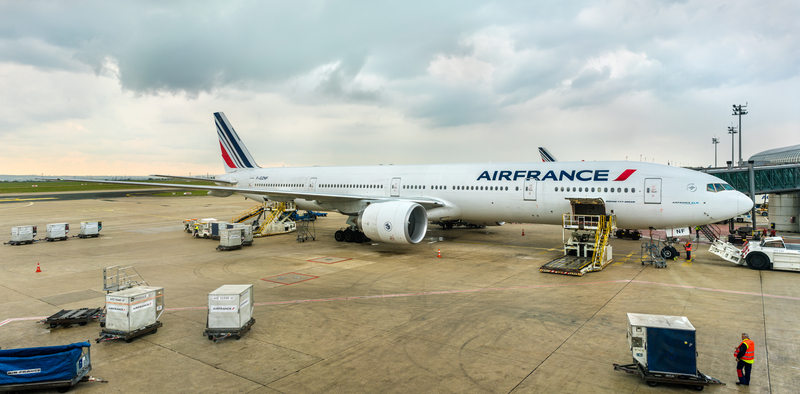
An Air France flight from Paris Charles de Gaulle Airport (CDG) to Detroit Metropolitan Wayne County Airport (DTW) was forced to divert to Montreal-Trudeau International Airport (YUL) after U.S. authorities determined that a passenger onboard should not have been allowed to travel to the United States under newly imposed Ebola-related entry restrictions.
The incident involved Air France flight AF378, which had already crossed much of the Atlantic before it was redirected away from Detroit. The passenger in question had recently been in the Democratic Republic of the Congo, one of the countries covered by new U.S. public health travel restrictions.
For aviation readers, this is not just a diversion story. It is one of the first visible examples of how new outbreak-control rules can directly alter international airline operations in real time.
Read our stories in your inbox
Two aviation newsletters. Zero fluff.
The Passenger Was Allowed To Board In Error
The central issue is straightforward.
U.S. authorities said the passenger should not have boarded the flight to Detroit because of new Ebola-related entry controls. Those restrictions had only recently come into effect and were designed to prevent travelers with recent presence in the DRC, Uganda, or South Sudan from arriving freely at U.S. airports.
That matters because the problem did not begin in the air. It began at the point of departure, when a passenger who did not meet the current U.S. entry requirements was still allowed onto a U.S.-bound aircraft.
Once that happened, the flight itself became part of the enforcement chain.
Why The Flight Could Not Continue To Detroit
Once the issue was identified, the aircraft could no longer simply continue to Michigan.
Because U.S. authorities had already determined the passenger was not eligible to arrive at Detroit under the current public-health entry regime, allowing the aircraft to land there would have defeated the purpose of the restriction. At that point, the only realistic options were a diversion outside the United States or some kind of return.

Montreal was the practical answer.
It was close enough to accept the aircraft without an extreme additional detour, and it allowed authorities to remove and assess the passenger without bringing the person into the U.S. system improperly.
This Was Not A Medical Emergency Onboard
One important point needs to be kept clear.
This was not an onboard Ebola outbreak or an in-flight medical emergency in the conventional sense. The available reporting indicates that the passenger was diverted because of entry restrictions tied to travel history, not because the aircraft suddenly experienced a symptomatic contagion event in the cabin.
That distinction matters a lot. The flight was diverted because of legal and public-health compliance, not because passengers were facing an immediate onboard biohazard emergency.
The Passenger Was Assessed In Canada
After landing in Montreal, the passenger was removed from the aircraft and assessed by Canadian public health authorities.
Reports indicate the traveler did not show symptoms and was then sent back to Paris. Once the passenger was offloaded, the aircraft continued on to Detroit, arriving later than scheduled.
Operationally, that sequence makes sense. Once the compliance issue was removed, the rest of the flight could proceed normally.
The U.S. Rules Had Just Tightened
This incident happened right as the U.S. was intensifying its Ebola-related travel controls.
The new framework had imposed a 30-day suspension on entry for certain non-U.S. travelers who had recently been in the DRC, Uganda, or South Sudan, while U.S. citizens and lawful permanent residents with recent travel history to those countries were being funneled into stricter screening procedures, including designated arrival points.
That timing is important because it helps explain how the mistake occurred. When a new public-health entry regime comes into force quickly, airlines, ground handlers, border agencies, and health authorities all have to adapt at once. This case appears to show what happens when that adaptation breaks at the boarding stage.
Why This Matters For Airlines
For airlines, the story is bigger than one diversion.
Outbreak-related travel restrictions create a difficult operational burden because carriers effectively become part of the border-control and health-screening chain. If a passenger is boarded incorrectly, the airline can suddenly find itself dealing with a mid-flight diversion, a disrupted long-haul operation, a regulatory headache, and significant downstream cost.
That is why these rules matter operationally even when the health threat onboard is not immediate.
This Could Become More Common During Outbreak Periods
The larger implication is that airlines may face more incidents like this whenever sudden public-health restrictions are imposed.
Modern international travel systems are built around documentation, timing, and coordination. When new restrictions are layered in quickly, especially those based on recent travel history rather than citizenship alone, mistakes become more likely unless airlines and border authorities synchronize very tightly.
This Air France diversion may therefore be remembered less for the passenger involved than for what it revealed about the fragility of fast-changing travel controls.
Bottom Line
Air France flight AF378 from Paris to Detroit was diverted to Montreal because a passenger who had recently been in the Democratic Republic of the Congo boarded the aircraft even though new U.S. Ebola-related entry restrictions meant that person should not have been on a Detroit-bound flight.
The flight itself was not responding to an onboard outbreak emergency. It was responding to a compliance failure that only became operationally visible once the aircraft was already over the Atlantic. That makes this one of the clearest recent examples of how outbreak control, immigration enforcement, and airline operations can collide mid-journey.
Keep reading FlyMag
Get the Daily Brief in the morning or the Route Watch weekly recap on Fridays. Or both.