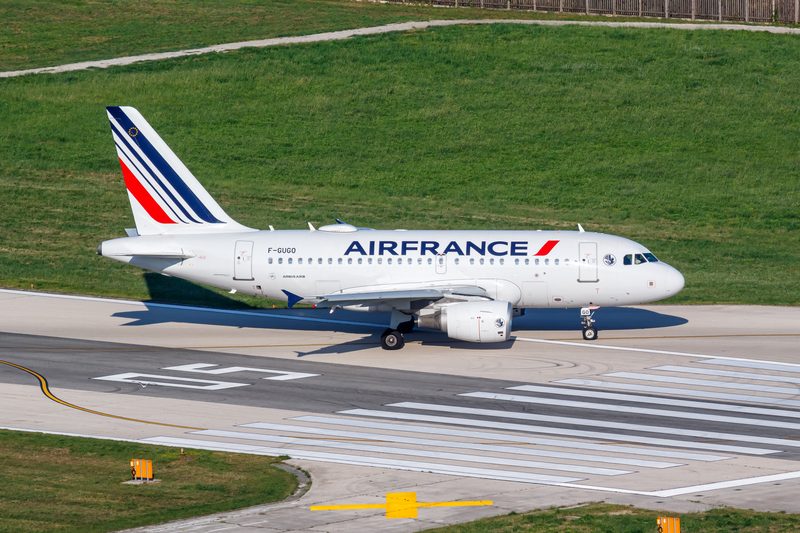
Air France has transferred one of its remaining Airbus A318-100 aircraft as part of a wider narrowbody transaction with asset manager FTAI Aviation, further shrinking an already tiny global fleet of the smallest A320-family member. While the A318 still wears a mainline badge at Air France more often than anywhere else, the economics of keeping a micro-subfleet alive have been working against it for years—and the secondary market for these jets increasingly values them for CFM56 engine and module feedstock rather than passenger flying.

For Air France, the sale is another quiet but important step in long-term fleet simplification: fewer subtypes, higher average gauge, and better per-seat efficiency across the short- and medium-haul operation centered at Paris Charles de Gaulle (CDG) and Paris Orly (ORY).
Read our stories in your inbox
Two aviation newsletters. Zero fluff.
What Air France Sold and Why It Matters
The A318 transfer was not a one-off. It was included in a package of seven off-lease Airbus narrowbodies acquired by FTAI—one A318-100, four A319-100s, and two A321-200s. That mix is telling: it’s weighted toward aircraft families with CFM56 engine commonality, which remains highly valuable in the MRO and used-parts market even as airframes age out of frontline service.
The A318 itself is an outlier in modern commercial aviation: only 80 were built globally, making it the rarest A320-family variant by a wide margin. That scarcity once made it a curiosity on European ramps; today it makes it a premium donor for spares and engines in a world where CFM56 support demand remains strong.

The A318 in One Sentence: Common Type Rating, Uncommon Economics
The A318 was designed to deliver A320-family commonality—shared cockpit philosophy, common type rating, and familiar maintenance practices—while right-sizing capacity for thinner markets. In practice, airlines learned a hard lesson: the A318’s “smaller jet” advantage was often too small to matter.
Here’s the economic pinch point professionals will recognize immediately:
-
An A318 typically carries about 25–30% fewer passengers than a standard A320 in comparable layouts.
-
Fuel burn and trip costs, however, tend to fall only marginally, because you’re still hauling a full-size A320-family wing, systems suite, and two mainline engines.
That gap hurts unit costs. In network terms, the A318 can be perfect for a handful of schedules—short runway performance, slot-constrained airports, or specific demand patterns—but it’s difficult to justify as a standalone fleet type once airlines begin consolidating around larger gauges and fewer subfleets.
Why the “Baby Bus” Lost the Market
When the A318 entered service in the early 2000s, the industry still had plenty of short-haul fleets that needed renewal, and the idea of a smaller A320-family aircraft looked sensible. Then three forces hit almost at once:
-
Regional jets improved rapidly. Newer Embraer and Bombardier platforms offered better economics in the 70–120 seat space, especially on thin routes where frequency mattered more than capacity.
-
Airlines chased unit cost. Slightly larger narrowbodies consistently delivered better margins, because they spread crew, landing fees, and fixed trip costs across more seats.
-
New-generation aircraft reset the benchmark. Types like the Airbus A220 and the modern Embraer E-Jet families brought better fuel burn per seat and more flexibility, squeezing the A318 from below and above.

The result: airlines either upgauged to A319/A320-class aircraft or downgauged into more efficient regional jets. The A318 got stuck in the middle—capable, but rarely optimal.
Why an A318 Can Be More Valuable on the Ground Than in the Air
In 2026, the A318’s strongest value proposition is often not “operating aircraft” but “support asset.”
Its CFM56 powerplants—and, just as importantly, the internal engine modules—are in demand for maintenance, repair, and exchange programs. That makes end-of-life airframes attractive to specialist lessors and asset managers who can monetize:
-
Engines and modules for teardown and exchange pools
-
High-value rotable components shared across the A320-family ecosystem
-
Landing gear, avionics, and structural spares that can keep other fleets flying
For carriers, selling an older, low-commonality airframe into that ecosystem can be financially cleaner than continuing to invest in an aging niche type, especially when training, spares stocking, and scheduling complexity are all part of the total cost.
What This Signals About Air France’s Short-Haul Direction
Air France’s narrowbody strategy has steadily moved toward simplification and efficiency. That means consolidating around aircraft that can cover more missions with fewer compromises, while also aligning cabin standards and maintenance pipelines.
As the airline modernizes the short-haul fleet that feeds CDG—and supports point-to-point flying from ORY—small mainline jets with weak per-seat economics face an uphill battle. The A318’s continued decline isn’t a verdict on Airbus’ design so much as a reflection of how today’s networks are built: schedule density, resilient unit costs, and subfleet simplicity win.
Bottom Line
Air France’s sale of an Airbus A318-100 to FTAI as part of a seven-aircraft narrowbody package is another clear marker that the “Baby Bus” era is winding down. With only 80 A318s ever produced, the type has become less a frontline airline tool and more a valuable source of CFM56 engines and component feedstock. For Air France—operating a complex short-haul machine anchored at Paris CDG (CDG) and Paris Orly (ORY)—each A318 that exits the fleet reduces subfleet drag and accelerates a broader shift toward simpler, more efficient aircraft families.
Keep reading FlyMag
Get the Daily Brief in the morning or the Route Watch weekly recap on Fridays. Or both.
Share this story
Composed for each network — click to share, or copy the composed text for your own timing.