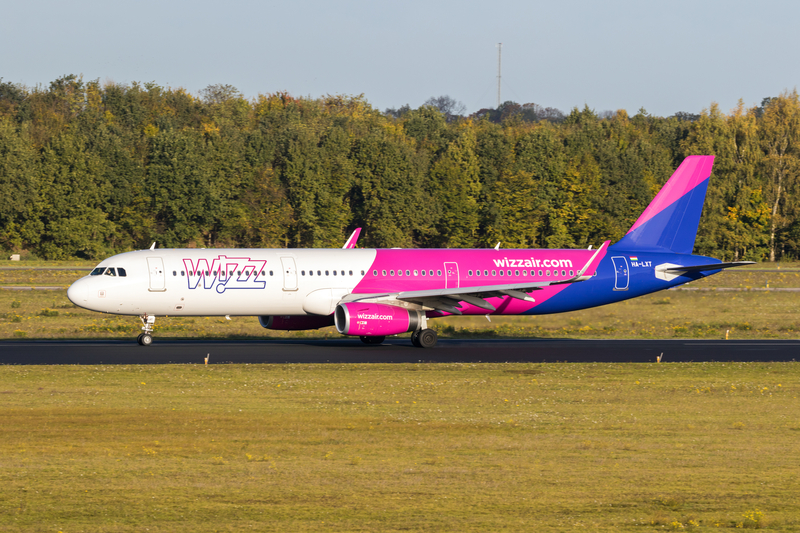
Wizz Air and SAC, the operator of Catania Fontanarossa (CTA) and Comiso (CIY), are scaling up their Eastern Sicily partnership with a clear, capacity-led move: a third Airbus A321neo will be stationed at the airline’s Catania (CTA) base from May 2026.

In base-network terms, adding an aircraft isn’t just “more seats.” It’s more schedule control. A based jet gives Wizz Air freedom to shape early-morning departures, late-night arrivals, and high-frequency domestic flying—exactly the tools that turn a leisure-heavy airport into something closer to a year-round utility station for both tourists and locals.
The aircraft: Airbus A321neo as a high-density Mediterranean workhorse
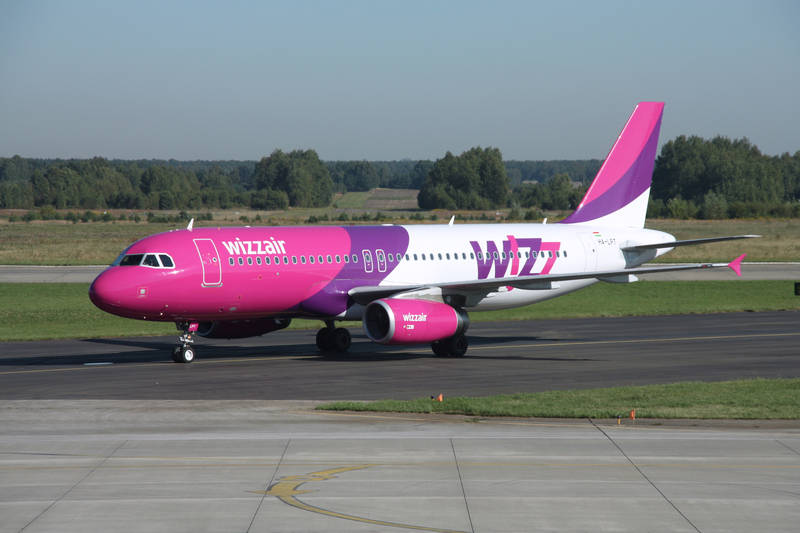
Wizz Air is building this expansion around the Airbus A321neo, the carrier’s core high-capacity narrowbody. In Wizz’s typical configuration, the A321neo is optimized for unit costs—high seat density, fast turns, and strong daily utilization.
Read our stories in your inbox
Two aviation newsletters. Zero fluff.
From an operator’s perspective, the A321neo is well suited to Eastern Sicily for three reasons:
First, it’s a right-sized gauge for a market like CTA, where demand is broad but highly seasonal. Second, the “neo” generation brings meaningful efficiency improvements versus prior A321 variants—crucial when you’re adding capacity into a competitive Italian market. Third, it offers the range and performance flexibility to cover domestic trunk flying and international sectors across Europe and the Eastern Med from the same tail, without sacrificing payload on typical stage lengths.
New international route: Catania (CTA) to Tel Aviv (TLV)
The headline route addition is a new link from Catania (CTA) to Tel Aviv Ben Gurion (TLV), scheduled to operate four times weekly from May 5, 2026.
For Wizz, Tel Aviv (TLV) is a classic “high-demand, high-volatility” market: strong VFR and leisure traffic potential, but one that requires disciplined commercial planning and robust operational coordination. A based aircraft at CTA matters here, because it improves flexibility if rotations need to be retimed, swapped, or protected during peak periods.
For Sicily, TLV is a meaningful connectivity add. It extends Eastern Sicily’s nonstop footprint beyond the traditional intra-Europe map and strengthens CTA’s positioning as a Mediterranean gateway rather than a purely Italian domestic airport.
Domestic frequency ramp: CTA–MXP and CTA–TRN go commuter-heavy
Wizz is also leaning into the bread-and-butter flying that makes a base profitable: frequency on trunk domestic routes.
Starting May 4, 2026, Wizz plans to boost:
-
Catania (CTA)–Milan Malpensa (MXP) from 12 to 19 flights per week
-
Catania (CTA)–Turin (TRN) from 11 to 14 flights per week
That’s not a cosmetic bump—it’s a structural shift in utility. Pushing close to three daily frequencies on CTA–MXP in peak weeks materially improves choice for business travelers, VFR flows, and short-break passengers. It also strengthens connectivity to Northern Italy’s economic centers without relying on a single daily departure that forces travelers into awkward departure windows.
What the third based aircraft unlocks across CTA and CIY
With the third A321neo in place, Wizz says it will operate 18 routes across 10 countries from Catania (CTA) and Comiso (CIY).
In practice, this is how base aircraft usually translate into network value:
More peak-day flying: the extra airframe lets Wizz layer in high-demand weekend rotations without cannibalizing weekday schedules.
More seasonality control: Sicily’s demand swings hard between shoulder season and summer peaks. A larger base gives Wizz more room to retime and rebalance without pulling out of markets entirely.
Better aircraft utilization: a third based jet typically means Wizz can build a day that mixes short domestic sectors (high frequency, fast turns) with longer international legs (higher total revenue per rotation), then returns the aircraft to CTA for the overnight. That’s where low-cost economics get sharp.
Capacity and jobs: the economic footprint of a “third aircraft” decision
Wizz and SAC are attaching concrete numbers to the expansion:
The third aircraft is expected to generate about 500,000 additional seats annually. Wizz also forecasts 40 new direct jobs, bringing its local headcount in Sicily to around 150, while supporting 350+ indirect jobs across the regional economy.
It’s also a reminder of how long this partnership has been maturing: Wizz notes it has carried nearly 9.7 million passengers through CTA and CIY since entering the Sicily market in 2009. That historical volume helps explain why the airline is comfortable doubling down now—base aircraft aren’t deployed where the carrier lacks confidence in long-term demand fundamentals.
Reliability as a selling point: completion rate tells you more than PR spin
Wizz is also emphasizing operational performance in 2025, citing over 1.7 million seats offered, 7,000+ flights operated, and a 99.8% completion rate, alongside improved punctuality.
For airline professionals, “completion rate” is the key metric there. It speaks to how often the carrier actually operates what it schedules—especially important in peak summer operations when disruption risk rises and passenger tolerance drops. If Wizz can maintain very high completion while growing the base, it strengthens the commercial case for adding more capacity into CTA and continuing to use CIY strategically for selected markets.
Bottom Line
Wizz Air’s decision to station a third Airbus A321neo at Catania (CTA) from May 2026 is a classic base-growth move with real network consequences: a new CTA–Tel Aviv (TLV) service launching May 5, and materially higher domestic frequency on CTA–Milan Malpensa (MXP) and CTA–Turin (TRN) from May 4. Add in the projected 500,000 incremental annual seats and the job impact across Eastern Sicily, and this reads less like a seasonal tweak—and more like a long-term bet that CTA is becoming one of Wizz’s most strategically useful nodes in the central Mediterranean.
Keep reading FlyMag
Get the Daily Brief in the morning or the Route Watch weekly recap on Fridays. Or both.