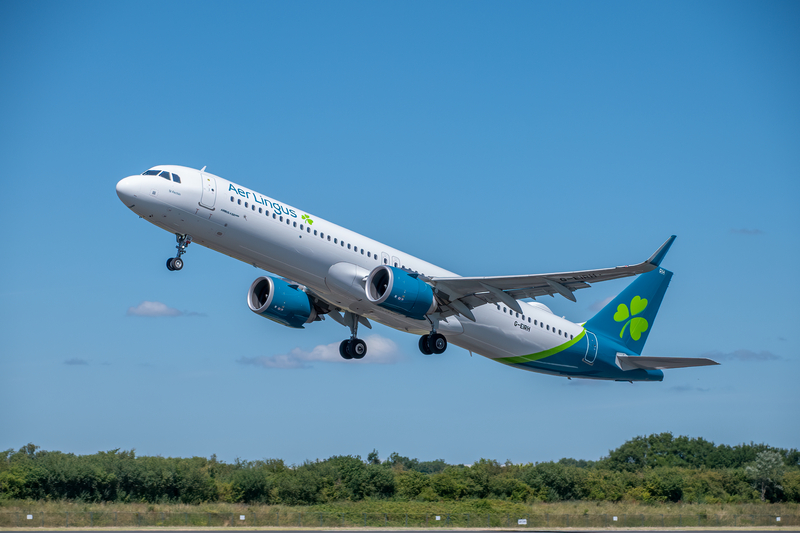
Cork Airport (ORK) is quietly becoming one of Aer Lingus’ most interesting regional growth stories—and Summer 2026 is where the strategy starts to look deliberate rather than incremental. Aer Lingus and Aer Lingus Regional have confirmed two new European launches from ORK, a year-round upgrade for Prague (PRG), and a frequency lift to Glasgow (GLA) that signals sustained demand on short-haul business-and-leisure crossover routes.

For a market that has historically watched most “new flying” concentrate around Dublin (DUB), the ORK schedule reads like a carrier leaning into local catchments and reducing leakage to other airports—especially for leisure breaks where one-stop itineraries are a non-starter for many travelers.
Two new continental routes: ORK–NCE and ORK–SCQ
Aer Lingus will open Cork (ORK) – Nice Côte d’Azur (NCE) from May 2, 2026, adding the French Riviera to Cork’s nonstop map. Nice (NCE) is the kind of destination that sells on two different channels: classic Mediterranean leisure demand, and higher-yield city-break traffic that tends to book earlier and travel lighter—useful characteristics for a regional route where unit revenue matters.
Read our stories in your inbox
Two aviation newsletters. Zero fluff.
A month later, Aer Lingus will launch Cork (ORK) – Santiago de Compostela (SCQ) from June 1, 2026. Santiago (SCQ) is a smart fit for Cork’s catchment because it isn’t just “another Spain route.” It’s a specialist leisure market tied to Galicia and the Camino de Santiago, which often behaves differently to sun-and-sand flying: more shoulder-season potential, more point-to-point demand, and a passenger mix that can skew toward longer stays.
Aircraft note for the fleet watchers: Aer Lingus’ short-haul growth is typically built around the Airbus A320-family, which is optimized for these mid-range European sectors. The A320 platform gives Aer Lingus the flexibility to right-size capacity, protect schedule reliability, and rotate crews efficiently—particularly important at a regional base where you want clean day turns and minimal knock-on disruption.
Prague (PRG) goes year-round: less seasonality, more network “stickiness”
The more strategic move may be the one that looks the least flashy. Aer Lingus is converting Cork (ORK) – Prague (PRG) into a year-round service.
That matters because Prague isn’t just a winter city-break. Making PRG year-round is a classic airline play to smooth seasonal swings, keep aircraft utilization stable outside peak months, and maintain market presence so demand doesn’t “retrain” itself back to one-stop options.
For ORK, year-round Prague also strengthens the airport’s positioning as more than a pure leisure gateway. City routes with strong off-peak appeal tend to build repeat travel—exactly the kind of demand that supports frequency growth later.

Aer Lingus Regional: more Glasgow (GLA), steady Bristol (BRS)
On the regional side, Aer Lingus Regional—operated exclusively by Emerald Airlines—will increase Cork (ORK) – Glasgow (GLA) from four to six weekly flights starting May 25, 2026, adding Tuesday and Wednesday departures. It’s a meaningful bump that suggests the route is performing well enough to justify improved week-of-travel flexibility, not just weekend-heavy patterns.
Emerald’s tool for this mission is the ATR 72-600, a high-efficiency turboprop designed for exactly these short-to-medium sectors. In airline terms, it’s the ideal “frequency builder”: lower trip cost than a jet, quick turn capability, and strong economics in markets where demand supports more departures but not necessarily larger-gauge aircraft.
The Cork (ORK) – Bristol (BRS) service remains a backbone business-and-leisure route, continuing daily, with double flights on Mondays and Fridays—a schedule pattern that’s typically aimed at both short-break leisure traffic and weekday business demand.
Cork’s expanding leisure portfolio: the route mix is getting broader
The new additions also sit neatly alongside Cork’s existing Aer Lingus leisure and trunk lineup, which already includes:
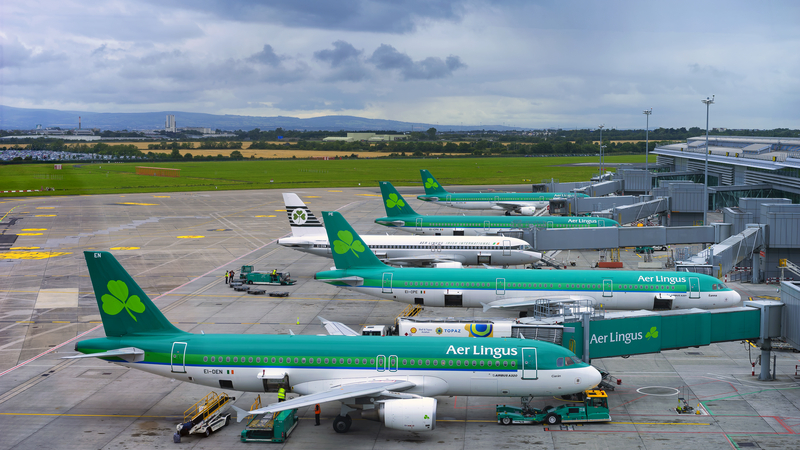
Malaga (AGP), Tenerife (TFS), Lanzarote (ACE), Faro (FAO), Palma de Mallorca (PMI), Bilbao (BIO), Bordeaux (BOD), and London Heathrow (LHR).
For ORK, this isn’t just about more destinations. It’s about the kind of network that keeps travelers local—fewer drives to other airports, fewer forced connections, and more nonstop choices that can compete on time and convenience rather than price alone.
A policy change that matters at the gate: 10kg carry-on rules expand across the Regional network
Alongside the route news, Aer Lingus confirmed that from March 3, 2026, its 10kg cabin baggage policy will apply across all Aer Lingus Regional flights operated by Emerald Airlines.
The details are operationally meaningful:
-
Plus and Advantage customers get a complimentary 10kg cabin bag.
-
Saver customers can pay to bring the 10kg bag onboard, or check it into the hold free of charge.
-
AerClub baggage benefits will also extend across the regional network.
-
The 10kg bag is sized to 55 × 40 × 24 cm, and all customers can still bring a small personal item that fits under the seat.
Why airline professionals should care: harmonizing baggage rules reduces front-line friction—fewer surprises at the gate, fewer ad hoc exceptions, and clearer expectations for boarding flows. At the same time, expanding cabin-bag eligibility can increase bin-space pressure on high-load ATR departures, so the “check it free” option becomes a useful release valve for on-time performance.
Bottom Line
Aer Lingus is turning Cork (ORK) into a more serious short-haul platform for Summer 2026, adding new nonstops to Nice (NCE) and Santiago de Compostela (SCQ), extending Prague (PRG) year-round, and lifting Glasgow (GLA) to six weekly flights while keeping Bristol (BRS) strong with daily service and extra Monday/Friday frequency. Combined with a unified 10kg carry-on policy across Aer Lingus Regional from March 3, the move reads like a carrier investing not just in routes, but in a smoother, more scalable regional operation out of ORK.
Keep reading FlyMag
Get the Daily Brief in the morning or the Route Watch weekly recap on Fridays. Or both.