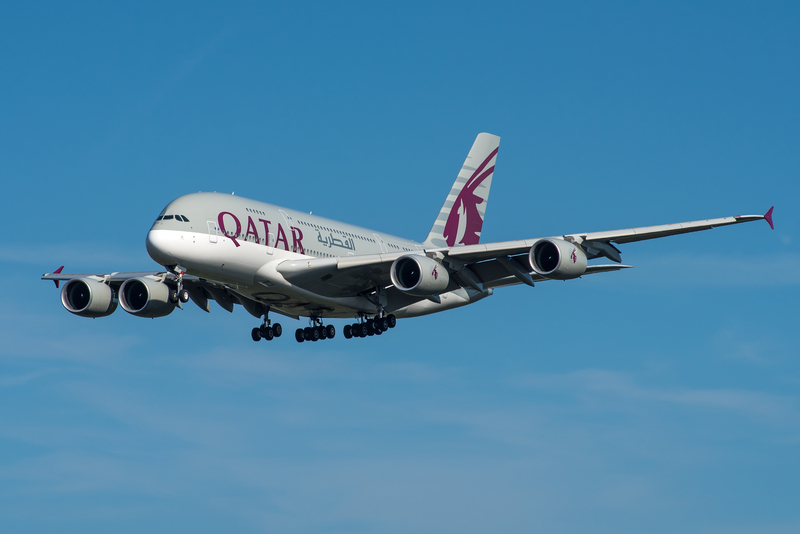
Qatar Airways has removed its Airbus A380 fleet from scheduled service through April and May, taking all eight active superjumbos out of the timetable as the airline continues to reshape its network around the operational fallout from the conflict involving Iran.
That matters because the A380 is not a peripheral aircraft in the Qatar Airways system when it is active. It is the airline’s highest-capacity passenger jet, used on dense, premium-heavy routes from Hamad International Airport (DOH) to major global gateways such as London Heathrow Airport (LHR), Bangkok Suvarnabhumi Airport (BKK), Singapore Changi Airport (SIN), Paris Charles de Gaulle Airport (CDG), and Sydney Airport (SYD).
Pulling the type entirely from the April and May schedule is therefore more than a fleet footnote. It is a sign that the carrier still does not see conditions as stable enough to justify operating its largest aircraft over the next two months.
Read our stories in your inbox
Two aviation newsletters. Zero fluff.
Why the A380 Was an Obvious Candidate to Pause
The Airbus A380 has always been a specialized tool for Qatar Airways rather than a backbone fleet type. The airline took the aircraft later than some of its Gulf rivals and has never used it as broadly as Emirates, instead deploying it selectively on routes where premium demand and slot constraints made very large gauge worthwhile.
That makes the current pause easier to understand. When a network is under pressure, airlines usually ground the least flexible aircraft first. The A380 offers immense capacity, but it also requires very specific route conditions, airport infrastructure, and demand density to work efficiently. In a disrupted operating environment, that is a difficult combination to defend.
By contrast, smaller long-haul aircraft such as the Airbus A350-1000 or Boeing 777-300ER are much easier to redeploy across a reduced or unstable schedule. For Qatar Airways, that makes the A380 the obvious type to remove when the network needs simplification rather than maximum seat volume.
The Aircraft Itself Is Still a Major Premium Asset
Even so, the pause underlines what the airline is temporarily losing.
Qatar Airways’ Airbus A380 is one of the carrier’s most distinctive products, with a First Class cabin, a large Business Class cabin, and a very high total seat count. It is the only passenger aircraft in the fleet offering First Class, which means the grounding also removes a specific premium tier from the network for the duration of the suspension.
That matters commercially as much as operationally. On routes such as DOH-LHR, DOH-SIN, and DOH-SYD, the A380 is not just about volume. It is also about product differentiation. When that aircraft disappears, Qatar Airways can still maintain service with other widebodies, but it cannot fully replicate the same top-end cabin mix or sheer capacity in one departure.
In practical terms, the airline is trading aircraft prestige and density for flexibility.
Doha’s Summer Recovery Plan Still Includes the A380
At this stage, the current working assumption in the schedule is that the A380 returns on June 1. If that holds, Qatar Airways is expected to bring the aircraft back first on a familiar set of trunk routes from DOH, with schedule filings pointing to LHR, BKK, SIN, CDG, and SYD as the initial markets.
That is an important phrase: if that holds.
The A380’s return is still best understood as a filed plan rather than a locked commitment. In the current environment, schedule filings are fluid. Qatar Airways can restore the aircraft quickly if conditions improve, but it can also keep pushing the return back if operational or geopolitical constraints remain unresolved.
That is why the June date should be treated as provisional, not definitive.
The Wider Context Is Bigger Than One Fleet Type
The A380 grounding only makes sense when viewed inside the broader collapse in Gulf aviation stability since late February.
Qatar Airways has already been among the carriers most visibly affected by the regional airspace disruption, with flights suspended, repatriation services launched, and safe corridors established only gradually after the first closure shock. The airline has not been alone, but it has been particularly exposed because Doha is such a large global connecting hub.
For a hub carrier, that matters enormously. The more a schedule relies on waves of connecting traffic through one airport, the harder it becomes to operate very large aircraft when flights are irregular, transfer patterns are unstable, and passenger confidence is weakened.
That is the real reason the A380 matters here. Its absence is not simply about the aircraft. It is about the shape of the network underneath it.
The Fleet Still Has Depth, but Less Margin for Premium Peaks
Qatar Airways can absorb the suspension better than some airlines could because its widebody fleet is deep and modern. The airline has large numbers of Airbus A350-900s, A350-1000s, and Boeing 777-300ERs, all of which can cover long-haul flying with greater day-to-day flexibility than the A380.
But those substitutions still come with compromises. A route that would normally support the A380’s sheer capacity may now need more careful inventory management, reduced premium supply, or tighter seat availability. In markets where the A380 usually plays a key role during peak periods, that can change both revenue strategy and passenger experience.
In other words, Qatar Airways has enough fleet depth to cope. It does not have an identical replacement for what the A380 does on its best routes.
The Bigger Signal Is Caution, Not Retrenchment
It would be too simplistic to read this as a long-term verdict on the Airbus A380 at Qatar Airways. The airline had already shown that it was willing to use the type again when conditions justified it, and the current schedule still points to a planned summer return.
The stronger conclusion is that Qatar Airways is choosing caution. It is keeping its most specialized aircraft parked until the network can support them properly again. That is not a retreat from the A380 concept as much as a recognition that, in the current environment, flexibility beats scale.
For airline professionals, that is the more telling lesson. When a network is unstable, the biggest aircraft often become the least useful, even when they remain commercially attractive in normal times.
Bottom Line
Qatar Airways’ decision to remove its Airbus A380s from the schedule through April and May is one of the clearest signs yet that the airline still sees its operating environment as too fragile for its highest-capacity aircraft.
The superjumbos are currently due back from June 1 on trunk routes from Doha (DOH) to London Heathrow (LHR), Bangkok (BKK), Singapore (SIN), Paris Charles de Gaulle (CDG), and Sydney (SYD), but that remains a tentative plan rather than a guaranteed restart.
For now, the message is straightforward. Qatar Airways is preserving flexibility, simplifying the network, and keeping its most specialized aircraft on the ground until the wider system can support them again.
Keep reading FlyMag
Get the Daily Brief in the morning or the Route Watch weekly recap on Fridays. Or both.