Air France is expanding its reach into Cyprus through a new partnership with Cyprus Airways, giving passengers access to nonstop flights between Paris Charles de Gaulle Airport (CDG) and Larnaca International Airport (LCA) under an Air France flight number.
The agreement took effect on July 7, 2026, although the two airlines formally announced it on July 20. Under the arrangement, Air France has added its AF code to flights operated by Cyprus Airways between Paris Charles de Gaulle Airport (CDG) and Larnaca International Airport (LCA).
Cyprus Airways will continue to provide the aircraft, pilots, cabin crews and onboard service. Air France, meanwhile, can market the flights as part of its own global network and sell connecting itineraries through its hub at Paris Charles de Gaulle Airport (CDG).
Read our stories in your inbox
Two aviation newsletters. Zero fluff.
The route will operate as many as six times per week during the peak summer season. The airlines say they intend to maintain connectivity throughout the year, although frequencies may vary outside the busiest travel periods. (Air France)
A Unilateral Codeshare Rather Than a Joint Operation
The agreement does not involve Air France launching its own flights to Larnaca International Airport (LCA).
Instead, it is a unilateral codeshare in which the AF flight code appears on Cyprus Airways-operated services. Cyprus Airways’ CY code is not being added to separate Air France-operated flights under the initial agreement.
That distinction matters because the two airlines are not jointly dividing the operation or adding capacity. The same Cyprus Airways Airbus A220-300 flight can now be sold under both Cyprus Airways and Air France flight numbers, depending on how the passenger books.
For Air France, the partnership adds a nonstop Cyprus option without committing an aircraft, crew or additional operating resources. For Cyprus Airways, the agreement places its flights inside Air France’s distribution network and makes them easier to include in connecting itineraries through Paris Charles de Gaulle Airport (CDG).
Cyprus Airways describes the arrangement as providing access through Paris Charles de Gaulle Airport (CDG) to destinations across Europe, Africa and the Americas. The airline’s own partnership information specifically identifies the Paris-Larnaca agreement as a unilateral codeshare with Air France.
The Airbus A220-300 Will Operate the Route
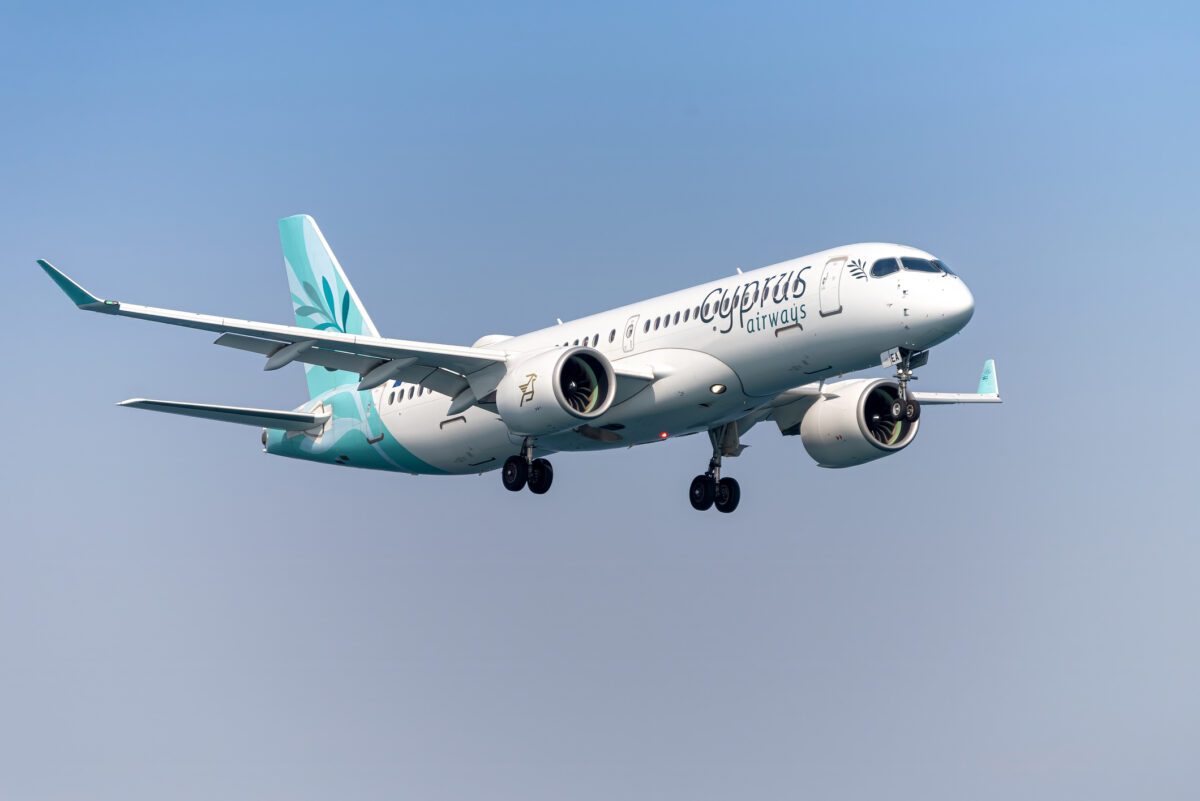
Flights between Paris Charles de Gaulle Airport (CDG) and Larnaca International Airport (LCA) will be operated by the Airbus A220-300, the newest aircraft family in the Cyprus Airways fleet.
The A220-300 is a clean-sheet single-aisle aircraft designed for approximately 120 to 160 passengers. It is powered by two Pratt & Whitney PW1500G geared turbofan engines and has a published maximum range of approximately 3,400 nautical miles.
That range gives the A220 considerably more capability than Cyprus Airways needs for the Paris-Larnaca sector, while its lower capacity allows the airline to operate the route more frequently than might be economical with a larger Airbus A320 or Boeing 737.
The aircraft’s five-abreast Economy Class layout is arranged with two seats on one side of the aisle and three on the other. As a result, only one seat in each Economy row is a middle seat.
Airbus says the A220 offers around 25% lower fuel consumption and carbon dioxide emissions per seat than previous-generation aircraft in its category. Its relatively small capacity and long range have made it particularly useful for routes that require narrowbody range but cannot consistently support the capacity of an Airbus A320neo or Boeing 737 MAX 8. (Airbus)
Cyprus Airways Has Several A220 Cabin Layouts
Cyprus Airways operates its A220-300 fleet in multiple configurations, giving the airline flexibility to match capacity and premium demand to individual routes.
One configuration has 12 Business Class seats and 110 Economy Class seats, providing total capacity for 122 passengers. A second version has eight Business Class seats and 130 Economy Class seats, for a total of 138 passengers.
The airline also lists a 140-seat all-Economy configuration. However, the Air France announcement specifically states that aircraft operating the Paris Charles de Gaulle Airport (CDG)-Larnaca International Airport (LCA) route will feature a dedicated Business Class cabin.
That suggests the route will normally use one of the two premium-equipped A220 configurations, although aircraft substitutions can occur for operational reasons.
Unlike the blocked-middle-seat Business Class commonly found on many European narrowbody flights, Cyprus Airways’ premium-equipped A220s have dedicated Business Class seats in a two-by-two layout.
Depending on the aircraft assigned, the forward cabin contains either eight or 12 wider reclining seats. Economy Class is arranged in the A220’s standard two-by-three layout. (Cyprus Airways fleet information)
A More Distinctive Regional Business Class
Cyprus Airways’ A220 Business Class product is more substantial than the short-haul product offered by many European network airlines.
Air France and most other large European carriers typically create short-haul Business Class by blocking the middle seat in a standard Economy row. The seat itself is usually identical to the Economy product, although passengers receive additional service, lounge access and greater flexibility.
Cyprus Airways instead offers a dedicated forward cabin with two seats on each side of the aisle. The seats are wider, provide additional recline and are physically separated from Economy Class.
Business Class passengers also receive priority check-in and boarding, lounge access where available, additional baggage and complimentary meals and beverages. The airline offers wireless entertainment through the AirFi platform, allowing passengers to stream content to their own devices.
Cyprus Airways notes that its onboard product can vary by aircraft and configuration, making it important for passengers to check the operating aircraft when booking. (Cyprus Airways Business Class)
Why Paris Charles de Gaulle Matters to Cyprus Airways
The value of the partnership extends well beyond passengers traveling only between Paris and Larnaca.
Paris Charles de Gaulle Airport (CDG) is Air France’s principal hub and the center of its long-haul network. Cyprus Airways passengers arriving from Larnaca International Airport (LCA) can be incorporated into Air France itineraries to destinations that Cyprus Airways could not serve independently.
For a relatively small carrier, establishing individual commercial agreements or launching flights to numerous long-haul destinations would be impractical. A codeshare with a major hub airline allows Cyprus Airways to offer a much larger virtual network without operating those onward sectors itself.
The arrangement may also generate additional inbound traffic for Cyprus. Passengers traveling from North America, Africa or other parts of Air France’s network can connect at Paris Charles de Gaulle Airport (CDG) to a Cyprus Airways-operated A220 flight for Larnaca International Airport (LCA).
Air France gains a similar advantage. It can offer a direct itinerary to Cyprus without operating its own aircraft into Larnaca International Airport (LCA), while retaining customers inside the Air France booking environment for more of their journey.
Six Weekly Flights Still Leave a Frequency Gap
Operating up to six times per week gives the route useful connectivity, but the absence of a full daily schedule creates some limitations.
Daily service is particularly valuable for connecting traffic because it provides consistent onward options throughout the week. With six weekly flights, at least one day will not have a nonstop Cyprus Airways operation between Larnaca International Airport (LCA) and Paris Charles de Gaulle Airport (CDG).
That can make certain connections less convenient and may require a longer layover or an alternative routing. However, six weekly flights still provide substantially more flexibility than the two- or three-times-weekly schedules commonly used on thinner seasonal routes.
The decision to stop short of daily service may reflect seasonal demand patterns between France and Cyprus. The market includes leisure travelers, visiting friends and relatives, business traffic and passengers connecting beyond Paris Charles de Gaulle Airport (CDG), but demand is naturally strongest during the European summer.
The airlines’ stated objective of maintaining year-round connectivity suggests that the route could continue during winter with a lower frequency rather than disappearing entirely after the summer season.
Athens and Milan Add Backup Connecting Options
Air France and Cyprus Airways are also establishing an interline arrangement covering flights through Athens International Airport (ATH) and Milan Malpensa Airport (MXP).
The cooperation includes Cyprus Airways-operated flights between Larnaca International Airport (LCA) and Athens International Airport (ATH), as well as between Larnaca International Airport (LCA) and Milan Malpensa Airport (MXP).
It also covers Air France-operated flights from Paris Charles de Gaulle Airport (CDG) to Athens International Airport (ATH) and Milan Malpensa Airport (MXP).
This creates two additional one-stop routing possibilities:
Paris Charles de Gaulle Airport (CDG)-Athens International Airport (ATH)-Larnaca International Airport (LCA), and Paris Charles de Gaulle Airport (CDG)-Milan Malpensa Airport (MXP)-Larnaca International Airport (LCA).
These itineraries are covered by an interline agreement rather than the main codeshare. Interlining allows flights from separate airlines to be issued as part of a coordinated itinerary, with through-checked baggage available where supported.
A codeshare is more deeply integrated because one airline places its own flight code on a service operated by the other. The Athens and Milan arrangements do not initially involve Air France and Cyprus Airways placing their respective codes on every connecting flight.
Nevertheless, the interline options provide useful alternatives when the nonstop service does not operate, is sold out or does not connect efficiently with a passenger’s long-haul flight.
The Partnership Strengthens Cyprus Airways’ Position
Cyprus Airways is a small carrier operating from a geographically constrained home market. Its fleet consists of Airbus A220-300 and Airbus A320-200 aircraft, which it uses on routes across Europe and the Middle East.
Its commercial challenge is not simply adding destinations. It must also provide passengers with access to markets beyond the practical range or demand profile of its own network.
Partnerships help solve that problem.
The airline already maintains interline relationships with several carriers, including Qatar Airways, Air India, flydubai, Middle East Airlines and SKY express. Each agreement gives Cyprus Airways access to different connecting flows without requiring membership in a global airline alliance.
The Air France agreement is particularly valuable because Paris Charles de Gaulle Airport (CDG) is one of Europe’s most important connecting hubs. It also gives Cyprus Airways greater visibility among passengers who may not previously have encountered the Cypriot airline through their normal booking channels.
For Air France, the partnership fills a network gap with little financial exposure. The airline can test demand for connecting itineraries to Larnaca International Airport (LCA) while Cyprus Airways carries the direct operating risk.
Tickets Will Be Sold Through Air France
Flights covered by the agreement are being made available through Air France’s normal sales and distribution channels, subject to regulatory approvals and completion of the necessary system implementation.
Passengers booking through Air France should clearly see that Cyprus Airways is the operating carrier. The operating airline determines the aircraft, onboard service, check-in procedures and many airport-related aspects of the journey.
This is particularly important for Business Class travelers. While a passenger may hold an Air France flight number, the seat and service between Paris Charles de Gaulle Airport (CDG) and Larnaca International Airport (LCA) will be provided by Cyprus Airways.
Connecting passengers should also review baggage allowances carefully. Codeshare and interline itineraries are designed to simplify travel between airlines, but the allowance shown on the issued ticket should be treated as authoritative.
Bottom Line
The new partnership gives Air France a presence on the nonstop Paris Charles de Gaulle Airport (CDG)-Larnaca International Airport (LCA) market without requiring the French carrier to operate its own aircraft.
Cyprus Airways remains responsible for the flights, using premium-equipped Airbus A220-300 aircraft as many as six times per week during the peak summer season.
The agreement is strategically more important than a simple change in flight numbers. Cyprus Airways gains access to Air France’s global distribution and connecting traffic at Paris Charles de Gaulle Airport (CDG), while Air France can offer Cyprus as part of its network with minimal operating risk.
The separate interline arrangements through Athens International Airport (ATH) and Milan Malpensa Airport (MXP) add further flexibility, particularly on days when the nonstop flight is unavailable.
For passengers, the result is a more integrated connection between Cyprus and Air France’s wider network. For the airlines, it is a low-risk partnership that allows each carrier to expand its reach without adding another aircraft to the route.
Keep reading FlyMag
Get the Daily Brief in the morning or the Route Watch weekly recap on Fridays. Or both.