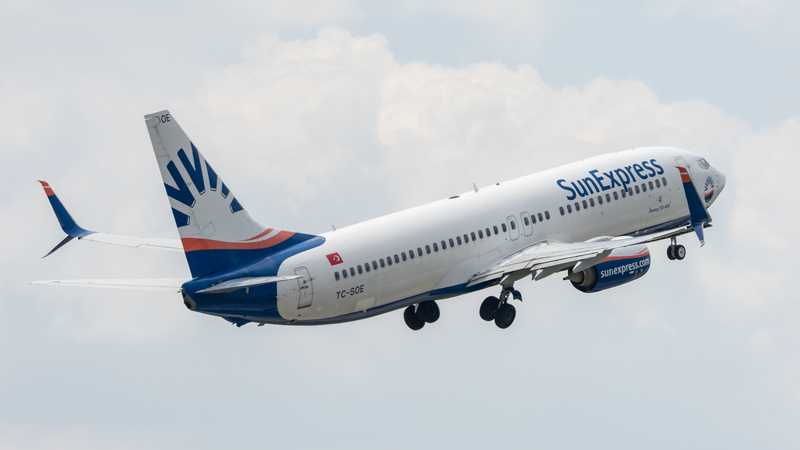
A SunExpress Boeing 737-800 was substantially damaged at Antalya Airport (AYT) on February 13 after its left main landing gear collapsed while the aircraft was taxiing for departure. The aircraft was operating flight XQ7646 bound for Gaziantep (GZT) when the incident occurred on taxiway J en route to Runway 18L.

According to the airline, the aircraft experienced a technical issue involving the landing gear strut during taxi. The aircraft rolled left and came to rest with its left engine (No. 1) in contact with the ground. All passengers and crew disembarked safely via mobile stairs, and no injuries were reported.
The affected service to GZT was later operated by a replacement aircraft, with passengers arriving after a delay of more than four hours.
Read our stories in your inbox
Two aviation newsletters. Zero fluff.
What happened on the taxiway at AYT
The event occurred during low-speed ground movement, not during takeoff or landing — a key operational distinction. Witness images circulating online suggest the left main landing gear strut failed structurally, bending or collapsing rearward. This caused the aircraft to settle onto the left side, placing weight onto the engine nacelle and lower wing structure.
A gear collapse during taxi is unusual but not unprecedented. Landing gear assemblies are designed to absorb vertical and lateral loads during landing, but a structural failure at taxi speed typically points toward a mechanical or structural issue rather than pilot action.
SunExpress confirmed the aircraft has been removed from service pending technical inspection.
Why this was not an inadvertent gear retraction
Some landing gear collapses occur when gear is accidentally retracted while the aircraft is still on the ground. However, that scenario is highly unlikely here for two reasons:
-
Boeing 737 main landing gear retract inward into the fuselage belly, not rearward. The damage pattern described does not match a retraction sequence.
-
The 737 incorporates multiple safeguards against ground retraction:
-
Weight-On-Wheels (WOW) system, which prevents gear retraction when the aircraft senses it is on the ground.
-
Landing gear safety pins, inserted during ground operations, which physically block hydraulic retraction mechanisms.
-
Based on the structural collapse observed, this appears to be a strut or attachment failure rather than a retraction event.
The aircraft type: Boeing 737-800
SunExpress operates a fleet built around the Boeing 737 family, particularly the 737-800 variant. The -800 is a narrowbody twin-engine aircraft widely used on short- and medium-haul routes. It features:
-
A conventional tricycle landing gear configuration
-
Main landing gear that retract sideways into the fuselage
-
Structural design intended to withstand significant landing loads
A taxi-speed collapse suggests a possible failure in the shock strut assembly, attachment fittings, or related structural components. Determining the root cause will require detailed inspection of:
-
The landing gear strut
-
Torque links and side brace assemblies
-
Hydraulic components
-
Airframe attachment points
-
Flight and maintenance data logs
Damage assessment: more than just the gear
When a 737 settles onto an engine, several areas typically require detailed evaluation:
-
Engine nacelle and fan section
-
Wing lower skin and structural spars
-
Pylon attachments
-
Fuel system integrity
-
Hydraulic lines
Even if the airframe appears visually intact, structural inspections often involve non-destructive testing (NDT) to check for hidden deformation.
Given the aircraft rested on Engine No. 1, the powerplant will almost certainly require removal and inspection before any return to service decision can be made.
Similar recent ground-collapse events
While rare, ground-based gear failures do occur. Recently, a FedEx Express Airbus A300 experienced a nose gear collapse at Baltimore (BWI) during ground operations. That event also occurred without injuries and is under investigation.
Ground collapses are distinct from hard-landing failures, as they happen without the kinetic loads associated with touchdown. They are typically linked to:
-
Structural fatigue
-
Maintenance-related issues
-
Hydraulic failures
-
Component manufacturing defects
Investigation and regulatory oversight
The incident occurred in Turkey and involves a Turkish-registered aircraft. As such, it will be investigated by Turkish aviation authorities. Given the aircraft type is manufactured by Boeing, technical coordination with the manufacturer is standard in these cases.
SunExpress is jointly owned by Turkish Airlines and Lufthansa, meaning technical support from those parent airlines may also be involved during inspection and recovery.
Operational impact
The aircraft remains grounded pending inspection and repairs. Depending on the level of structural damage, recovery timelines can range from weeks to months. If major wing or structural components are affected, repair economics become a central question.
SunExpress has confirmed that passenger safety remains its priority and that affected services will be operated by alternate aircraft.
Bottom Line
SunExpress flight XQ7646 suffered a left main landing gear collapse while taxiing at Antalya (AYT) prior to departure for Gaziantep (GZT). The Boeing 737-800 came to rest on its left engine, sustaining substantial damage, but all passengers and crew exited safely with no injuries. Early indications suggest a technical strut failure rather than inadvertent gear retraction. The aircraft is out of service pending investigation and structural inspection, with Turkish authorities expected to lead the probe.
Keep reading FlyMag
Get the Daily Brief in the morning or the Route Watch weekly recap on Fridays. Or both.