Miami International Airport (MIA) has returned Runway 8R/26L to full service after crews removed the wreckage of the Amazon Air Boeing 767 that overran Runway 30 on September 6.
The reopening on Wednesday, September 16, restores both operating directions on the 10,506-foot east-west runway. It does not mean that the entire airfield has returned to its normal four-runway configuration: Runway 12/30, where the accident sequence began, remains unavailable while recovery and investigative work continues.
The runway restoration gives controllers access to all three of MIA’s parallel east-west runways. The FAA’s September 17 operations plan lists continuing taxiway restrictions at Miami but no closure of 8R/26L, marking a significant improvement from the reduced-capacity operation that followed the crash.
Read our stories in your inbox
Two aviation newsletters. Zero fluff.
Miami Gradually Rebuilt Its Runway Capacity
The September 6 accident initially brought departures from MIA to a halt. An FAA ground-stop advisory attributed the disruption to a disabled aircraft and warned that a low-rate ground-delay program would follow when the airport reopened.
When traffic resumed, the initial configuration was particularly restrictive. Another FAA advisory showed arrivals and departures using Runway 9/27, MIA’s southernmost and longest runway. On September 7, the airport was accepting arrivals on Runway 9 and dispatching departures from Runway 8L, with the FAA assigning an average delay of more than two hours under one traffic-management program.

Miami-Dade County Mayor Daniella Levine Cava said on September 7 that two of MIA’s four runways remained closed while federal investigators worked at the site. The following day, county officials confirmed that an additional runway had been returned to service.
Runway 8R was initially used for eastbound departures. By September 12, an FAA ground-delay advisory listed arrivals on Runway 9 and departures on both 8L and 8R. Clearing the aircraft structure and associated recovery equipment has now allowed 8R/26L to resume unrestricted runway operations.
The reopened runway is an important part of MIA’s normal traffic plan. According to the airport’s published airfield data, 8R/26L is 10,506 feet long and 200 feet wide. It sits between the shorter northern parallel, 8L/26R, and Runway 9/27 to the south. The remaining closed runway, 12/30, is MIA’s 9,355-foot crosswind runway.
Flight 7598 Overran Runway 30
21 Air Flight 7598 was operating from San Juan (SJU) to Miami as a Part 121 cargo service when it overran the end of Runway 30. The aircraft, registered N1997A, continued through the airport perimeter and across two active roads, striking several vehicles before coming to rest in a field. Its right wing was breached and a post-crash fire followed, according to the FAA’s preliminary accident record.
Five people died in the accident. Miami-Dade County identified them as Rolando Aleman Leon, Yoel Rodriguez Naranjo, Julio C. Pineda, Carlos Acosta Fajardo and Javierkys Reyes Quevedo. The county also said Miami-Dade Fire Rescue reached the scene in less than 30 seconds, extinguished the fire and treated the injured.
The National Transportation Safety Board’s investigation, designated DCA26MA352, remains open. Investigators recovered both recorders and successfully downloaded more than two hours of cockpit audio and approximately 54 hours of flight data covering more than 400 parameters.
The agency’s preliminary recorder summary shows that one pilot repeatedly raised concerns about excessive speed during the final approach. The cockpit voice recorder captured several terrain and sink-rate alerts, followed by touchdown and a go-around call about 15 seconds before the end of the recording.
Initial flight-data information indicates that the nose and right main landing gear touched down at a groundspeed of 158 knots. The left main gear touched down later, at 134 knots. The crew released the brakes and increased thrust to a value consistent with a go-around before returning the throttles to idle and reapplying the brakes.
The flight-data recording ended with the aircraft still traveling at 65 knots. The NTSB said the recorded data contained no indication that the speed brakes or thrust reversers deployed. Those findings are preliminary and do not establish the accident’s probable cause.
Aircraft Was a Converted Boeing 767-300
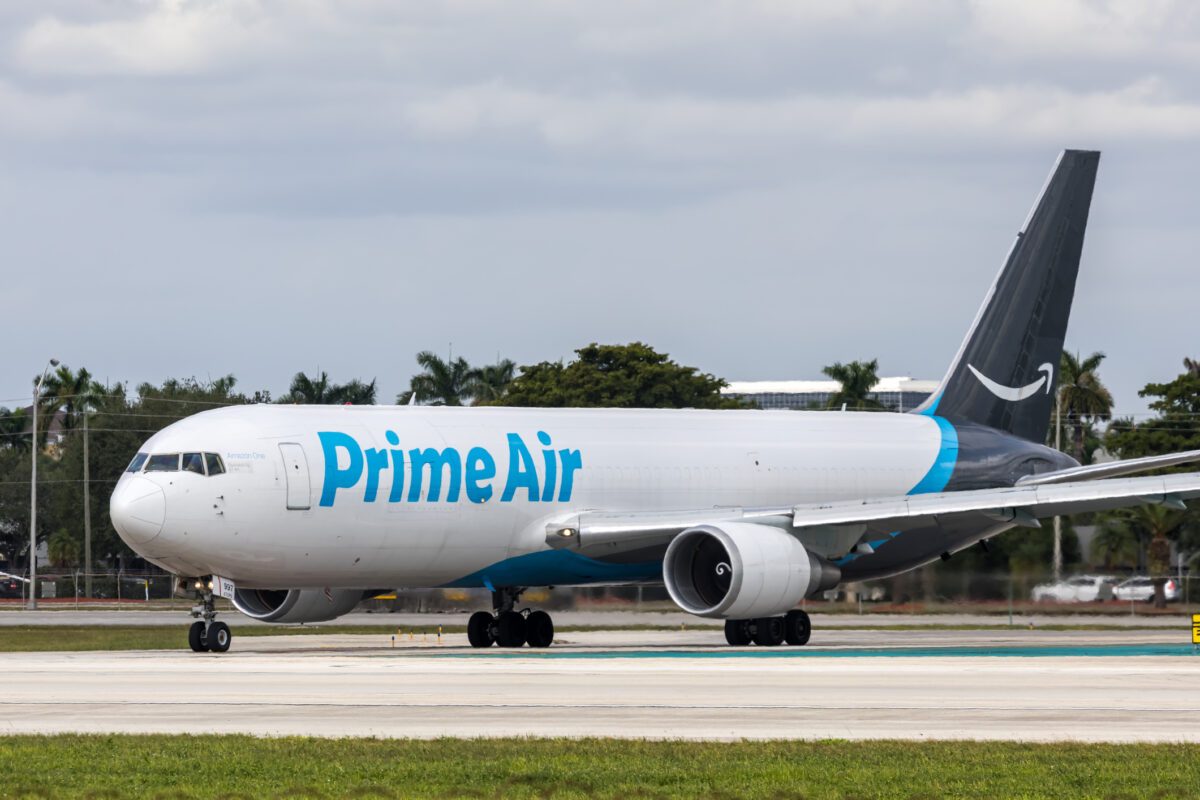
The FAA aircraft registry identifies N1997A as a Boeing 767-33A manufactured in 1994 and powered by General Electric CF6-80C2 engines. The aircraft was registered to Andromeda Leasing II LLC and operated by 21 Air on Amazon’s behalf.
The twin-engine 767-300 has become a core type in express-freight networks because it combines widebody volume with lower trip costs than larger long-haul freighters. Boeing lists the 767-300 converted freighter with a maximum structural payload of about 57 metric tons and a range of roughly 3,300 nautical miles, comfortably exceeding the requirements of the San Juan-Miami sector.
Amazon confirmed that Flight 7598 was part of its air network. On September 13, the company said it had paused operations with 21 Air while supporting the federal investigation and those affected by the accident. The carrier, meanwhile, said it was cooperating with the NTSB, FAA and local authorities.
Bottom Line
Restoring 8R/26L gives Miami’s air traffic operation far more flexibility than it had immediately after the accident. Controllers can again distribute departures across the northern parallels while preserving Runway 9 for arrivals or mixed use. That matters at an airport where international passenger banks and intensive cargo activity create sustained demand rather than a handful of isolated daily peaks.
The operational recovery is separate from the longer investigation. The NTSB’s early recorder release has already identified the sequence that investigators will examine closely: the approach speed, the timing of the landing-configuration changes, touchdown geometry, the attempted go-around and the apparent absence of recorded speed-brake or reverse-thrust deployment. The final analysis will also have to reconcile cockpit, aircraft-performance, runway and weather evidence before assigning cause.
Amazon’s decision to pause flying with 21 Air gives the accident consequences beyond the loss of one airframe. Amazon Air depends on contracted operators to supply aircraft, crews and operating certificates across its network, and any extended interruption will require capacity to be reassigned. The next developments to watch are the reopening of Runway 12/30, Amazon’s plans for the affected flying and the NTSB’s preliminary report.
Keep reading FlyMag
Get the Daily Brief in the morning or the Route Watch weekly recap on Fridays. Or both.