A Frontier Airlines flight from San Juan to Chicago diverted to Miami late Sunday night after a passenger allegedly tried to open an emergency exit door, attempted to reach the cockpit, and assaulted an off-duty flight attendant.

Frontier Flight 3345 was operating from Luis Muñoz Marín International Airport (SJU) in San Juan, Puerto Rico, to Chicago O’Hare International Airport (ORD) when the crew reported a passenger disturbance. The aircraft diverted to Miami International Airport (MIA), where it landed safely and was met by law enforcement.
Authorities identified the passenger as 51-year-old Juan Reyes. According to police records and federal court documents cited in local reporting, Reyes allegedly became disruptive about 45 minutes after departure from San Juan (SJU), said he wanted to get off the aircraft, tried to open an emergency exit door, then moved toward the front of the cabin and attempted to force his way toward the cockpit.
Read our stories in your inbox
Two aviation newsletters. Zero fluff.
The aircraft landed safely at Miami (MIA) around 11:55 p.m. ET. Law enforcement removed the passenger, and the flight later continued to Chicago O’Hare (ORD).
Flight 3345 Diverts On San Juan–Chicago Route
Frontier Flight 3345 was scheduled as a late-evening service from San Juan (SJU) to Chicago O’Hare (ORD), a route of roughly 2,070 miles across the Caribbean and eastern United States.
The flight instead diverted to Miami (MIA), the nearest large suitable airport once the disturbance became serious enough that the crew no longer continued toward Chicago. From an operational standpoint, Miami was a logical diversion choice. It is a major international airport with long runways, 24-hour law enforcement support, extensive emergency response capability, and airline ground-handling infrastructure.
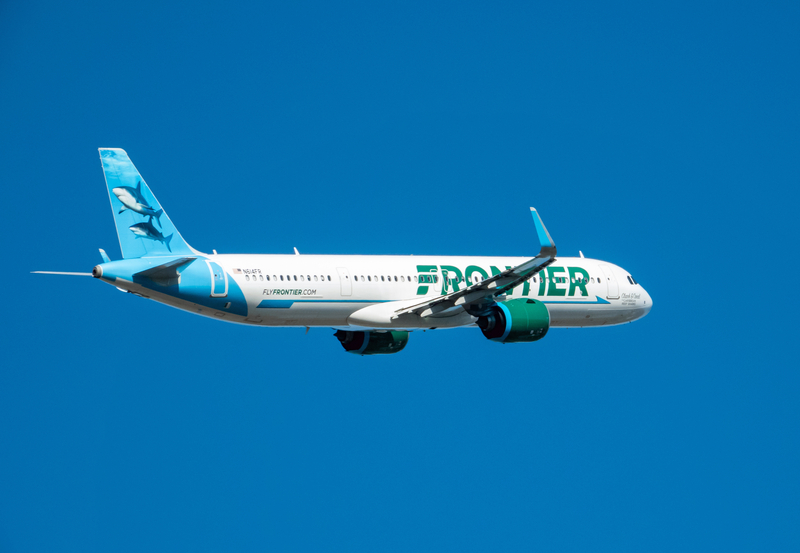
The aircraft involved has been identified in flight-status data as an Airbus A321neo, registration N660FR. Frontier’s A321neo is one of the highest-density narrowbody aircraft operating in the U.S. market, configured with 240 all-Economy seats. On a full or near-full flight, a serious onboard disturbance can therefore affect a large number of passengers and crew members.
The flight later operated the Miami (MIA) to Chicago O’Hare (ORD) sector after law enforcement removed the passenger. That continuation arrived in Chicago in the early morning hours, turning what should have been a nonstop overnight flight into a significantly delayed journey.
Alleged Door Attempt Escalated Into Cockpit Concern
The most serious part of the incident was not simply that a passenger was disruptive. It was the nature of the behavior.
According to reports citing law enforcement documents, Reyes allegedly attempted to open an emergency exit door while the aircraft was in flight. After being prevented from doing so, he moved toward the front of the cabin and began pushing against the cockpit door area.
That immediately changes the risk profile for any airline crew.
Modern commercial aircraft are designed so that cabin doors cannot realistically be opened during cruise flight because of pressurization, locking mechanisms, and the way the doors are engineered. On an Airbus A321neo at cruise altitude, the pressure differential between the cabin and the outside atmosphere makes an emergency exit door attempt functionally futile.
But that does not make the behavior harmless.

A passenger trying to open an aircraft door can injure crew, alarm passengers, distract the flight deck, and create a security emergency. A passenger moving toward the cockpit raises an even more serious concern. Since the post-9/11 security overhaul, unauthorized access to the flight deck has been treated as one of the most critical passenger-behavior threats in commercial aviation.
That is why the crew diverted.
Passengers And Crew Restrained The Man
The situation reportedly escalated further after an off-duty flight attendant volunteered to sit near the passenger to help keep him calm and contained.
According to local reporting, when the off-duty flight attendant later moved away, Reyes allegedly tried to take the man’s bag. When confronted, he allegedly attacked the off-duty flight attendant and choked him.
Several passengers and on-duty flight attendants then intervened. Reports say the group used flex cuffs and seatbelt extenders to restrain the passenger, but he allegedly broke free several times before being fully controlled.
One of the passengers who helped restrain the man was Josh Longood, a former professional MMA fighter and Brazilian Jiu-Jitsu black belt. His involvement has attracted attention because it shows how quickly passenger assistance can become critical when a cabin disturbance turns physical.
For airline professionals, the bigger point is crew coordination. Cabin crews are trained to de-escalate, contain, communicate with the flight deck, and protect the safety of passengers. But in a physical onboard confrontation, especially on a narrowbody aircraft with limited aisle space, help from able-bodied passengers can become important.
The crew’s priority would have been to keep the passenger away from the exits and cockpit, secure him as safely as possible, and give the flight deck enough confidence to continue only as far as the nearest suitable diversion airport.
Why Opening A Door At Cruise Is Not The Main Risk
Headlines about passengers “opening a door at 36,000 feet” often create fear, but the physics of a pressurized airliner make that scenario very different from how it may sound.
At cruise altitude, an Airbus A321neo’s cabin is pressurized. The pressure inside the cabin is far greater than the outside atmospheric pressure. That pressure differential, combined with door design and locking systems, prevents a passenger from simply pulling a door open in flight.
The greater danger is the disturbance itself.
A passenger attempting to open an emergency exit can cause panic, trigger a physical struggle, interfere with cabin crew duties, and create an unpredictable security situation. If the same passenger then moves toward the cockpit, the event becomes even more serious. The flight deck must consider whether the situation is contained, whether the passenger could break free, whether crew members are injured, and whether the aircraft should remain airborne any longer than necessary.
In this case, the decision was to land at Miami (MIA) rather than continue to Chicago (ORD). That was a conservative and appropriate response.
The Aircraft: Frontier’s Airbus A321neo
The aircraft identified in flight data, N660FR, is an Airbus A321neo.
The A321neo is the largest member of the Airbus A320neo family and is a major part of Frontier’s fleet strategy. Frontier uses the aircraft in a high-density 240-seat configuration, allowing the carrier to spread operating costs across a large number of passengers. The type is powered by new-generation engines and is designed to offer lower fuel burn than older A321ceo aircraft.
For Frontier, the A321neo is well suited to longer leisure and visiting-friends-and-relatives routes such as San Juan (SJU) to Chicago (ORD). It offers the range to operate longer domestic and near-international sectors while providing the seat count that supports the ultra-low-cost carrier model.
The aircraft’s cabin layout also matters in an incident like this. A 240-seat single-aisle aircraft has limited space for crew and passengers to manage a physical disturbance. The aisle is narrow, the forward cabin is close to the flight deck, and movement around exits and galleys can quickly become a safety concern.
That is why a disruptive passenger on an A321neo can become an operational emergency even when the aircraft itself is functioning normally.
Law Enforcement Response In Miami
After Flight 3345 landed at Miami International Airport (MIA), law enforcement boarded the aircraft and removed the passenger.
Miami-Dade authorities arrested Reyes, and federal authorities became involved because the alleged conduct occurred onboard an aircraft in flight. Incidents involving interference with crewmembers, attempted access to the cockpit, or violence onboard commercial aircraft can trigger both local and federal review.
The FAA also has civil enforcement authority over unruly passenger cases. Interfering with crewmembers is a violation of federal law, and passengers can face civil penalties as well as criminal prosecution depending on the conduct.
The legal process will determine the final charges and outcome. For the airline and crew, however, the operational response had to happen in real time. They did not need to know the passenger’s motive to decide that the safest option was to divert.
Another Serious Passenger Event In A Difficult Week
The Frontier incident came only days after another serious passenger disturbance involving a United Airlines flight from Chicago O’Hare (ORD) to Minneapolis–St. Paul (MSP).
That United flight, UA2005, diverted to Madison (MSN) after a passenger reportedly attempted to breach the cockpit area. In that case, law enforcement officers traveling on the aircraft helped restrain the passenger, and no injuries were reported. Authorities later described the individual as appearing confused and experiencing a mental health crisis.
The two incidents were different, but they highlight the same operational challenge. Airlines can train crews, reinforce cockpit doors, and enforce strict rules, but they still must manage unpredictable human behavior in a confined aircraft cabin.
When that behavior involves exit doors, flight deck access, physical assault, or refusal to follow crew instructions, the situation moves beyond ordinary disruption. It becomes a safety and security issue.
Diversions Are Costly, But Safety Comes First
A diversion caused by an unruly passenger is expensive and disruptive.
The airline must burn additional fuel, coordinate with air traffic control, arrange ground handling at the diversion airport, involve law enforcement, manage passengers, protect crew duty limits, and recover the aircraft schedule. Passengers may miss connections, arrive hours late, or require rebooking. The aircraft may also be delayed for security checks before continuing.
But those costs are secondary to safety.
Once a passenger has allegedly attempted to open an exit door, approached the cockpit, and assaulted another person onboard, the crew cannot treat the event as merely inconvenient. Even if the passenger is restrained, the captain must consider whether the restraint will hold, whether the cabin crew can monitor the situation, whether there are injured passengers or crew, and whether the aircraft should remain in the air any longer than necessary.
A diversion to Miami (MIA) gave the crew a controlled environment, law enforcement support, and a way to remove the passenger before continuing to Chicago (ORD).
Why These Events Remain Rare But Serious
Successful opening of a cabin door at cruise altitude is extraordinarily unlikely on a modern pressurized airliner. Successful cockpit breaches are also rare because of reinforced cockpit doors and strict access procedures.
Yet attempted interference remains serious because it disrupts the safe operation of the aircraft.
Commercial aviation depends on crew authority. Passengers are required to follow crewmember instructions because the aircraft cabin is a safety-critical environment. A person who refuses those instructions, assaults crew or passengers, or attempts to interfere with exits or cockpit access creates risk far beyond the individual seat.
That is why airlines and regulators continue to treat these cases aggressively. Even when no injuries occur and the aircraft lands safely, the conduct can lead to arrest, fines, prosecution, and airline bans.
The deterrent is part of the safety system.
Bottom Line
Frontier Flight 3345 from San Juan (SJU) to Chicago O’Hare (ORD) diverted to Miami (MIA) after a passenger allegedly tried to open an emergency exit door, attempted to reach the cockpit, and assaulted an off-duty flight attendant.
The aircraft, identified in flight data as Airbus A321neo N660FR, landed safely at Miami (MIA) around 11:55 p.m. ET. Law enforcement removed the passenger, and the flight later continued to Chicago (ORD).
The reported attempt to open a door at cruise altitude was not likely to succeed because of pressurization and aircraft door design. But that is not the key issue. The real risk was the passenger’s behavior: alleged exit-door interference, movement toward the cockpit, physical assault, and repeated attempts to break free after being restrained.
For Frontier’s crew, the safest decision was to divert. For passengers, it meant a long delay. For the industry, it was another reminder that unruly passenger events remain a serious operational and security concern, even when modern aircraft systems make the worst-case scenario unlikely.