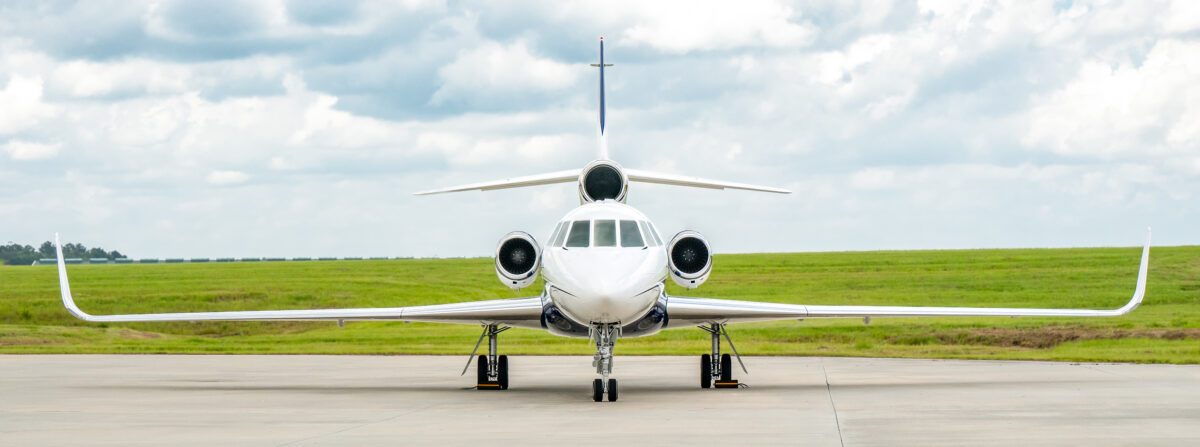
A Dassault Falcon 50 ran off Runway 1L during departure from Las Vegas Harry Reid (LAS) on Sunday, October 18, prompting the airport to close both of its parallel north-south runways for inspection.
The aircraft left the paved surface at about 11 a.m. local time and made contact with the airport perimeter fence. LAS said there were no known injuries in its initial statement on the runway excursion.
Emergency personnel responded while Runways 1L and 1R were taken out of service. The closures reduced the airfield to its east-west runway pair and led the Federal Aviation Administration to meter traffic bound for Las Vegas. The airport advised passengers to check directly with their airlines as delays developed.
Read our stories in your inbox
Two aviation newsletters. Zero fluff.
Parallel Runways Closed for Inspection
Runway 1L/19R is the western member of the two north-south parallels at LAS. The FAA’s airport data lists a physical length of 9,770 feet, with 8,988 feet of takeoff run available in the Runway 1L direction. The neighboring Runway 1R/19L is 9,769 feet long.
Closing both parallels removed half of LAS’s four-runway system from service. Although the longer 8L/26R and parallel 8R/26L remained available, concentrating arrivals and departures on one runway pair reduces the number of movements controllers can accommodate and limits their options for sequencing traffic.
The closure of 1R as well as the excursion runway provided separation for emergency vehicles, recovery work and airfield inspection around the aircraft. Before reopening a runway after an excursion, airport personnel must check the pavement, lighting, signs and surrounding safety areas for damage or debris.
Later on Sunday, the FAA’s airport status system was no longer reporting destination-specific delays for LAS. The status page was showing shorter departure and arrival delays attributed to wind, indicating that the earlier flow restrictions associated with the aircraft emergency had ended.
Aircraft Identified as N200SG
Flight-tracking records identified the aircraft as N200SG. The FAA registry entry for N200SG describes it as a Dassault-Breguet Falcon 50, serial number 239, powered by three Garrett TFE731-series turbofans. The registration is held by Jacks Wings LLC of Boca Raton, Florida.
The registry records an airworthiness date of July 15, 1993, although it does not list the aircraft’s year of manufacture. A Department of Transportation filing lists N200SG with nine passenger seats.
The Falcon 50 is a long-range, three-engine business jet developed from the earlier Falcon 20 family. Dassault says the type made its first flight in November 1976 and became the first purpose-built business aircraft capable of operating transatlantic missions while meeting the applicable public-transport rules of the period. The later Falcon 50EX increased range to 3,260 nautical miles and introduced updated engines and avionics, but FAA records identify N200SG as the original Falcon 50 model.
Its trijet layout distinguishes the Falcon 50 from most current midsize and large-cabin business aircraft. The design combines two fuselage-mounted engines with a third powerplant at the base of the vertical stabilizer, fed through an S-duct. Dassault’s Falcon 50 history credits the aircraft with establishing the manufacturer in the transoceanic business-jet market.
Cause of Rejected Takeoff Not Established
The airport’s first statement described the occurrence as taking place upon departure but did not identify why the takeoff was rejected. No official finding has been issued on the point at which the crew began decelerating, the aircraft’s speed, its loading or the condition of its brakes and tires.
Those details will determine whether the runway excursion followed a technical failure, a directional-control problem or a crew response to another indication during the takeoff roll. They will also establish how much usable pavement remained when the rejected takeoff began.
The FAA says its preliminary accident and incident reports are normally posted within one or two business days. The agency had not added the Las Vegas event to its public accident and incident statement page by early Monday. Any decision by the National Transportation Safety Board to open a separate investigation will depend in part on the extent of damage to the Falcon 50.
Bottom Line
The immediate operational consequence was disproportionate to the size of the aircraft involved. LAS retained two long runways, but losing an entire parallel pair during a Sunday travel period left controllers with less capacity and fewer recovery options. The resulting traffic-management measures illustrate why an excursion involving one general aviation aircraft can quickly affect airline schedules across a much wider region.
The investigation will center on the timing and reason for the rejected takeoff, along with the Falcon’s braking and directional-control performance. Damage findings will also matter: contact with the perimeter fence does not by itself establish whether the aircraft sustained the substantial damage that would bring the event under a formal NTSB accident investigation. The next useful information should come from the FAA’s preliminary report and from any subsequent NTSB notification.
For LAS, the event will also require scrutiny of the runway safety area, fence and associated airfield equipment beyond Runway 1L. The airport’s ability to shift traffic to the east-west pair kept operations moving, but the delays show the limits of runway redundancy when emergency access and inspection requirements remove two closely spaced surfaces at once.
Keep reading FlyMag
Get the Daily Brief in the morning or the Route Watch weekly recap on Fridays. Or both.