Breeze Airways is expanding its presence at Tampa International Airport (TPA) with daily service to Harry Reid International Airport in Las Vegas (LAS) and a new twice-weekly nonstop route to Long Island MacArthur Airport (ISP).

The Las Vegas schedule is set to begin January 5, 2027, while the first nonstop Tampa-Islip flight is scheduled for January 6. Both routes have been loaded into Breeze’s booking system, which currently accepts reservations through March 23, 2027.
The two additions represent different types of network growth. Las Vegas (LAS) is a major leisure market where Breeze already operates limited service and will face established competition. Islip (ISP), by comparison, is a lower-frequency market intended to connect Florida’s Gulf Coast directly with Long Island while avoiding the congestion associated with New York’s larger airports.
Read our stories in your inbox
Two aviation newsletters. Zero fluff.
The expansion will also give Breeze more than 20 nonstop destinations from Tampa (TPA), reinforcing the airport’s position as one of the most important stations in the airline’s network.

Breeze’s New Tampa Schedule
Breeze has not yet published a complete timetable with flight numbers and departure times for both January additions. The schedule currently provides the following basic details:
| Route | Launch date | Planned frequency | Market status |
|---|---|---|---|
| Tampa (TPA)-Las Vegas (LAS) | January 5, 2027 | Daily | Expansion of an existing limited-frequency route |
| Tampa (TPA)-Long Island/Islip (ISP) | January 6, 2027 | Twice weekly | First Breeze nonstop on the city pair |
The distinction between the two routes is important. Breeze is not entering Tampa-Las Vegas for the first time in January. The carrier is already selling flights between Tampa (TPA) and Las Vegas (LAS) for July, August, and September 2026. Recent flight history shows Breeze operating the route with the Airbus A220-300 on selected days.
The January change therefore represents a substantial frequency increase and winter schedule expansion rather than the launch of a completely new destination from Tampa.
Islip is different. Breeze currently sells Tampa-Islip itineraries, but Long Island MacArthur Airport describes Tampa as a BreezeThru destination involving one stop without an aircraft change. The January service will eliminate that intermediate stop and create Breeze’s first scheduled nonstop between Tampa (TPA) and Islip (ISP).
Las Vegas Will Become a Daily Breeze Route
Moving Tampa-Las Vegas to daily service is the larger of the two capacity commitments.
Breeze’s current summer schedule includes flights MX148 from Tampa (TPA) to Las Vegas (LAS) and MX149 on the return journey. Recent operating history shows MX149 flying on Mondays and Fridays during portions of June and July 2026, using the Airbus A220-300. The aircraft assigned on July 13 was listed with 137 seats.
Daily operation beginning January 5 would give Breeze seven weekly round trips instead of a limited schedule concentrated on selected travel days. It would also provide passengers with far more flexibility for vacations, conventions, weekend trips, and connections to events in Las Vegas.
The increase is commercially significant because frequency can be as important as price in a leisure market. A twice-weekly service requires travelers to organize an entire trip around the airline’s operating days. Daily flights allow customers to choose trip lengths more freely and make Breeze more competitive with airlines that already provide regular nonstop service.
Breeze is currently selling Tampa-Las Vegas flights into September 2026, although its booking calendar shows a break later in the fall before the daily January operation begins. That indicates the route may remain seasonal or operate in separate schedule periods rather than continuously at the same frequency throughout the year.
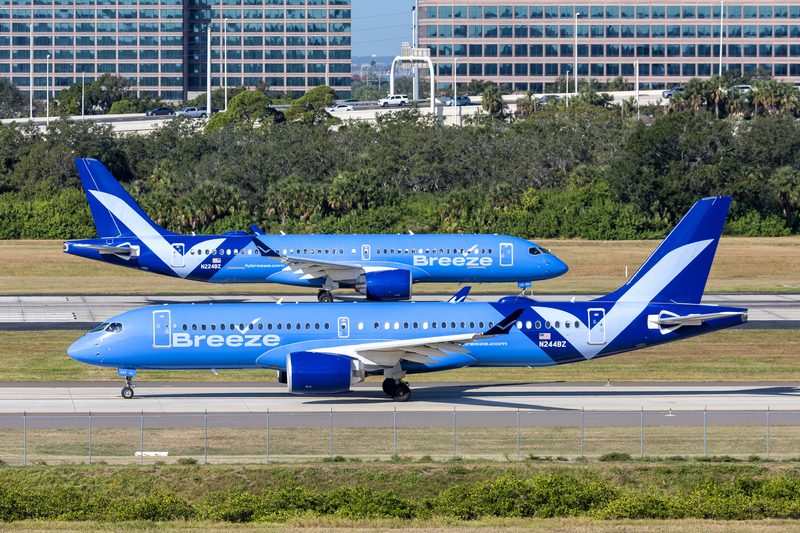
Breeze Will Face Established Competition to Las Vegas
The Tampa-Las Vegas market is not underserved in the traditional sense associated with many Breeze routes.
Southwest Airlines and Frontier Airlines already sell nonstop service between Tampa International Airport (TPA) and Harry Reid International Airport (LAS). Frontier’s booking system shows flights available throughout the second half of 2026, while Southwest markets regular nonstop service on the route.
Breeze will therefore compete on schedule, fares, onboard product, and passenger experience rather than benefiting from exclusivity.
That represents a departure from the airline’s original emphasis on routes with little or no nonstop competition. As Breeze’s fleet and network have grown, it has increasingly entered larger leisure markets where demand is substantial enough to support multiple carriers.
Las Vegas (LAS) fits that strategy. It is one of the country’s largest leisure and convention destinations, creating traffic from vacationers, entertainment travelers, casino customers, sports fans, and groups attending major trade events.
Tampa (TPA) also provides a large and growing origin market. The surrounding region includes Tampa, St. Petersburg, Clearwater, Sarasota, and fast-growing communities throughout Florida’s Gulf Coast.
Unlike a small underserved market, however, Las Vegas can expose airlines to aggressive fare competition. Southwest and Frontier can adjust capacity or pricing in response to Breeze’s daily operation, particularly during weaker travel periods in January and February.
Breeze must therefore attract enough passengers through a combination of competitive fares, its premium seating product, and customer preference for the Airbus A220.
Islip Provides Direct Access to Long Island
The Islip route targets a very different customer base.
Long Island MacArthur Airport (ISP) is located in Ronkonkoma and is owned and operated by the Town of Islip. It sits approximately 50 miles east of New York City and primarily serves the roughly three million residents of Nassau and Suffolk counties.
For many Long Island residents, ISP can be more convenient than John F. Kennedy International Airport (JFK) or LaGuardia Airport (LGA). Travelers can avoid driving west toward New York City, while parking, security screening, and terminal navigation are generally simpler at the smaller airport.
Long Island MacArthur Airport also provides access to the Long Island Rail Road through the nearby Ronkonkoma/MacArthur Airport station. The airport emphasizes shorter lines, close-in parking, and reduced terminal congestion as central parts of its passenger proposition.
Those advantages make ISP attractive for Florida service. Long Island has substantial seasonal, family, retirement, and second-home traffic to destinations throughout the state.
The Tampa Bay region provides an alternative to the heavily traveled Orlando and South Florida markets. It attracts vacationers headed to Gulf Coast beaches while also serving people visiting friends and relatives throughout west-central Florida.
Breeze Will Become the Fourth Nonstop Option
Breeze will not have the Tampa-Islip market to itself.
Tampa International Airport currently lists Frontier Airlines, Southwest Airlines, and seasonal JetBlue Airways service between Tampa (TPA) and Islip (ISP). Breeze will become an additional nonstop operator when its twice-weekly schedule begins.
The schedule snapshot cited in the original route analysis showed seven weekly nonstop flights during August 2026. Frontier was scheduled to operate five weekly Airbus A320neo services, while Southwest planned two weekly Boeing 737 flights.
The market was expected to decline to approximately five weekly flights during November, illustrating its seasonal nature. Breeze’s January launch will arrive during an important winter travel period when demand from the Northeast to Florida is normally strong.
Frontier’s Airbus A320neo generally provides considerably more capacity per departure than Breeze’s Airbus A220-300. Depending on its specific configuration, Frontier’s A320neo can carry approximately 186 passengers, compared with 137 seats on Breeze’s standard A220.
Southwest’s Boeing 737-800 and 737-8 aircraft accommodate 175 passengers in their current layouts, while the smaller 737-700 seats 137 following cabin modification.
Breeze may therefore operate the smallest aircraft in the nonstop market. That can be an advantage on a twice-weekly route because the carrier needs fewer passengers to fill each departure while it builds awareness and tests demand.
The Reported Islip Demand Increase Needs Context
Third-party origin-and-destination estimates cited in the original report indicate that demand between Tampa (TPA) and Islip (ISP) increased sharply during the year ending in March 2026.
The figures reportedly rose from 79 passengers daily each way, commonly abbreviated as PDEW, to 274 PDEW. The estimated average round-trip fare declined from $382 to $331 during the same period.
Taken at face value, those numbers imply that estimated local demand more than tripled while average fares fell by approximately 13%.
That would be consistent with a market being stimulated by additional nonstop capacity. Lower fares and more available seats can attract travelers who previously drove to JFK or LGA, used another Florida airport, connected through an intermediate city, or did not make the trip at all.
However, the numbers should be identified as third-party market estimates rather than audited passenger counts released by Tampa International Airport, Long Island MacArthur Airport, or the Bureau of Transportation Statistics.
PDEW figures are commonly generated from booking, ticketing, and itinerary databases. They can include passengers using connecting itineraries and may not match the number of people physically boarding nonstop flights between the two airports.
The same analysis estimated the following airline shares for the year ending in March 2026:
| Airline | Estimated Tampa-Islip market share |
| Frontier Airlines | 58% |
| Southwest Airlines | 27% |
| JetBlue Airways | 11% |
| Other itineraries | Approximately 4% |
The data also placed 56% of the market’s point of sale on the Islip side and 44% in Tampa. That relatively balanced split suggests the route is not driven solely by New York residents traveling south. Tampa-area travelers also appear to generate meaningful demand for visits to Long Island and the wider New York region.
Breeze will need to determine whether the reported growth is sustainable or partly reflects unusually aggressive fares and temporary capacity changes.
Breeze Is Pursuing Two Different Route Strategies
The Las Vegas and Islip additions demonstrate the increasingly broad role Tampa plays within Breeze’s network.
Tampa-Las Vegas is a long domestic leisure route serving two large metropolitan markets. It will operate daily and compete directly with airlines that have stronger local recognition and larger networks.
Tampa-Islip is a narrower point-to-point opportunity. Breeze will initially operate only twice weekly, allowing the airline to test the market with limited exposure.
The Las Vegas route depends on volume. Breeze must consistently fill a significant number of seats across seven weekly departures in each direction.
Islip depends more heavily on convenience. The airline can attract passengers who value avoiding JFK and LGA or who currently use connecting BreezeThru itineraries between Tampa and Long Island.
The two services also have different schedule requirements. Daily Las Vegas flights must be timed to appeal to customers taking trips of varying lengths. The Islip operation can be concentrated around popular leisure days, such as Wednesdays and Saturdays or Thursdays and Sundays, although Breeze has not yet publicly confirmed the exact operating days.
That flexibility is central to the Breeze model. The airline frequently adjusts frequencies by season and may operate routes only two or three times weekly when daily service would place too much capacity into the market.
The Airbus A220 Is Well Suited to Both Markets
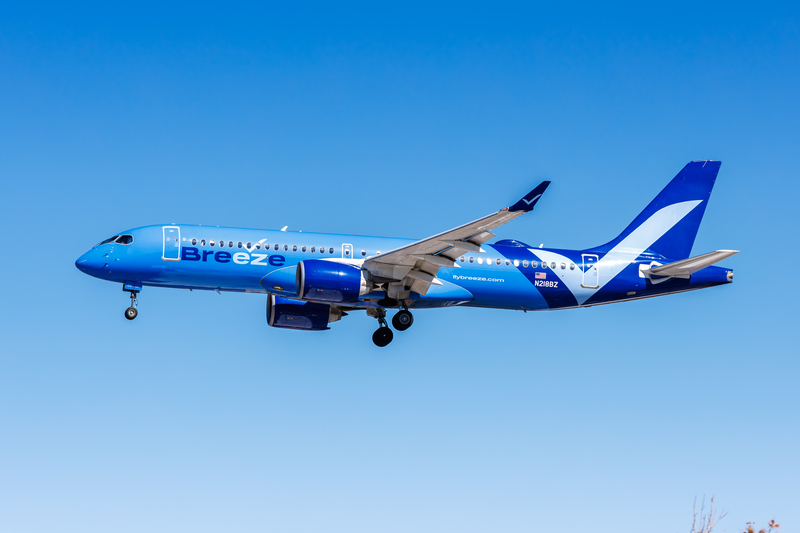
Breeze’s Airbus A220-300 is particularly well suited to routes such as Tampa-Las Vegas and Tampa-Islip.
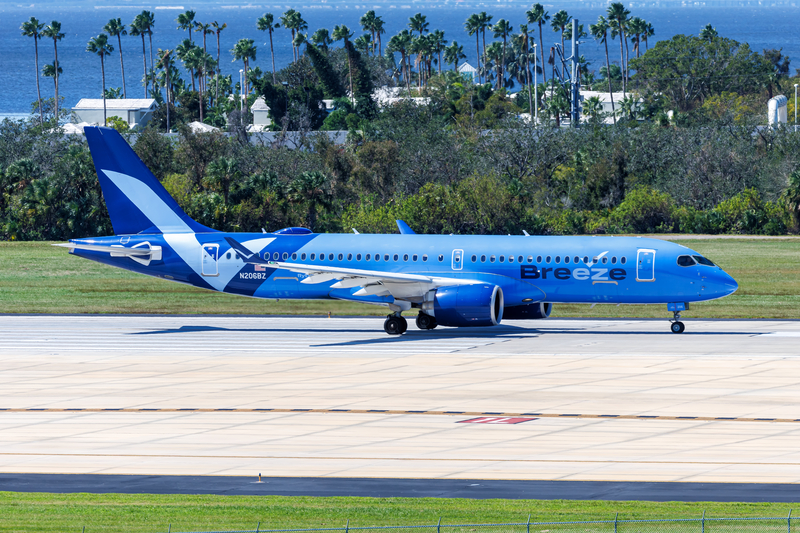
The airline’s A220s use a 137-seat configuration that includes 12 premium Breeze Ascent seats along with extra-legroom and standard economy seating. The aircraft also offers Viasat Wi-Fi and a five-abreast economy cabin arranged 2-3, meaning only one side of each row has a middle seat.
The Airbus A220-300 was designed specifically for the 120-to-160-seat portion of the single-aisle market. Airbus lists a maximum range of approximately 3,450 nautical miles, more than sufficient for the transcontinental-length journey between Tampa (TPA) and Las Vegas (LAS).
The aircraft is powered by two Pratt & Whitney PW1500G geared turbofan engines. Its combination of range, relatively low total trip cost, and moderate seating capacity allows Breeze to operate routes that may be too long for a regional jet but too thin for a larger Boeing 737-800 or Airbus A320neo.
That is especially important on Tampa-Las Vegas. The route covers nearly the full width of the continental United States, but Breeze does not need to fill the 175 to 190 seats typically found on competing low-cost carrier aircraft.
On Tampa-Islip, the A220 gives Breeze enough capacity to benefit from peak winter demand without committing to the larger number of seats offered by Frontier’s A320neo.
The premium cabin can also improve route economics. Breeze can sell its 12 Ascent seats at a higher fare, giving the airline another source of revenue beyond standard economy tickets and ancillary charges.
Daily Las Vegas Service Adds Substantial Capacity
Assuming Breeze continues using its standard 137-seat A220-300, daily service to Las Vegas would provide 959 seats from Tampa each week.
The twice-weekly Islip route would add another 274 weekly departing seats.
Combined, the two schedules would create approximately 1,233 additional one-way seat positions from Tampa every week, or 2,466 seats when both directions are included.
| Route | Weekly departures from TPA | Seats per departure* | Weekly outbound seats |
| Tampa-Las Vegas | 7 | 137 | 959 |
| Tampa-Islip | 2 | 137 | 274 |
| Total | 9 | — | 1,233 |
*Capacity estimate assumes Breeze’s standard 137-seat Airbus A220-300. Aircraft assignments can change.
The majority of the added capacity comes from Las Vegas. That route accounts for nearly 78% of the combined weekly seats in the two-market expansion.
Breeze has not confirmed that every Islip departure will use the A220. The airline continues to operate a limited number of Embraer 190 aircraft, although it previously announced plans to transition scheduled flying toward the newer Airbus fleet. Aircraft assignments should therefore be checked once the complete January timetable is published.
Tampa Has Become a Major Breeze Station
Tampa has played an important role in Breeze’s network since the airline began operations in 2021.
The airport now lists more than 20 Breeze nonstop destinations, extending from short Florida routes to longer services across the Northeast, Midwest, West, and Caribbean.
The route list includes cities such as Pittsburgh (PIT), Raleigh-Durham (RDU), Richmond (RIC), Providence (PVD), Hartford (BDL), Memphis (MEM), Burlington (BTV), and Key West (EYW), along with international destinations such as Nassau (NAS), Punta Cana (PUJ), and San José, Costa Rica (SJO). Breeze’s booking platform also lists Las Vegas and Islip among the destinations available from Tampa.
That breadth gives Breeze several advantages.
Aircraft and crews can be based or rotated through a larger operation, reducing dependence on a single route. A substantial station can also support local maintenance, spare-parts availability, employee scheduling, and stronger brand recognition.
Tampa’s geography is equally valuable. It allows Breeze to connect Florida with markets throughout the eastern United States while also supporting longer A220 routes to the West Coast and international destinations.
The airline’s growth at TPA is no longer limited to finding completely unserved city pairs. It is increasingly willing to challenge incumbent airlines when it believes its aircraft size, cost structure, or product can support a competitive entry.
Las Vegas Carries More Risk Than Islip
Of the two additions, daily Las Vegas service represents the larger commercial risk.
Breeze must fill seven weekly flights in a market already served by Southwest and Frontier. Those airlines have established customer bases, frequent-flyer programs, and the ability to respond with lower fares or additional capacity.
Las Vegas is also highly sensitive to seasonal demand, convention schedules, major events, and discretionary consumer spending.
Breeze’s limited 2026 operation provides useful experience before the daily schedule begins. The carrier can evaluate booking patterns, fare performance, ancillary revenue, passenger origins, and the number of customers choosing premium seats.
Moving to daily service indicates that Breeze believes the existing operation has demonstrated sufficient potential—or that winter demand will be materially stronger than the current schedule can accommodate.
Islip presents less exposure because it begins with only two weekly flights. If demand underperforms, Breeze has committed relatively little aircraft time and can adjust the schedule more easily.
The challenge at ISP will be awareness. Passengers accustomed to Frontier, Southwest, or seasonal JetBlue service may not immediately know that Breeze has converted its one-stop option into a nonstop flight.
The airline will need to market the distinction clearly, particularly because its website already sells Tampa-Islip itineraries that can appear similar in a basic fare search.
Bottom Line
Breeze Airways is expanding its Tampa International Airport (TPA) operation with daily flights to Harry Reid International Airport in Las Vegas (LAS) beginning January 5, 2027, and twice-weekly nonstop service to Long Island MacArthur Airport (ISP) beginning January 6.
The two routes should not be described in exactly the same way.
Breeze already operates limited Airbus A220-300 service between Tampa (TPA) and Las Vegas (LAS). The January schedule represents a move to daily flights and a major capacity increase, not the airline’s first entry into the market.
Breeze also currently sells Tampa-Islip itineraries, but those are BreezeThru services involving one stop without an aircraft change. The January launch will create the airline’s first true nonstop between Tampa (TPA) and Islip (ISP).
Las Vegas will test Breeze’s ability to compete daily against established operators in a large leisure market. Islip is a more traditional Breeze opportunity: a lower-frequency route using a smaller airport that provides travelers with a convenient alternative to JFK and LGA.
The Airbus A220-300 gives Breeze an appropriate tool for both assignments. Its 137-seat cabin is smaller than most competing Boeing 737 and Airbus A320 aircraft, while its range, premium seating, and five-abreast cabin allow the airline to pursue longer routes without committing excessive capacity.
For Tampa, the additions bring nine more planned Breeze departures each week and approximately 1,233 outbound seats if every flight uses the standard A220 configuration.
More importantly, they show how Breeze’s Tampa strategy is evolving. The airline is still targeting convenience-driven, lower-frequency markets such as Islip, but it is also increasingly prepared to challenge larger carriers with daily service on major routes such as Las Vegas.