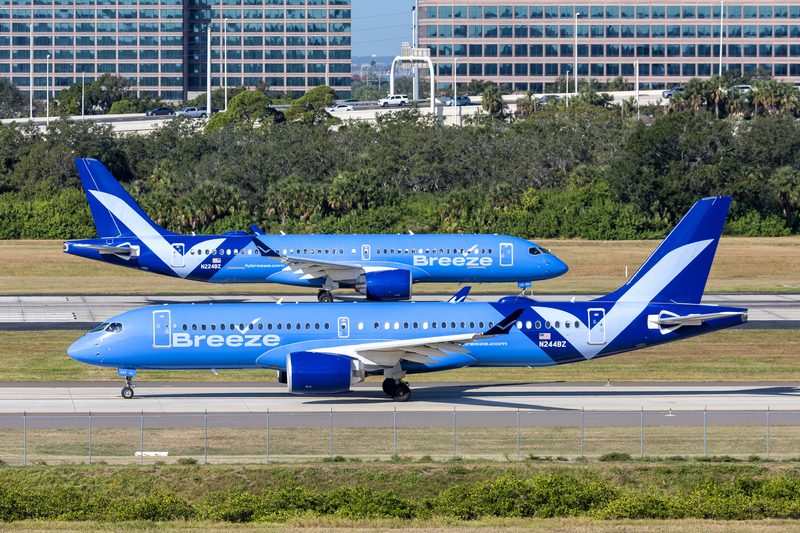
Breeze Airways has removed 18 domestic routes from its network, a reminder that the airline’s rapid growth strategy still depends on constant testing, adjustment, and redeployment of aircraft.

The cuts are not a sign that Breeze is retreating. In fact, the opposite is true. The carrier continues to add routes, expand into new cities, and build its first international network. But the discontinued markets show the other side of Breeze’s model: not every thin, underserved, or previously unserved route can generate the right mix of load factor, fare, frequency, and aircraft utilization.
That is especially true when the route is long.
Read our stories in your inbox
Two aviation newsletters. Zero fluff.
Breeze’s strategy has always been different from the large U.S. network carriers. It does not rely on massive connecting hubs like Atlanta (ATL), Dallas/Fort Worth (DFW), Charlotte (CLT), Chicago O’Hare (ORD), or Denver (DEN). Instead, it looks for city pairs that larger airlines have ignored, often using the Airbus A220-300 to connect secondary airports with nonstop service that passengers could not previously buy.
That approach can produce real opportunity. It can also produce route churn.
The 18 Routes Breeze Has Dropped
The 18 discontinued routes were all domestic and ended between January 2025 and May 2026. They represent a small share of Breeze’s total capacity, but they are still useful because they show where the airline’s network model has faced resistance.
| Ended | Route |
|---|---|
| January 2025 | Orlando (MCO) – Mobile International (BFM) |
| February 2025 | Fort Myers (RSW) – Bangor (BGR) |
| February 2025 | Fort Myers (RSW) – New York Stewart (SWF) |
| February 2025 | Westchester/White Plains (HPN) – Sarasota/Bradenton (SRQ) |
| April 2025 | Orlando (MCO) – Plattsburgh (PBG) |
| May 2025 | New York Stewart (SWF) – Vero Beach (VRB) |
| August 2025 | Akron-Canton (CAK) – Los Angeles (LAX) |
| August 2025 | Tampa (TPA) – Orange County/Santa Ana (SNA) |
| September 2025 | Huntsville (HSV) – Los Angeles (LAX) |
| September 2025 | Norfolk (ORF) – Syracuse (SYR) |
| September 2025 | Westchester/White Plains (HPN) – Greenville/Spartanburg (GSP) |
| January 2026 | Raleigh/Durham (RDU) – Los Angeles (LAX) |
| April 2026 | Orange County/Santa Ana (SNA) – Montrose/Telluride (MTJ) |
| April 2026 | Orlando (MCO) – Ogdensburg (OGS) |
| May 2026 | Hartford/Bradley (BDL) – Daytona Beach (DAB) |
| May 2026 | Orlando (MCO) – Manchester (MHT) |
| May 2026 | Westchester/White Plains (HPN) – Daytona Beach (DAB) |
| May 2026 | Westchester/White Plains (HPN) – Jacksonville (JAX) |
The list covers a wide range of markets, but several themes stand out. Breeze has cut some long-haul domestic routes to Los Angeles (LAX), several Florida-focused leisure routes, and multiple routes from smaller Northeast airports such as Westchester (HPN), New York Stewart (SWF), Plattsburgh (PBG), and Ogdensburg (OGS).
That does not mean those airports are poor markets. It means those specific city pairs did not appear to support Breeze’s required economics during the period examined.
This Is Route Churn, Not A Network Collapse
The first point to understand is scale.
The 18 removed routes accounted for a relatively small amount of Breeze’s overall capacity. In the examined period, the discontinued markets had roughly 248,000 round-trip seats for sale, or less than 2% of the airline’s system capacity.
That is important. A large carrier can cut 18 routes and still be shrinking. Breeze can cut 18 routes while still growing.
The airline is young, having launched scheduled passenger service in 2021. In that short period, it has built a broad U.S. network around underserved point-to-point flying. A certain amount of trial and error is built into the model. Breeze is intentionally entering markets where there is limited nonstop precedent. Some routes perform well because passengers were waiting for a nonstop option. Others reveal that the market looked better on paper than it did in actual bookings.
That is not unusual for a young airline. What matters is whether the aircraft can be redeployed into stronger markets quickly.
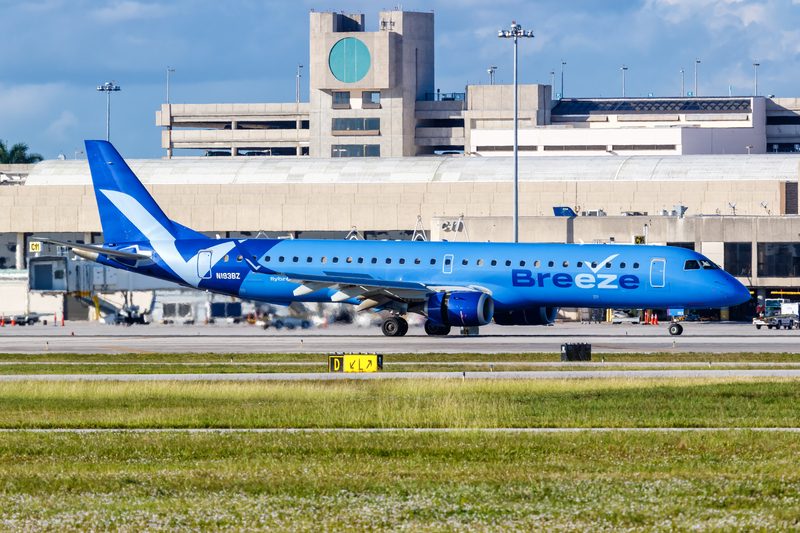
Breeze’s current growth suggests it can.
The Airbus A220 Is The Core Tool
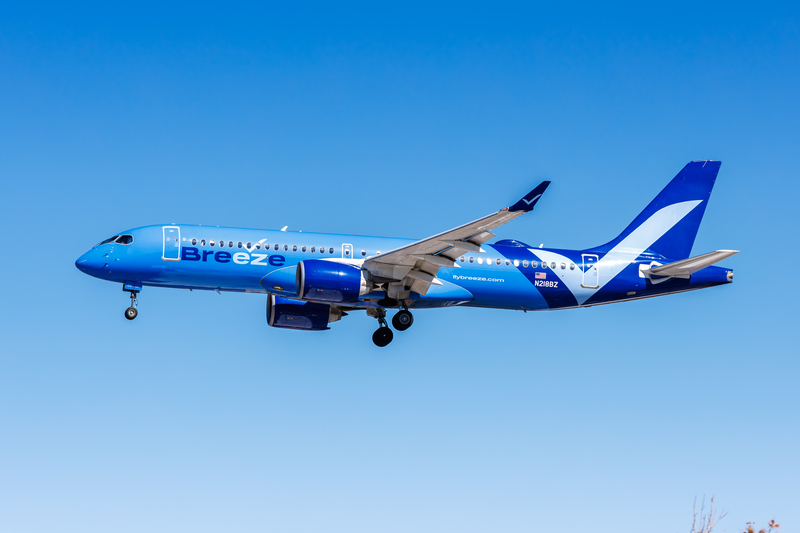
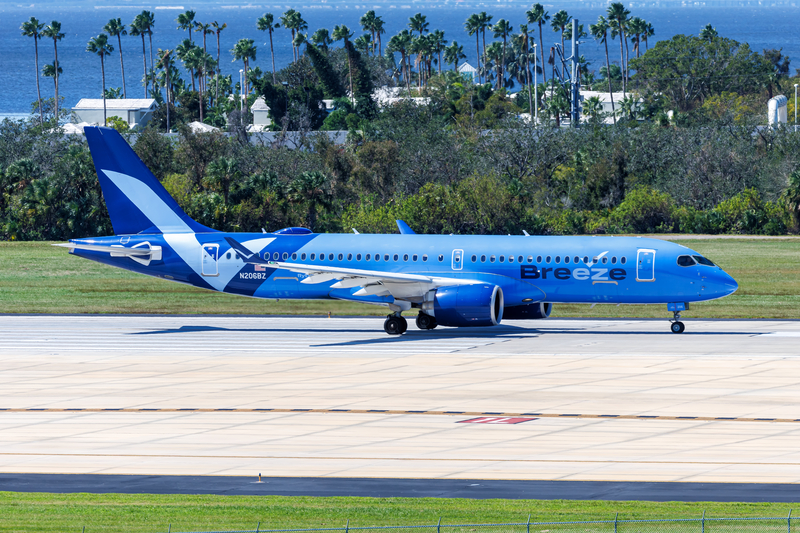
The Airbus A220-300 is the most important aircraft in Breeze’s network strategy.
Breeze uses the A220 because it sits in a useful middle ground. It is smaller than a Boeing 737 MAX 8 or Airbus A320neo, but it has the range and economics to fly longer routes that would be difficult for older regional jets or smaller narrowbodies. In Breeze’s 137-seat layout, the aircraft includes 12 first-class-style Ascent seats, 45 extra-legroom Nicer seats, and 80 standard Nice seats.
That cabin mix is central to the airline’s commercial model. Breeze is not simply selling the cheapest possible seat. It is trying to combine low fares with a more comfortable product, including a premium section that can generate higher revenue on longer routes.
The A220 is also passenger-friendly. It has a wider economy seat than many narrowbodies, large windows, a quieter cabin, and a 2-3 economy layout, meaning fewer middle seats than a 737 or A320. For a route such as Akron-Canton (CAK) to Los Angeles (LAX), Raleigh/Durham (RDU) to Los Angeles (LAX), or Tampa (TPA) to Orange County (SNA), that matters.
But aircraft efficiency does not guarantee route success.
A long route still consumes aircraft time. It still burns more fuel. It still requires enough fare premium to justify tying up an aircraft for several hours each way. If a route fills seats but does so at weak fares, the A220 cannot magically make the economics work.
Los Angeles Routes Were The Hardest Test
The most revealing cuts involve Los Angeles (LAX).
Breeze removed or ended several LAX routes during the period examined: Akron-Canton (CAK)–LAX, Huntsville (HSV)–LAX, and Raleigh/Durham (RDU)–LAX. These are exactly the kind of routes that attract attention when launched. They offer a nonstop link between a smaller or midsize city and one of the largest air markets in the United States.
They are also difficult.
Los Angeles (LAX) has enormous demand, but it is a competitive, high-cost, and schedule-sensitive airport. For a carrier like Breeze, the challenge is not only filling seats from Akron-Canton, Huntsville, or Raleigh. It is filling them at fares that make sense over a long stage length.
Akron-Canton (CAK) to Los Angeles (LAX) is a good example. When announced, it was promoted as CAK’s first nonstop service to California and the airport’s longest scheduled passenger route. That made it strategically interesting and locally important.
The route was also a major test of Breeze’s model. At roughly 1,800 nautical miles, CAK–LAX was a long domestic narrowbody mission from a smaller Ohio airport that competes for passengers with Cleveland Hopkins (CLE), about an hour away. Breeze could offer the only nonstop service, but passengers still had connecting alternatives through large hubs.
The route reportedly operated with a load factor below Breeze’s overall average during the relevant period. More importantly, the fare had to support a route far longer than the typical Breeze flight from Akron-Canton (CAK). A 70% load factor may look acceptable in isolation, but if the fares are not high enough relative to the distance, the route can underperform.
That is the hard lesson of long thin routes. A market can be popular, unique, and locally celebrated while still failing to meet the airline’s economic threshold.
Mobile Shows The Other Side Of The Model
The Orlando (MCO)–Mobile International (BFM) cut tells a different story.
Mobile International Airport (BFM) is not Mobile Regional Airport (MOB). It is the downtown-area airport at Brookley Field, located near the Airbus U.S. assembly site where A220 aircraft are built. That gave Breeze’s Mobile route a natural story: the airline was flying the A220 to the city where the aircraft is assembled.
The symbolism was strong. The passenger numbers were not.
Mobile airport officials later said the route struggled with low passenger counts. That is a straightforward reminder that a route needs more than a compelling narrative. It needs enough travelers, on the right days, at the right fares.
Breeze’s original Mobile schedule also operated only twice weekly, which can be difficult for leisure travelers if the operating days do not match typical trip patterns. A Wednesday-Saturday pattern, for example, may not appeal to passengers who want a long weekend, a full week, or more flexibility.
For smaller airports, frequency is often just as important as nonstop status. A twice-weekly nonstop can be convenient for some passengers, but unusable for others.
Westchester And Stewart Were Also Tested
Several of the discontinued routes involved New York-area secondary airports.
Breeze ended Westchester County Airport (HPN) routes to Sarasota/Bradenton (SRQ), Greenville/Spartanburg (GSP), Daytona Beach (DAB), and Jacksonville (JAX). It also ended New York Stewart (SWF) routes to Fort Myers (RSW) and Vero Beach (VRB).
These airports are interesting because they serve large population areas but do not behave like major hubs.
Westchester (HPN) is convenient for parts of suburban New York, Connecticut, and the Hudson Valley, but it is slot- and capacity-constrained, operationally sensitive, and not a mass-market airport in the same way as New York JFK (JFK), LaGuardia (LGA), or Newark (EWR). Stewart (SWF) has plenty of room but requires passengers to accept a longer drive from much of the New York metro area.
Breeze’s proposition at these airports is attractive: avoid the big New York airports and fly nonstop to leisure destinations. The challenge is that the airport convenience advantage only works if the destination, fare, and schedule all line up.
Florida routes can do well from secondary Northeast airports, but they are also seasonal and competitive. If the route does not build enough repeat demand, Breeze has little reason to keep scarce A220 or Embraer capacity tied up.
Florida Remains A Major Theme
Many of the cuts involve Florida, but that does not mean Breeze is backing away from the state.
Florida remains central to the airline’s network. The discontinued routes include Fort Myers (RSW), Orlando (MCO), Tampa (TPA), Sarasota/Bradenton (SRQ), Vero Beach (VRB), Daytona Beach (DAB), and Jacksonville (JAX). That is a long list, but Breeze also continues to serve and expand in Florida markets.
This is more about route selection than state-level weakness.
Florida demand is huge, but not every Florida city pair works. Some routes are highly seasonal. Some depend on snowbird traffic. Some depend on second-home owners. Some require very specific operating days. Some look attractive because there is no nonstop competition, but then fail to generate enough volume once launched.
Breeze’s Florida strategy is broad because the state has strong leisure demand and many airports. But the airline still has to sort out which city pairs justify aircraft time.
That sorting process is visible in the route cuts.
Breeze Is Still Adding More Than It Is Removing
The route cuts should be viewed alongside Breeze’s ongoing expansion.
From June 2026 onward, the airline is adding far more new markets than it has removed in this particular analysis window. That includes additional domestic flying and a growing set of international routes.
Tampa (TPA) is especially important. Breeze is adding international service from TPA to Nassau (NAS), Punta Cana (PUJ), San José (SJO), Cancun (CUN), and Montego Bay (MBJ), while also adding St. Thomas (STT), which is treated as domestic because the U.S. Virgin Islands are a U.S. territory.
The Tampa strategy makes sense. TPA is a strong leisure airport with a large local market, growing population, and natural demand for Caribbean, Mexico, and Central America service. Breeze can use its point-to-point model to add routes that do not always attract daily service from the largest U.S. carriers.
The international move also marks a major development for Breeze. After starting as a domestic-only airline, it is now testing cross-border leisure markets that fit its aircraft and brand. That is a more mature phase of growth.
The A220 Is Efficient, But Not Unlimited
The A220 gives Breeze more flexibility than older aircraft would, but it has limits.
A 137-seat A220-300 is a strong aircraft for medium-density routes. It can serve smaller markets with better economics than many larger narrowbodies. It also offers a passenger experience that can support fare premiums in the Ascent and extra-legroom sections.
But long routes still require careful revenue performance.
On shorter routes, lower fares can be offset by lower trip costs and higher aircraft utilization. On long domestic routes, aircraft time becomes a bigger issue. A route from Akron-Canton (CAK) to Los Angeles (LAX) or Raleigh/Durham (RDU) to Los Angeles (LAX) uses the aircraft for far longer than a two-hour leisure route. That means the airline needs higher revenue per departure.
If the market cannot produce that revenue, it may be better to use the aircraft on multiple shorter sectors or on a stronger leisure route.
This is why the A220 is best understood as an enabler, not a guarantee. It opens markets that were previously difficult. It does not make every thin route profitable.
Route Churn Is Built Into Breeze’s Business Model
Breeze’s route churn is not accidental. It is part of how the airline discovers where its model works.
Legacy carriers often rely on hubs, corporate contracts, alliance feed, and high-frequency schedules. Breeze relies more heavily on local nonstop demand, lower airport costs, aircraft efficiency, and a differentiated onboard product. That means it must be willing to test markets that others have ignored.
Some of those markets will surprise positively. Others will fail quickly.
The key is discipline. An airline can lose money by being too cautious and missing opportunities. It can also lose money by being too sentimental and keeping weak routes alive for too long. Breeze appears willing to cut routes that do not work and move aircraft to markets with better prospects.
That is healthy, as long as the churn does not damage customer trust. Passengers are less forgiving when they book far in advance and later see routes disappear. For a young airline, reliability and schedule confidence are part of brand-building.
Breeze needs experimentation, but it also needs customers to believe the routes they book will still exist when travel day arrives.
What The Cuts Say About Underserved Markets
The cuts also reveal an important truth about underserved markets.
A route can be underserved for two very different reasons. Sometimes it is underserved because airlines have missed an opportunity. Other times it is underserved because demand is too thin, too seasonal, or too low-yielding to support nonstop service.
Breeze’s model is built around finding the first category. The route cuts are evidence that it sometimes finds the second.
That does not mean the strategy is wrong. It means the strategy requires constant refinement. The U.S. has hundreds of city pairs with some level of demand but no nonstop service. The challenge is identifying which ones can support a real airline schedule, not just theoretical traffic leakage.
For airline planners, the question is never simply, “Do people travel between these two cities?” The real question is, “Will enough people pay enough money, on the days we fly, to support the aircraft we assign?”
That is the question these 18 routes appear to have answered.
Bottom Line
Breeze Airways has removed 18 domestic routes from its network, including several long-haul domestic services to Los Angeles (LAX), multiple Florida leisure links, and several routes from secondary Northeast airports such as Westchester (HPN) and New York Stewart (SWF).
The cuts are notable, but they do not signal a broad retreat. The discontinued routes represented a small share of Breeze’s total capacity, and the airline continues to add new domestic and international markets.
The real story is network discipline. Breeze is using the Airbus A220-300 to test thin, underserved routes that larger carriers often avoid. That aircraft gives the airline a useful cost and capacity advantage, with 137 seats, a premium Ascent cabin, extra-legroom seating, and the range to fly longer domestic sectors.
But the A220 cannot make every route work. Long flights such as Akron-Canton (CAK) to Los Angeles (LAX), Huntsville (HSV) to Los Angeles (LAX), and Raleigh/Durham (RDU) to Los Angeles (LAX) still need strong fares and load factors to justify the aircraft time. Smaller leisure routes also need the right schedule, seasonality, and local demand.
Breeze is still growing. It is also learning. These cuts show the airline refining its network rather than abandoning its strategy.