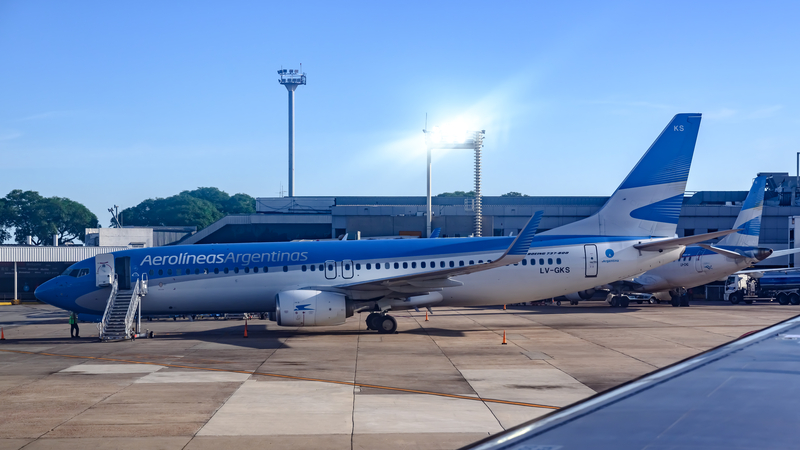
Aerolíneas Argentinas (AR) is stretching the Boeing 737 MAX 8 close to the edge of its long-haul envelope this summer with three unusual one-stop services linking regional Argentina directly to Miami (MIA) via Punta Cana (PUJ). Timed to capture peak demand around the World Cup period, the routes clock in at up to 13 hours block time, including ground time in the Dominican Republic.

For narrowbody enthusiasts, this is a fascinating deployment of the MAX. For network planners, it’s a low-risk seasonal extension of existing services to PUJ, converted into a U.S.-bound product without committing widebody lift.
The Three Routes: ROS, COR, and TUC to MIA via PUJ
Aerolíneas already operates nonstop flights from:
Read our stories in your inbox
Two aviation newsletters. Zero fluff.
-
Rosario (ROS) to Punta Cana (PUJ)
-
Córdoba (COR) to Punta Cana (PUJ)
-
Tucumán (TUC) to Punta Cana (PUJ)
For summer 2026, those flights are being extended onward to Miami (MIA), creating a through itinerary on a single aircraft.
Here’s how they stack up:
✈ Rosario (ROS) – Punta Cana (PUJ) – Miami (MIA)
-
Max block time: 13h 10m
-
Distance: 3,898 nm (7,219 km)
-
Operating period: June 9 – August 2
-
Frequency: 3x weekly
-
Arrival MIA: 11:45 pm
-
Departure MIA: 2:15 am
✈ Córdoba (COR) – Punta Cana (PUJ) – Miami (MIA)
-
Max block time: 12h 40m
-
Distance: 3,782 nm (7,004 km)
-
Operating period: June 8 – July 29
-
Frequency: 2x weekly
-
Arrival MIA: 12:20 am
-
Departure MIA: 2:15 am
✈ Tucumán (TUC) – Punta Cana (PUJ) – Miami (MIA)
-
Max block time: 12h 15m
-
Distance: 3,511 nm (6,502 km)
-
Operating period: June 11 – August 1
-
Frequency: 2x weekly
-
Arrival MIA: 11:45 pm
-
Departure MIA: 2:15 am
Block times appear lengthy largely because they include the refueling stop and crew change in PUJ. The stop is operational only; there are no traffic rights between PUJ and MIA for local passengers.
The Aircraft: Boeing 737 MAX 8 at Long-Range Limits
Aerolíneas Argentinas operates 15 Boeing 737 MAX 8s, typically configured with:
-
8 Business Class seats
-
162 Economy seats
-
170 seats total
That relatively modest seat count helps range performance, as lighter payload allows more fuel margin—critical when operating sectors that approach the upper limit of the MAX 8’s capabilities.
The MAX 8’s published maximum range is roughly 3,550–3,700 nautical miles depending on configuration and conditions. By splitting the journey into two sectors—Argentina to PUJ (~8 hours), then PUJ to MIA (~2 hours)—Aerolíneas stays within realistic operational envelopes without resorting to widebody equipment.
Passengers won’t find seatback screens onboard. Instead, content streams to personal devices via the airline’s onboard Wi-Fi portal.
Why Punta Cana Makes This Possible
The strategic lever here is Punta Cana.
PUJ is:
-
A high-demand leisure market for Argentine travelers
-
A natural fuel and crew stop
-
Operationally positioned to bridge South America and Florida
By extending flights that already exist into a one-stop Miami service, Aerolíneas avoids launching an entirely new U.S. route from ROS, COR, or TUC. That reduces commercial and operational risk.
It’s a classic “extend the leg” model—similar in concept to how some airlines seasonally tag on additional destinations to maximize aircraft utilization during peak demand windows.
Demand Reality: Only Córdoba Has Depth
Looking at pre-World Cup traffic data:
-
Córdoba–Miami: ~55,000 round-trip passengers annually
-
Rosario–Miami: ~15,000
-
Tucumán–Miami: ~7,000
Only Córdoba represents meaningful sustained traffic. The others are thin and likely wouldn’t support year-round nonstop service to MIA under normal market conditions.
This is clearly a seasonal, event-driven capacity play rather than a structural network shift.
Interestingly, Mendoza (MDZ), with roughly 29,000 Miami passengers annually, is not included in this extension—primarily because Aerolíneas does not operate MDZ–PUJ service.
Narrowbody Marathon Flights: A Growing Trend?
These routes join a small but growing club of ultra-long narrowbody one-stop operations. Recently, Boliviana de Aviación (BoA) operated Santa Cruz (VVI) – Panama City (PTY) – Washington Dulles (IAD) with a Boeing 737-800 during peak periods—another example of stretching single-aisle aircraft for diaspora-heavy demand.
While these operations are technically feasible, they are:
-
Highly seasonal
-
Dependent on fuel pricing and payload conditions
-
Vulnerable to headwinds and weather variability
-
Best suited for short-term demand spikes
They are rarely permanent fixtures of long-haul strategy.
Bottom Line
Aerolíneas Argentinas is launching three unusual one-stop services from Rosario (ROS), Córdoba (COR), and Tucumán (TUC) to Miami (MIA) via Punta Cana (PUJ) using its Boeing 737 MAX 8 fleet. With block times reaching 13 hours, these routes push the narrowbody close to its operational limits but avoid widebody risk through a strategic stop in the Dominican Republic. Designed to capitalize on peak World Cup demand, the flights are a clever seasonal extension rather than a long-term shift—and a reminder that with careful planning, even a single-aisle jet can cross surprisingly long distances.
Keep reading FlyMag
Get the Daily Brief in the morning or the Route Watch weekly recap on Fridays. Or both.
Share this story
Composed for each network — click to share, or copy the composed text for your own timing.