St. Helena’s commercial air link has been abruptly curtailed after St. Helena Airport (HLE) was downgraded from Category 6 firefighting cover, a move the island’s aviation authorities tied to concerns over fire-service readiness. The change immediately impacts Airlink’s scheduled operation—the island’s only regular commercial service—because Airlink’s aircraft type and passenger load require a level of rescue-and-firefighting capability that HLE can’t currently certify.

For a remote British Overseas Territory where aviation is not a convenience but critical infrastructure, the operational consequence is outsized: fewer options for travelers, tighter freight capacity, and renewed vulnerability to weather and shipping timelines. It’s a reminder that on small islands, the limiting factor is often not runway length or terminal space, but RFFS (Rescue and Fire Fighting Services) capability.
What changed at HLE, and why Category 6 matters
Airport “category” in this context is shorthand for how much firefighting and rescue capability is available on the airfield—primarily driven by aircraft size, fuselage length, and the volume of water/foam and response coverage required. Category 6 generally supports narrowbody regional jets and certain mid-size aircraft types; dropping below that can restrict or outright prevent commercial operations, regardless of whether the runway and navigation infrastructure remain serviceable.
Read our stories in your inbox
Two aviation newsletters. Zero fluff.
HLE was downgraded following technical assessments that reduced confidence in the readiness of airport fire tenders. The airport has since secured Category 4 status, which keeps the island from being completely cut off by air—but Category 4 is not a like-for-like substitute for commercial service. It typically supports smaller aircraft and essential movements, including medical evacuation flights, while leaving scheduled airline operations constrained until full cover is restored.
Airlink’s role: the only scheduled commercial operator into HLE
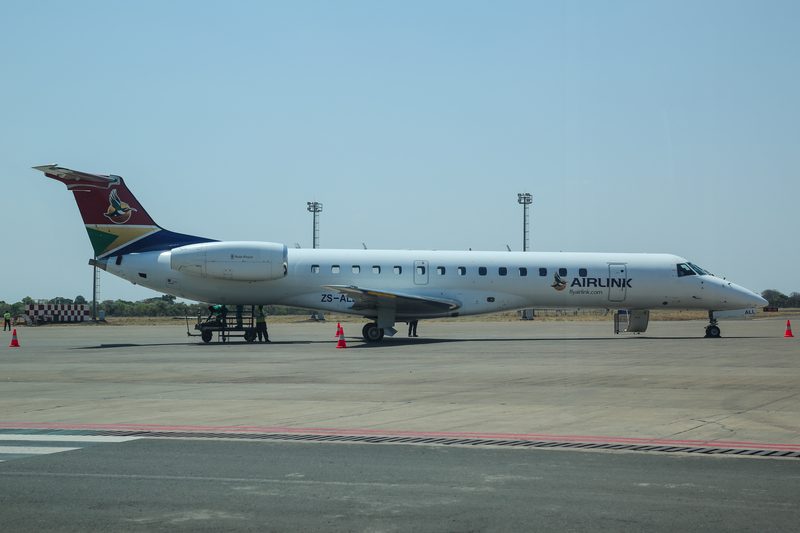
Airlink is the sole airline providing regular passenger access to St. Helena (HLE), operating a weekly service from Johannesburg O.R. Tambo (JNB). Airlink also runs a monthly extension onward to Ascension Island (ASI)—a crucial link in its own right given Ascension’s limited civilian access pathways.
The scheduled operation is typically flown with the Embraer E190 (often referenced as the E190-100IGW in historical HLE service documentation). In practical terms, the E190 is the perfect “right-sized” aircraft for St. Helena: large enough to move meaningful passenger volumes and belly freight, small enough to operate economically on a long oceanic sector, and agile enough for an airport environment that can be operationally demanding.
But that same aircraft sizing is exactly why the firefighting category matters: an E190-level operation generally can’t continue under Category 4 fire cover. That’s why a fire-service downgrade becomes a commercial shutdown, even if the aircraft itself is mechanically fine and the weather is good.
What happens now: suspended schedules, limited operations, and a moving restart window
Airlink has suspended commercial flying to HLE under the current certification constraints. Reporting indicates services will remain paused until at least February 20, 2026, while local authorities work through restoration steps. St. Helena’s government has also stressed that cancellations have been handled in a controlled manner and that the airport’s Category 4 status preserves a minimal air bridge for critical needs, but not normal airline operations.

This is a key nuance for airline professionals: the difference between “airport closed” and “airport closed to scheduled commercial service” is enormous. With Category 4, you can still support mission-critical movements—particularly medevac—and you can maintain a baseline of operational readiness. But you cannot rebuild passenger demand or schedule integrity until the airport returns to a category that supports regular narrowbody jet operations.
The network and economic ripple effects on an island operation
On paper, losing one weekly flight might look minor. In reality, for St. Helena it affects multiple pillars simultaneously:
-
Tourism: visitor arrivals tend to be “lumpy” already, constrained by the limited schedule into HLE. A pause compounds that by forcing rebookings into uncertain windows.
-
Supply chain: even when the majority of freight arrives by sea, airlift often carries time-sensitive cargo—medical items, critical parts, high-value goods—where delays are disproportionately painful.
-
Community mobility: family travel, medical travel, and essential services are all tied to the reliability of that single commercial operator.
This is also why the firefighting category is such a hard constraint. You can add staff, adjust schedules, or charter lift—but you cannot bypass certification without changing aircraft size or mission profile, and even then, only within what the airport can safely support.
Looking ahead: Cape Town seasonal service still on the books
Airlink is scheduled to add a weekly seasonal service from Cape Town (CPT) to St. Helena (HLE) between December 2026 and March 2027, a notable expansion that would diversify St. Helena’s access beyond the JNB gateway—assuming HLE maintains the necessary operational category and reliability to support additional demand and rotations.
That planned growth is also a reminder of the island’s longer arc. St. Helena only received its first commercial flight in October 2017, and since then air access has been central to reshaping tourism, logistics, and the island’s practical connectivity. A temporary downgrade doesn’t erase that trajectory—but it does show how fragile it can be when key safety systems are the gating factor.
Bottom Line
St. Helena has effectively lost scheduled commercial air service after St. Helena Airport (HLE) was downgraded from Category 6 due to fire-cover concerns, forcing Airlink to suspend its weekly Johannesburg (JNB)–HLE operation and the monthly extension to Ascension Island (ASI). The airport’s move to Category 4 keeps a limited lifeline open—particularly for smaller aircraft and medevac—but it doesn’t support normal commercial flying for Airlink’s Embraer E190 service. The near-term focus is restoring full operational readiness so scheduled flights can resume, with the next restart window tied to reattaining the firefighting category required for regular passenger operations.
Keep reading FlyMag
Get the Daily Brief in the morning or the Route Watch weekly recap on Fridays. Or both.
Share this story
Composed for each network — click to share, or copy the composed text for your own timing.