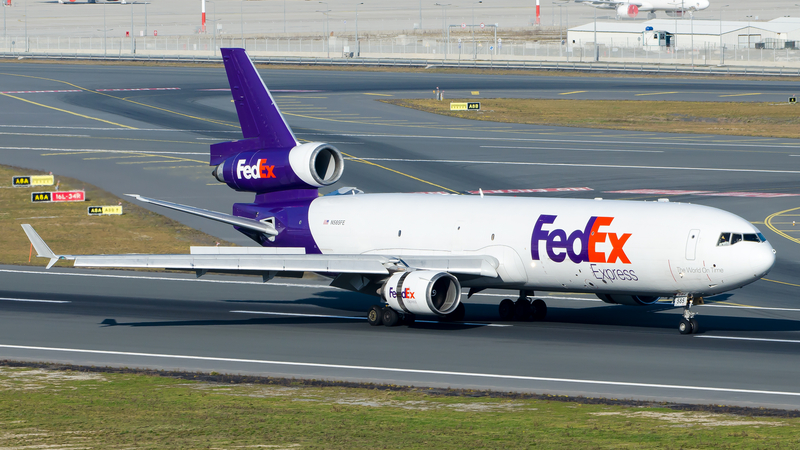
A FedEx McDonnell Douglas MD-11F overran Runway 26R while landing at Miami International Airport (MIA) on Wednesday evening, closing most of the airport’s runway system and prompting the Federal Aviation Administration to stop Miami-bound departures at their origins.
The aircraft was operating FedEx Flight 910 from Memphis (MEM). In an initial statement, MIA placed the overrun at approximately 8:40 p.m. local time on November 25 and said Miami-Dade Fire Rescue had responded. No injuries were reported.
All but one of MIA’s runways were initially closed. The airport advised passengers traveling Wednesday night to check their flight status with their airline before leaving for the terminal.
Read our stories in your inbox
Two aviation newsletters. Zero fluff.
FAA Ground Stop Followed by Single-Runway Operations
The FAA’s National Airspace System status showed a ground stop for flights bound for MIA, citing a disabled aircraft on a runway. The measure covered departures handled by the Atlanta, Washington, Houston, Jacksonville, Fort Worth, Miami, Memphis and Indianapolis air route traffic control centers.
The ground stop’s event window began at 8:16 p.m. Eastern and was extended to 10:30 p.m., with the FAA listing a medium probability of a further extension. At one stage, the agency reported average delays of 47 minutes and a maximum delay of two hours for affected flights.

Departures from Miami began moving again while restrictions on inbound traffic remained in place. Later FAA traffic-management information showed MIA operating with a single runway, supported by miles-in-trail restrictions on several arrival flows. The agency’s restrictions page continued to list single-runway operations into early Thursday.
The disruption came on the night before Thanksgiving, when MIA’s passenger schedule and South Florida’s cargo operations were carrying elevated holiday demand. Restricting an airport with four runways to one arrival and departure surface sharply reduces acceptance rates, while diversions and extended airborne holding can complicate the recovery long after movements resume.
South Florida traffic was already constrained before the overrun. The FAA’s November 25 air traffic report warned that thunderstorms could delay flights at Miami and Fort Lauderdale, and Command Center advisories had anticipated weather-related ground stops or delay programs. The disabled aircraft, however, was the reason given for the later MIA ground stop. No cause for the runway excursion has been established.
WATCH: Close-up footage shows the FedEx cargo plane that overran the runway at Miami International Airport.
VIA: @newsnoteworthy https://t.co/Ge6dLQSvpn
— Breaking911 (@Breaking911) November 26, 2026

Aircraft Identified as N605FE
MIA’s operational flight feed identified Flight 910 as an MD-11F registered N605FE. The aircraft was listed on the Memphis-Miami sector with a scheduled arrival shortly after 7 p.m.

The FAA aircraft registry records N605FE as a 1992-built McDonnell Douglas MD-11F owned by Federal Express. The trijet is powered by General Electric CF6-80-series engines.
The MD-11 remains one of FedEx’s largest freighters. The company’s 2026 annual filing gives the type a maximum gross structural payload of 192,600 pounds, between the Boeing 777F and 767F in FedEx’s fleet. On a domestic sector such as Memphis-Miami, the aircraft provides high-volume lift rather than being selected for the long-range capability that once made it a mainstay of intercontinental cargo operations.
Runway 26R is MIA’s northern parallel runway. The current FAA chart supplement lists it as an 8,600-foot by 150-foot grooved asphalt surface, with 8,600 feet of landing distance available. Its western end lies within a runway complex where an immobilized widebody can affect access to other movement areas even when it does not physically occupy each runway.
MD-11 Fleet Had Returned After FAA Inspections
The incident comes months after FedEx began returning its MD-11 fleet to commercial operation following a fleetwide grounding. The FAA issued an emergency airworthiness directive in November 2025 after the left engine and pylon separated from a UPS MD-11 during takeoff at Louisville. The directive prohibited further flights until inspections and any required corrective work were completed using an FAA-approved method.
FedEx said in its September 2026 quarterly filing that it began returning MD-11s to active commercial service in May and that most of the fleet was back in operation by September 30. Nothing released about the Miami overrun indicates any connection between Wednesday’s landing excursion and the engine-pylon issue addressed by the directive.
FedEx reported 29 MD-11s in its fleet at the end of May 2026 after retiring five examples during the fiscal year. Although the carrier has added Boeing 767Fs and 777Fs, it has extended its planned phaseout of the remaining MD-11 fleet to the end of 2032, preserving a substantial block of high-capacity lift while moderating near-term aircraft spending.
Investigation to Focus on the Landing Sequence
The FAA said it would investigate the incident. Early information establishes the flight, aircraft, runway and operational consequences, but does not establish why the MD-11 failed to stop on the paved surface.
Investigators will reconstruct the approach and touchdown, aircraft configuration, braking and reverse-thrust response, runway condition, wind and precipitation at the time of landing. Aircraft loading and the precise point at which N605FE crossed the runway end will also be central to determining the stopping performance available to the crew.
The timing of the overrun magnified its network effect. MIA is both a major passenger gateway and an important cargo station, and the loss of three runways during an evening holiday bank quickly propagated to flights waiting at airports across the eastern and central United States.
Bottom Line
The immediate operational priority is recovering runway capacity without interfering with the aircraft examination and removal process. Single-runway operations can sustain a limited schedule, but they leave little resilience for further weather, equipment or traffic-flow constraints. Airlines with late-night aircraft and crews displaced by the stop may carry disruption into Thanksgiving morning even after the airport restores additional pavement.
For FedEx, the event places one of its remaining MD-11s under renewed scrutiny only months after the fleet returned from FAA-mandated inspections. There is no evidence linking the Miami overrun to the issue behind the earlier grounding, and the investigation must treat the landing excursion on its own facts. What matters next is whether N605FE sustained significant structural, landing-gear or engine damage and how long the aircraft and Runway 26R remain unavailable.
The broader fleet question is capacity. FedEx still depends on the MD-11 for payload that its much larger 767 fleet cannot match, while 777F deliveries offer only a gradual replacement path. Any prolonged loss of individual MD-11s during peak shipping periods tightens that high-capacity segment of the network, increasing the importance of aircraft rotation, spare coverage and the pace of fleet modernization.