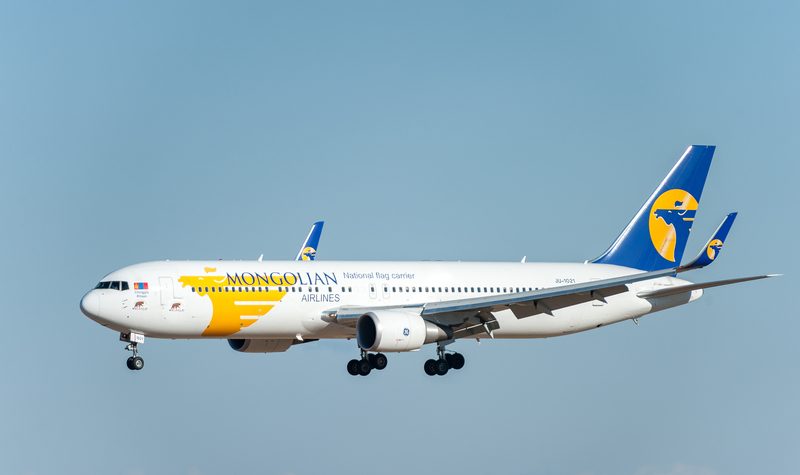
MIAT Mongolian Airlines is targeting 2028 for the start of nonstop flights between Mongolia and the United States, subject to the country securing a Category 1 rating under the Federal Aviation Administration’s International Aviation Safety Assessment program.
The timetable was set out during a Mongolian government delegation’s visit to the United States and confirmed in a November 24 statement from MIAT. The delegation, led by Road and Transport Minister Borkhuu Delgersaikhan, also visited Boeing’s Customer Experience Center in Seattle, where MIAT and the manufacturer signed a memorandum of understanding covering expanded cooperation.
MIAT said Mongolia’s civil aviation sector intends to reach Category 1 during 2027, clearing a central regulatory hurdle for the airline to begin US operations the following year. Boeing told the delegation it was prepared to support both MIAT and the Mongolian civil aviation authority as they work toward that objective.
Read our stories in your inbox
Two aviation newsletters. Zero fluff.
FAA Rating Is the Critical Step
The proposed service is not waiting on bilateral traffic rights. The United States and Mongolia signed an air transport agreement in August 2023 that permits airlines from either country to operate passenger and cargo services without bilateral restrictions on capacity, frequency or aircraft type.
The agreement provides Mongolian airlines with broad authority to serve points in the United States, subject to the carriers obtaining the required safety, security and economic approvals. Its open route provisions also allow intermediate and beyond points, code-sharing arrangements and changes of aircraft.
Category 1, however, is required before a Mongolian carrier can apply for the FAA operations specifications needed to conduct commercial service with its own aircraft. The rating applies to the state’s aviation safety oversight system rather than to MIAT alone. It indicates that the national regulator licenses and supervises airlines in accordance with International Civil Aviation Organization standards.
The FAA’s assessment criteria cover the regulator’s legislation, organization, technical expertise, inspector training, enforcement processes and continuing surveillance of operators. A foreign carrier must come from a Category 1 state before it can seek Part 129 operations specifications, alongside US Department of Transportation economic authority and any required Transportation Security Administration program.
Mongolia began a more structured push toward that rating in February 2026, when the US Trade and Development Agency agreed to finance technical assistance for the Mongolia Civil Aviation Authority. The USTDA program, carried out by Washington-based Wicks Group Consulting, includes on-site gap analysis, a corrective action plan and training intended to address areas of noncompliance with ICAO standards.
MIAT has separately obtained FAA Part 145 approval for its maintenance organization, according to the airline’s corporate history. That certification supports maintenance activity under US rules, but it is distinct from the country-level IASA rating and the operational approvals required to fly scheduled services to the United States.

Boeing Agreement Covers Fleet Development
The memorandum signed in Seattle is a cooperation framework rather than a disclosed firm aircraft order. MIAT said talks covered its long-term development strategy, the global air transport outlook and the capabilities of Boeing’s 737 and 787 families, including production technology and cabin configurations.
The discussions connect two different parts of MIAT’s fleet plan. Boeing 737 aircraft support regional growth across East and Central Asia, while the Boeing 787-9 is the type positioned to operate the planned US route from Ulaanbaatar Chinggis Khaan (UBN).
MIAT took delivery of a second Boeing 737-8 MAX, named Ogedei Khaan, on November 25, one day after announcing the memorandum. The additional narrowbody expands a fleet that also includes Boeing 737-800s, a Boeing 767-300ER, two Boeing 787-9s, regional Bombardier CRJ-700s and a Boeing 757 freighter.
The airline’s two 787-9s are configured with 292 seats: 30 in business class and 262 in economy. MIAT lists a range of 14,010 kilometers for the aircraft, while Boeing’s current standard specification gives the 787-9 a maximum range of up to 8,300 nautical miles, or 15,370 kilometers.

That performance makes the type suitable for nonstop flying from Mongolia to the US West Coast while retaining a lower seat count than larger long-haul widebodies. Boeing and MIAT had already identified the West Coast as part of the Dreamliner strategy when the manufacturer announced the airline’s original 787 plan in 2019.
The 787 program was delayed by the pandemic, but MIAT eventually received its first aircraft in August 2023 and its second in April 2024. The airline currently deploys the type on long-haul and high-demand international services, and has consistently identified eventual US operations as one of the fleet’s intended uses.
Bottom Line
The 2028 target gives Mongolia a defined regulatory sequence rather than an immediate route launch. The bilateral agreement has already removed the principal government-to-government market restrictions; the remaining work is concentrated in safety oversight, security approval and MIAT’s own US certification. Progress toward Category 1 during 2027 will therefore be a more meaningful indicator than early route announcements or tentative schedules.
Fleet depth will be the other test. Two Boeing 787-9s give MIAT the range and cabin size to enter the US market, but they also support the carrier’s existing long-haul network. A scheduled transpacific operation needs enough spare coverage to absorb maintenance events without destabilizing European and Asian flying. The Boeing memorandum creates a channel for technical and fleet planning, but any additional widebody commitment would materially strengthen the credibility of the 2028 timetable.
If the regulatory program remains on schedule, MIAT could become the first Mongolian airline to operate its own aircraft to the United States. The route would also mark the 787 fleet’s transition from regional and European expansion into the strategic role for which MIAT originally selected it: opening markets that were not practical with the airline’s older widebodies.