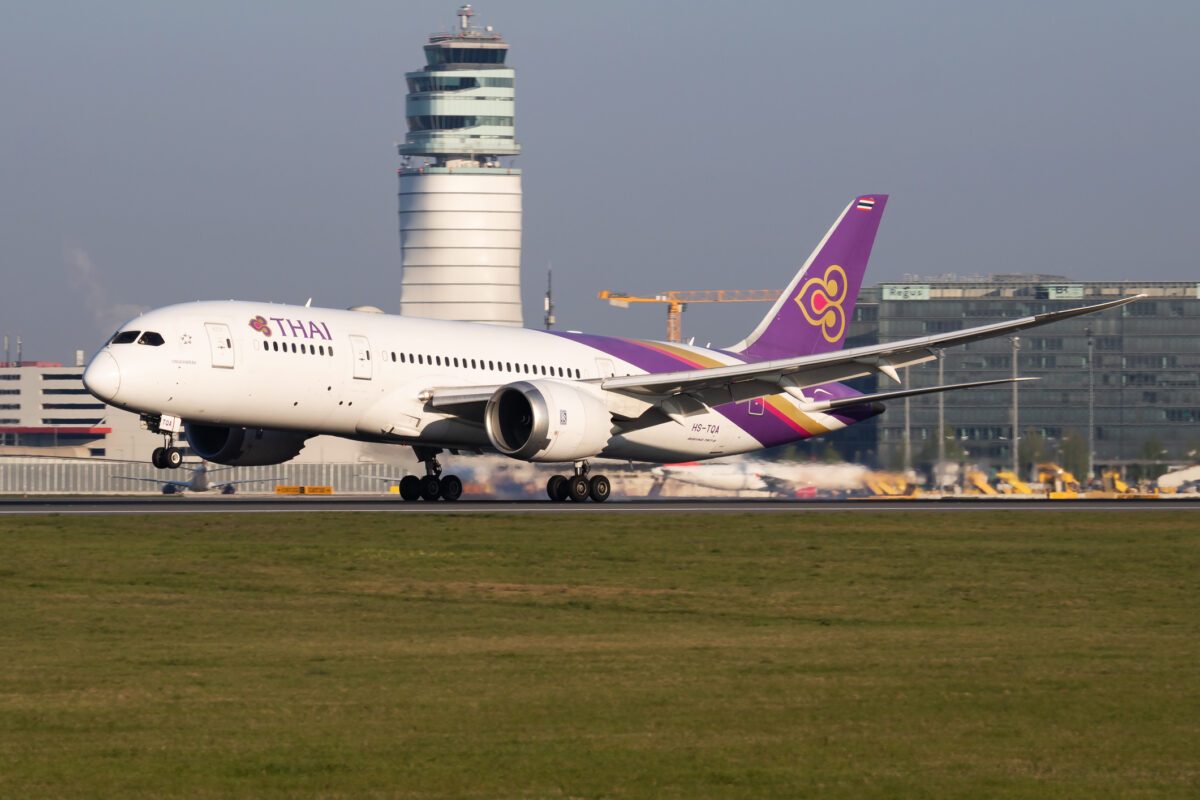
Thai Airways will add a sixth daily flight between Bangkok Suvarnabhumi (BKK) and Singapore Changi (SIN) from February 1, 2027, increasing its schedule on the route from 35 to 42 weekly services in each direction.
The new rotation will be operated by an Airbus A321neo. Flight TG411 will leave BKK at 6:30 a.m. and arrive at SIN at 10 a.m. The aircraft will return as TG412, departing Singapore at 11 a.m. and reaching Bangkok at 12:20 p.m. All times are local.
Thai Airways is already promoting TG411 and TG412 as its new Singapore service. Current schedule data shows the additional daily flight operating from February 1 through March 27, the final day of the 2026-27 northern winter timetable.
Read our stories in your inbox
Two aviation newsletters. Zero fluff.
New Flight Builds Morning Capacity
The additional rotation strengthens Thai Airways’ morning schedule rather than opening a substantially different travel window. TG411 will depart Bangkok 75 minutes before TG403, while the Singapore departure will leave 85 minutes before TG404.
For Bangkok-originating passengers, the 6:30 a.m. departure provides the earliest Thai Airways arrival in Singapore. It also creates an additional morning connection from the airline’s long-haul and regional network at BKK, although the timing will favor passengers already at the airport or arriving on early inbound services.
From Singapore, the 11 a.m. departure fills the gap between Thai Airways’ early TG402 service and its lunchtime TG404 flight. The resulting timetable distributes six departures across the day in each direction:
- Bangkok to Singapore: 6:30 a.m., 7:45 a.m., 11:10 a.m., 2:40 p.m., 4:35 p.m. and 6:45 p.m.
- Singapore to Bangkok: 8:15 a.m., 11 a.m., 12:25 p.m., 3:55 p.m., 7:15 p.m. and 9 p.m.
The new frequency represents a 20% increase in departures. The A321neo will add 1,225 seats per week in each direction, or 2,450 across the round trip, before accounting for any other aircraft substitutions within the schedule.
Half of the Schedule Will Use the A321neo
Thai Airways’ planned February aircraft mix consists of three daily Airbus A321neo flights, two Airbus A350-900 flights and one Boeing 787-8 flight in each direction. Narrow-body and wide-body departures will therefore be evenly split, with each accounting for 21 weekly services.
The added frequency underlines the role assigned to the A321neo in Thai Airways’ regional network. The airline configures the aircraft with 175 seats: 16 in Royal Silk Business Class and 159 in Economy Class. Its business cabin has fully flat seats, giving Thai Airways a more consistent premium proposition than is typically found on a narrow-body aircraft operating a sector of this length.
The additional rotation alone will provide 112 Royal Silk seats per week in each direction. Its smaller gauge also allows Thai Airways to increase schedule depth without adding the capacity of another 300-seat wide-body flight.
That distinction matters on a route where frequency is valuable to business travelers and connecting passengers. The A321neo gives the airline more departure choices while retaining the larger A350 and 787 aircraft on three daily rotations for higher-volume travel periods and connecting traffic.
Singapore Was the A321neo’s Launch Route
Singapore has been central to Thai Airways’ A321neo deployment from the start. The airline’s first aircraft, HS-TOA, entered commercial service on the Bangkok-Singapore route as TG413 in January 2026. Thai Airways said the aircraft was the first of 32 A321neos planned for its fleet.
The type is powered by CFM International LEAP-1A engines. Thai Airways says its cabin includes fully flat Royal Silk seats, 4K inflight-entertainment screens throughout the aircraft and larger overhead bins. The airline described the aircraft as a tool for improving both fleet efficiency and its product on strategic Asia-Pacific routes when it accepted its first example in December 2025.
The fleet has since expanded quickly. Thai Airways reported taking four more A321neos during the third quarter of 2026 as part of a broader intake of narrow-body and wide-body aircraft. The airline said those deliveries were intended to support short- and medium-haul operations in its November 2026 operating update.
The February schedule shows how that fleet growth is changing the network. Thai Airways previously relied heavily on wide-body aircraft between Bangkok and Singapore. It can now combine higher frequency with a premium-equipped narrow-body while retaining wide-body capacity where demand justifies it.
Thai Airways Closes the Frequency Gap
The sixth daily flight also narrows Thai Airways’ frequency gap with Singapore Airlines. Singapore Airlines increased its own Bangkok schedule to as many as seven daily services from March 2026, according to the carrier’s network adjustment announcement.
Both airlines use Bangkok and Singapore as major connecting points, making departure timing as important as local demand. Thai Airways’ expanded schedule offers more options for passengers connecting at BKK to domestic Thailand, South Asia, Europe and other parts of its regional network.
The additional service is presently concentrated in the final eight weeks of the northern winter season. As with any schedule published several months before operation, aircraft assignments and operating dates remain subject to adjustment.
Bottom Line
Thai Airways is using frequency, rather than a simple return to all-wide-body flying, to rebuild its position between Bangkok and Singapore. Six daily departures give the airline a more competitive timetable and create additional connecting opportunities at BKK, while the 175-seat A321neo limits the capacity risk attached to opening another rotation.
The aircraft mix is equally significant. By assigning half of the schedule to the A321neo and half to the A350 and 787, Thai Airways can offer narrow-body economics without withdrawing wide-body capacity from the route. The fully flat Royal Silk cabin also reduces the product compromise normally associated with moving regional services to single-aisle aircraft.
The next development to watch is whether the sixth flight survives beyond March 27 or returns in a later schedule season. An extension would indicate that Thai Airways sees six daily frequencies as a sustainable competitive requirement rather than a temporary winter deployment made possible by the rapid arrival of additional A321neos.