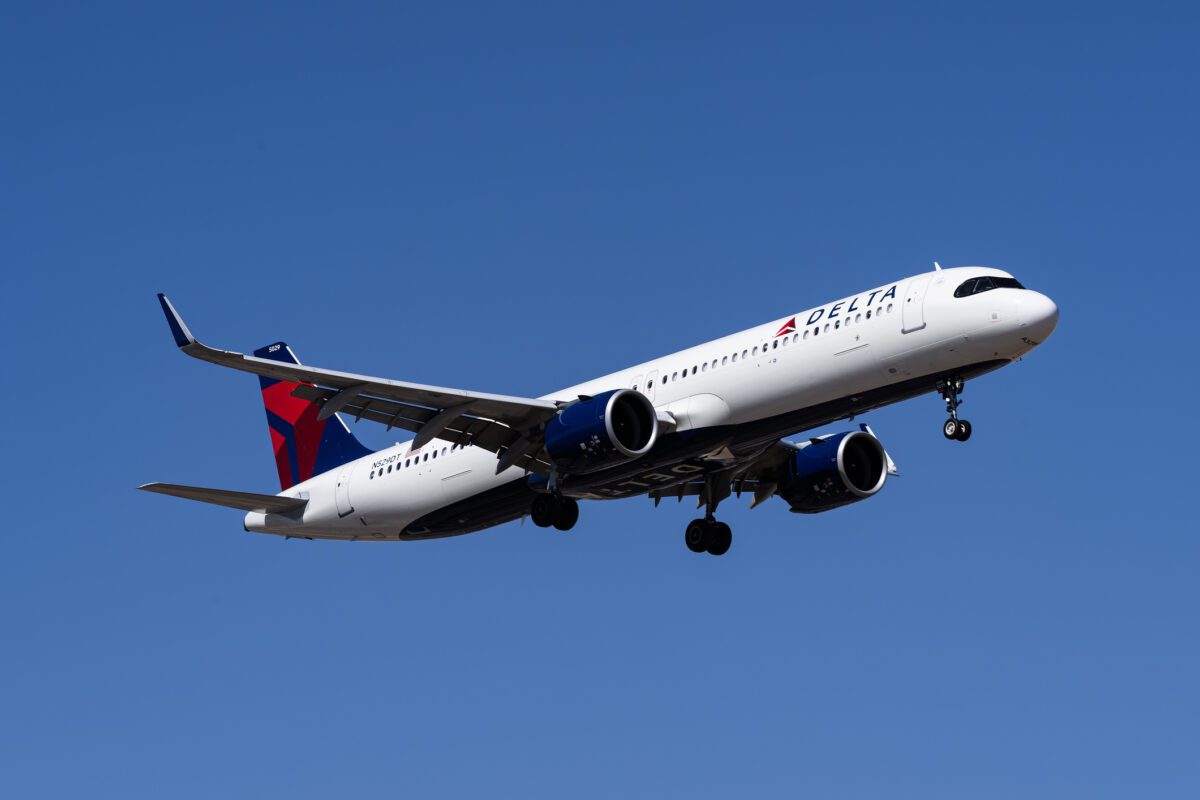
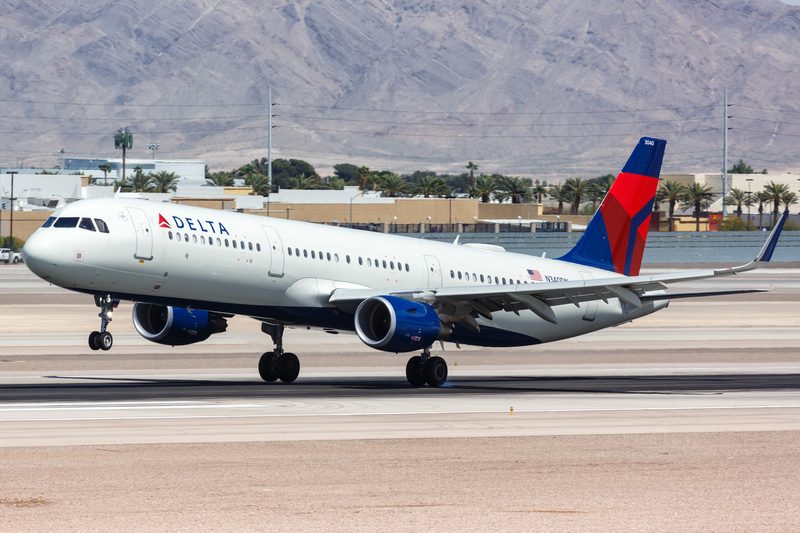
Delta Air Lines is extending one of the most unusual narrowbody configurations in its fleet, keeping its 44-seat First Class Airbus A321neo on daily flights between Hartsfield-Jackson Atlanta International Airport (ATL) and Harry Reid International Airport (LAS) through at least April 11, 2027.

The specially configured aircraft, identified by Delta as the 3NP, carries only 164 passengers despite being the same Airbus A321neo that accommodates 194 passengers in Delta’s standard configuration.
The difference is almost entirely at the front of the aircraft. Instead of the usual 20 Delta First seats, the 3NP has 44 First Class seats spread across 11 rows.
Read our stories in your inbox
Two aviation newsletters. Zero fluff.
Delta originally described the configuration as a temporary solution while seven new A321neos wait for their intended lie-flat premium cabins. Its continued deployment well into spring 2027 means passengers traveling between Atlanta Airport (ATL) and Las Vegas Airport (LAS) will have an unusually large number of First Class seats available for several more months.
Daily Atlanta–Las Vegas Flights Begin November 9
Delta plans to place the premium-heavy A321neo on one daily round trip beginning November 9, 2026.
The current schedule for Flight DL777 is:
DL777: Hartsfield-Jackson Atlanta International Airport (ATL) 8:05 a.m. – Harry Reid International Airport (LAS) 9:37 a.m.
DL777: Harry Reid International Airport (LAS) 11:00 a.m. – Hartsfield-Jackson Atlanta International Airport (ATL) 5:49 p.m.
All times are local.
The westbound flight is scheduled for approximately four hours and 32 minutes, while the eastbound return takes just under four hours after accounting for the three-hour time difference.
Earlier schedule filings had only shown the 164-seat aircraft on the route from November 9 through December 18. The latest schedule now extends the unusual configuration through April 11, 2027.
That puts the aircraft on the route through Thanksgiving, Christmas and New Year travel, the winter convention season and much of the busy spring travel period.
Nearly 27% of the Entire Aircraft Is First Class
The most striking aspect of the 3NP is not simply that it has more First Class seats. It is how much of the aircraft is devoted to them.
Delta’s official A321neo seat map lists the 164-seat configuration as:
- 44 Delta First
- 54 Delta Comfort
- 66 Delta Main
First Class alone represents approximately 26.8% of every seat on the aircraft.
Add Delta Comfort and 98 of the aircraft’s 164 seats—or almost 60%—are outside the standard Main Cabin.
That is extraordinary for a domestic narrowbody.
By comparison, Delta’s conventional 194-seat A321neo has 20 First Class seats. The 3NP therefore provides 120% more First Class capacity on each flight.
A daily round trip between Atlanta Airport (ATL) and Las Vegas Airport (LAS) creates 308 First Class seats in each direction every week, compared with only 140 if Delta used a conventional 20-seat A321neo.
For Medallion members hoping for a complimentary upgrade, those extra 24 seats can materially change the odds.
Why Does Delta Have an A321neo With 44 First Class Seats?
Interestingly, Delta never intended the 44-seat cabin to become a permanent aircraft configuration.
The airline announced in February that seven newly delivered Airbus A321neos were supposed to receive a new premium interior containing lie-flat suites. Supply-chain delays prevented those seats from being installed on schedule.
Rather than leave seven brand-new aircraft parked while waiting for the intended seats, Delta developed an interim layout.
“We chose to implement a creative solution,” Delta Vice President of Customer Experience Design Mauricio Parise said when the aircraft were announced.
The result was 11 full rows of conventional domestic First Class.
Delta’s original announcement for the 44-seat A321neos said the unusual aircraft would enter service beginning in May 2026 and initially focus on longer routes from Atlanta Airport (ATL) to Los Angeles International Airport (LAX), San Francisco International Airport (SFO), Seattle-Tacoma International Airport (SEA) and San Diego International Airport (SAN).
Las Vegas was not originally among the primary routes.
Its addition—and now extension into April—shows Delta is willing to move the seven-aircraft subfleet around its domestic network while the jets remain in their temporary configuration.
These Are Regular First Class Seats, Not Lie-Flat Beds
With 44 premium seats on one narrowbody, passengers could easily assume the aircraft offers something resembling Delta One.
It does not.
The 3NP currently uses Delta’s conventional domestic First Class seat.
Delta lists the seat at 21 inches wide with 38 inches of pitch. Passengers receive substantially more personal space than in Economy, dedicated overhead bin space, priority airport services and upgraded food and beverage service.
According to Delta’s current First Class product information, passengers on longer domestic flights can receive a full meal along with complimentary beer, wine and spirits.
Every cabin aboard the A321neo also includes seatback entertainment, USB power, electrical outlets and Wi-Fi.
The eventual configuration planned for these seven aircraft is a very different product. Delta says the temporary First Class seats will ultimately be replaced with flatbed suites, although it has not announced exactly when each aircraft will be converted.
That makes the current 44-seat arrangement something of an aviation oddity: a temporary cabin created because the aircraft arrived before the seats that were originally supposed to go inside it.
Las Vegas Is a Logical Market for 44 First Class Seats
Las Vegas Airport (LAS) may initially look like an unusual place for such a premium-heavy aircraft. The city is overwhelmingly associated with leisure travel.
But Las Vegas is not exclusively a low-fare vacation market.
The city hosts major conventions, corporate events, trade shows, professional sports, casino customers and entertainment traffic throughout the year. It also attracts a significant number of travelers willing to spend considerably more for convenience and comfort.
Atlanta–Las Vegas is also a relatively long domestic flight. At more than four hours westbound, the value difference between a standard Economy seat and a 38-inch-pitch First Class seat is much more noticeable than on a one-hour domestic segment.
For Delta, Harry Reid International Airport (LAS) is also a very large destination from its Atlanta Airport (ATL) hub. Multiple flights operate between the cities each day, allowing the airline to place the 44-seat aircraft on one departure while retaining conventional configurations on others.
That gives Delta a way to concentrate premium demand onto a particular schedule rather than adding 44 First Class seats to every Atlanta–Las Vegas flight.
The A321neo Carries 30 Fewer Passengers Overall
The premium cabin comes at a significant capacity cost.
Delta’s normal A321neo has 194 seats. The 3NP has only 164.
That means Delta sacrifices 30 total seats per departure, or approximately 15.5% of the aircraft’s normal passenger capacity.
The trade is intentional.
Instead of maximizing the number of travelers aboard the aircraft, Delta has allocated considerably more cabin floor space to passengers purchasing higher-priced tickets.
On a daily round trip, the 3NP removes 420 total one-way seats from the Atlanta–Las Vegas market each week compared with operating the standard 194-seat version.
But Delta gains another 336 First Class seats across both directions during the same period.
If those additional premium seats generate enough revenue, carrying fewer passengers can actually be more financially attractive than filling the aircraft with another 30 Economy customers.
That strategy reflects a broader trend across the U.S. airline industry as Delta, United and increasingly American focus heavily on premium revenue rather than competing solely on passenger volume.
Airbus A321neo Is Becoming Central to Delta’s Fleet
The unusual seven-aircraft subfleet is tiny compared with Delta’s overall A321neo operation.
As of June 30, 2026, Delta had 99 Airbus A321neos in service, according to its official A321neo fleet information.
The aircraft is powered by Pratt & Whitney geared turbofan engines and has become one of Delta’s most important fleet-renewal platforms.
Delta also exercised options for another 34 aircraft in February. Once existing commitments are fulfilled, the airline expects its A321neo fleet to grow to 189 aircraft.
The type is replacing older and less efficient narrowbodies while giving Delta considerably more flexibility to increase premium capacity on high-demand domestic routes.
Delta lists a cruising speed of 525 mph and a range of approximately 3,300 to 3,370 miles for its A321neo configurations, making Atlanta Airport (ATL)–Las Vegas Airport (LAS) a routine mission for the aircraft.
Bottom Line
Delta Air Lines is extending its unusual 164-seat Airbus A321neo on daily flights between Hartsfield-Jackson Atlanta International Airport (ATL) and Harry Reid International Airport (LAS) through at least April 11, 2027.
The aircraft begins its scheduled Las Vegas assignment on November 9.
Delta’s official configuration contains 44 First Class seats, 54 Delta Comfort seats and only 66 Delta Main seats. That means more than one-quarter of the entire aircraft is First Class, while nearly 60% of its seats are either First Class or extra-legroom Delta Comfort.
The 44-seat cabin was never intended to be permanent. Seven new A321neos received the unusual interior after supply-chain problems delayed the lie-flat suites Delta eventually plans to install.
Until those conversions begin, however, Delta has an aircraft with more than twice the normal number of domestic First Class seats—and Las Vegas passengers now have several more months to take advantage of it.