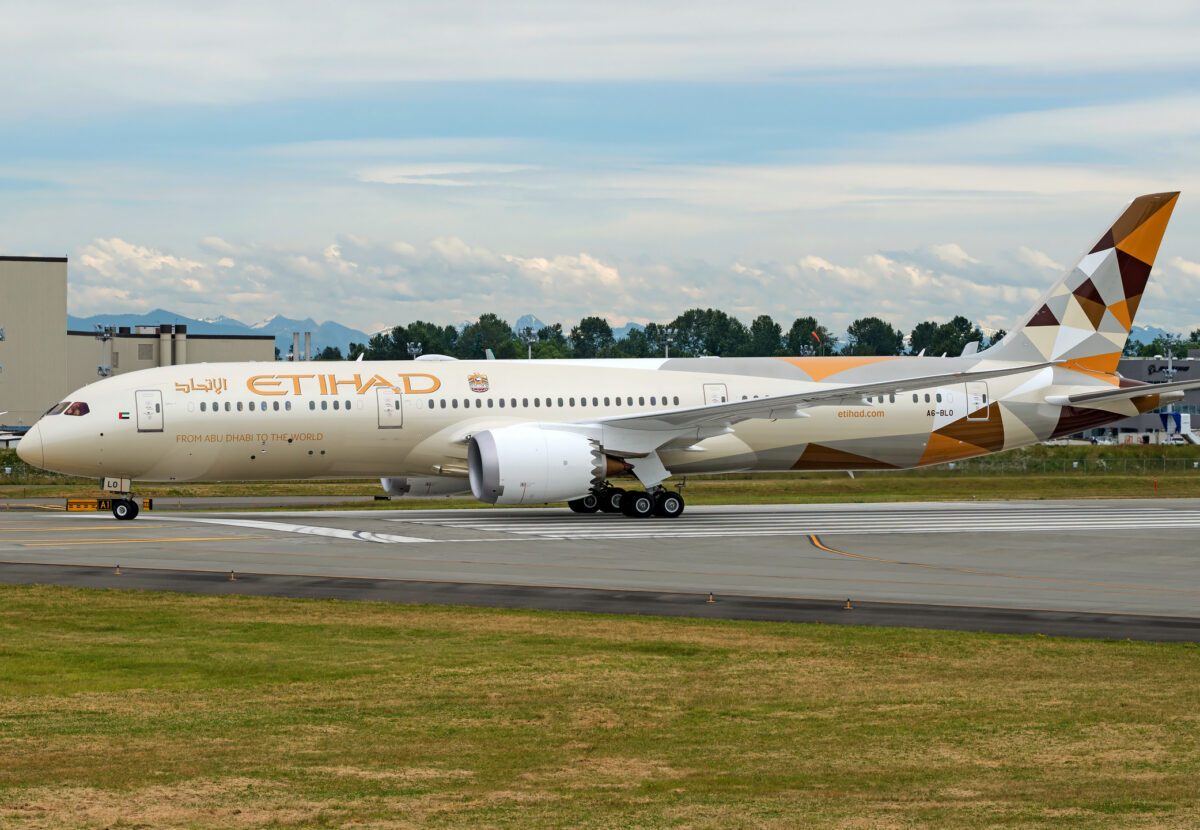
Etihad Airways began nonstop service between Abu Dhabi (AUH) and Calgary (YYC) on Sunday, October 25, opening the first direct air route between the Middle East and Western Canada.

The four-times-weekly service is operated with a Boeing 787-9 under flight numbers EY29 and EY30. Calgary becomes Etihad’s second Canadian destination after Toronto Pearson (YYZ), adding a western gateway to a Canadian network previously concentrated in Ontario.
The start came nine days earlier than the November 3 date in Etihad’s original route announcement. By October, the airline was identifying Calgary as a destination joining its network on October 25 in its official North American network material.
Read our stories in your inbox
Two aviation newsletters. Zero fluff.
A 14-Hour Link to Western Canada
Etihad’s current schedule provides four weekly frequencies, a measured entry into a long-haul market with no previous nonstop service. The airline’s Calgary booking page lists a journey of about 14 hours from YYC to AUH and a distance of approximately 7,185 miles, or 11,563 kilometers.

The route has significance beyond local Calgary-Abu Dhabi demand. AUH gives passengers from Alberta one-stop access to Etihad markets across India, Pakistan, Southeast Asia, the Gulf and Africa. In the opposite direction, Calgary provides access to Alberta’s energy sector and serves as the principal international gateway for Banff and the surrounding Canadian Rockies.
That connecting proposition will be important to the route’s performance. Four weekly flights are less convenient for purely local corporate traffic than a daily schedule, but they allow Etihad to concentrate passengers from a broad group of markets onto each departure. The airline can also test how much demand Calgary generates independently of Toronto.
The 787-9 Matches the Route
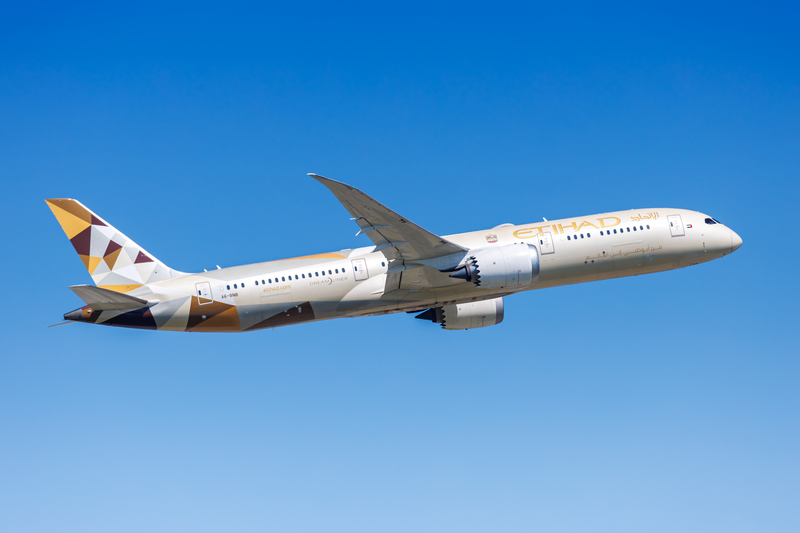
The Boeing 787-9 is a logical aircraft for a sector of this length. Boeing lists a maximum range of up to 8,300 nautical miles for the type, providing ample capability for the approximately 6,200-nautical-mile great-circle distance between the two cities. Its capacity is also better suited to developing a new long-haul market than the larger Boeing 787-10 or Airbus A380.
Etihad operates several 787-9 cabin layouts. Its newest two-class version accommodates 303 passengers, with 32 Business Suites and 271 Economy seats. The latest Etihad 787-9 interior places Business in a 1-2-1 arrangement, giving every passenger direct aisle access, while Economy uses the standard nine-abreast 3-3-3 layout.
The newer Business product includes fully flat beds, privacy doors and 17.3-inch 4K entertainment screens. Economy is fitted with 13.3-inch 4K screens, while the aircraft offers Bluetooth audio and Ka-band connectivity. Those details matter on a route with scheduled block times approaching 15 hours.
The 787-9’s range and mid-sized widebody capacity have made it a common choice for routes that are strategically useful but not large enough for higher-capacity aircraft. Boeing says the variant typically seats between 250 and 325 passengers in a two-class layout and publishes its technical specifications on the manufacturer’s 787 program page.
New Traffic Rights Opened the Door
The Calgary route follows a substantial expansion of aviation rights between Canada and the United Arab Emirates. In December 2025, the Canadian government increased the bilateral allowance by 14 weekly passenger flights per country, bringing the total to 35.
Those additional rights created room for UAE airlines to expand beyond their established eastern Canadian gateways. Calgary Airports said the revised agreement helped make the route possible when it announced the service with Etihad in January.

The timing also aligns with closer commercial ties between the countries. Canada and the UAE concluded negotiations toward a Comprehensive Economic Partnership Agreement in July 2026, with both governments targeting greater trade, investment and market access. Transport Canada said the expanded air agreement was intended to provide more competition and support the movement of passengers and cargo between the countries.
Etihad Adds a Second Canadian Gateway
Etihad’s Canadian operation had centered on Toronto before the Calgary launch. Adding YYC extends the airline’s reach into a distinct catchment encompassing Alberta, Saskatchewan and parts of British Columbia without requiring passengers to backtrack through eastern Canada.
For Calgary, the arrival adds a new airline and a new geographic market to an international network historically built around the United States, Europe, Mexico and leisure destinations. It also gives YYC a direct link to a major connecting airport east of the traditional European hubs used for journeys to South Asia, Africa and the Middle East.
Etihad is marketing Calgary as a year-round destination and describes the city on its destination page as its first direct connection between the Middle East and Western Canada. The initial four-flight schedule gives the carrier room to build recognition at both ends while preserving enough frequency to support business, leisure and visiting-friends-and-relatives traffic.
Bottom Line
Calgary gains more than a nonstop flight to the UAE. The route changes the available geography of one-stop travel from Western Canada, particularly for passengers bound for South Asia and markets around the Indian Ocean. Etihad can compete for that traffic without forcing customers through Toronto, a European hub or a U.S. gateway, while Alberta businesses receive a direct path into a growing Gulf commercial market.
For Etihad, Calgary is a test of whether its rapid network expansion can create durable long-haul markets outside the largest North American cities. The 787-9 limits the capacity risk, while four weekly frequencies allow the airline to assemble connecting traffic across multiple departure points. Strong performance would strengthen the case for additional frequencies rather than a larger aircraft.
The key measures will be year-round loads, premium-cabin demand and the quality of Etihad’s connections over AUH. Calgary’s energy industry can support front-cabin traffic, but sustained success will require a broader mix of tourism and connecting passengers. If that balance develops, the route could establish YYC as a permanent Gulf gateway rather than a niche addition to Etihad’s expanding map.