Etihad Airways is expanding deeper into Northern Europe with a new seasonal route between Zayed International Airport (AUH) in Abu Dhabi and Gothenburg Landvetter Airport (GOT), giving western Sweden its first nonstop connection to the United Arab Emirates.

The Abu Dhabi-based carrier will begin flying to Gothenburg (GOT) on December 17, 2026, with four weekly flights continuing through March 21, 2027. Etihad will use its new Airbus A321LR, allowing the airline to offer First Class, lie-flat Business Class and Economy on a route that would traditionally have required a larger widebody aircraft.
According to Etihad Airways’ route announcement, Gothenburg will become its 15th new destination launch of 2026 as the airline continues one of the fastest periods of network growth in its recent history.
Read our stories in your inbox
Two aviation newsletters. Zero fluff.
For Gothenburg Landvetter Airport (GOT), the significance goes beyond another European route. Airport operator Swedavia confirmed that this will be the first nonstop connection between Gothenburg and the United Arab Emirates, while Etihad describes the service as Gothenburg’s first direct air link to the Middle East and Asia.
Etihad Will Fly To Gothenburg Four Times A Week
Etihad has scheduled the approximately 3,113-mile route four times weekly on Tuesdays, Thursdays, Saturdays and Sundays.
The published schedule is:
| Flight | Route | Departure | Arrival | Days |
|---|---|---|---|---|
| EY175 | Abu Dhabi (AUH) → Gothenburg (GOT) | 2:50 a.m. | 7:25 a.m. | Tue, Thu, Sat, Sun |
| EY176 | Gothenburg (GOT) → Abu Dhabi (AUH) | 9:10 a.m. | 6:55 p.m. | Tue, Thu, Sat, Sun |
All times are local.
The scheduled flying time is approximately 7 hours and 35 minutes from Abu Dhabi (AUH) to Gothenburg (GOT) and 6 hours and 45 minutes in the opposite direction.
The early morning arrival at Gothenburg Landvetter Airport (GOT) should work well for passengers beginning trips in western Sweden, while the 6:55 p.m. arrival at Abu Dhabi (AUH) is particularly important to Etihad’s strategy.
That timing places passengers into the carrier’s evening connecting banks, opening one-stop journeys from Gothenburg to a wide range of destinations in India and Asia.
Etihad specifically highlights connections from AUH to Bangkok, Phuket, Krabi, Singapore, Hanoi, Bali, Shanghai, Taipei, Bengaluru and Colombo.
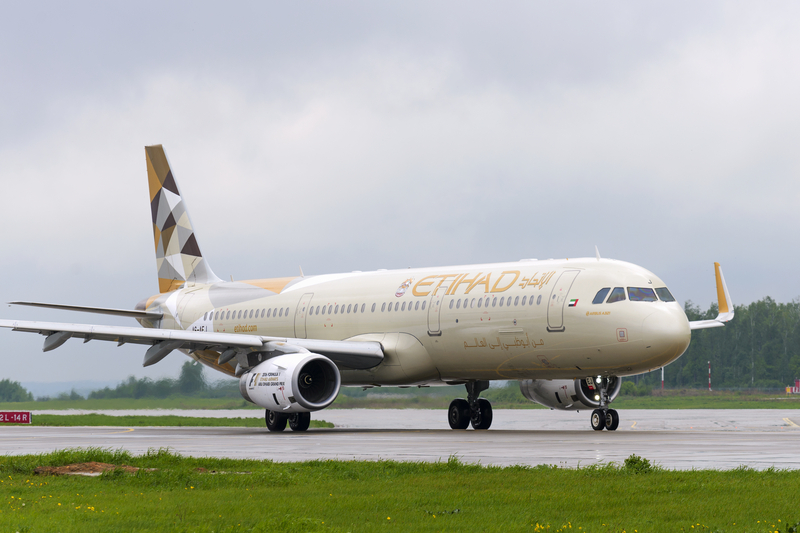
The Airbus A321LR Is What Makes Gothenburg Work
The most interesting part of the new route may be the aircraft.
Etihad’s Calgary Breakthrough: First Nonstop Service Opens Western Canada to the Gulf
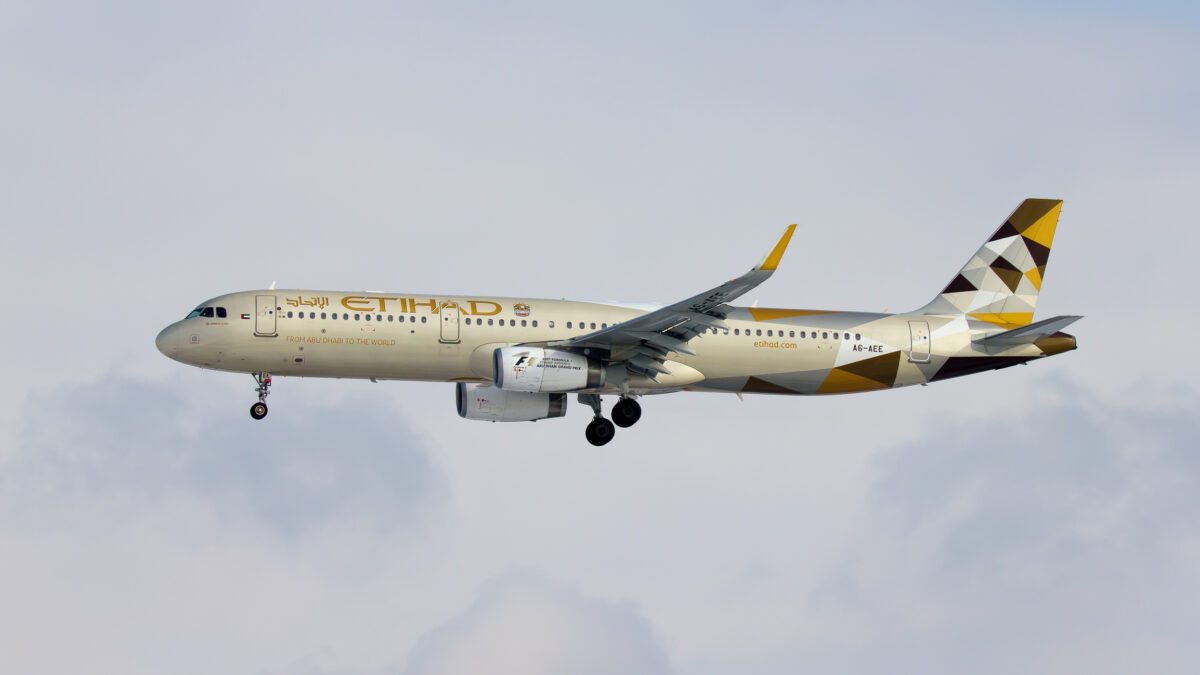
Etihad will operate Gothenburg (GOT) with its Airbus A321LR, a long-range derivative of the A321neo that has increasingly allowed airlines to launch long, relatively thin routes without committing the capacity of an Airbus A330, Airbus A350 or Boeing 787.
Airbus gives the A321LR a range of up to 4,000 nautical miles, or approximately 7,400 kilometers, using additional center fuel tanks. That puts the roughly 2,700-nautical-mile great-circle distance between Abu Dhabi and Gothenburg comfortably within the aircraft’s intended operating envelope. Airbus describes the A321LR as a 4,000-nautical-mile aircraft.
More importantly for Etihad, the A321LR allows the airline to test a market such as Gothenburg with only 160 seats.
A daily widebody operation could introduce substantially more capacity than the market can support, particularly during the route’s initial development. Four weekly A321LR flights give Etihad a much smaller capacity commitment while still providing enough frequency to attract both connecting and local passengers.
Etihad CEO Antonoaldo Neves specifically pointed to that advantage, saying the A321LR allows the airline to bring its complete three-cabin product to Gothenburg “at a scale that suits” the market.
That is precisely the role aircraft such as the A321LR were designed to fill: routes with long stage lengths and meaningful premium demand, but not necessarily enough traffic to justify 250 to 300 seats on every departure.
Etihad’s A321LR Has Just 160 Seats
Etihad has taken a particularly premium approach to its A321LR.
The aircraft carries only 160 passengers, configured with two First Suites, 14 Business Class seats and 144 Economy Class seats. By comparison, Airbus permits considerably denser A321neo configurations, with the family capable of carrying well over 200 passengers.
Etihad is using that available cabin space to create a product that resembles a small widebody more than a conventional European narrowbody.
The two First Suites are arranged in a 1-1 configuration and feature sliding privacy doors. Each converts into a fully flat bed and includes a 20-inch 4K entertainment screen, Bluetooth audio, wireless charging and dedicated power.
Business Class consists of 14 seats in a 1-1 herringbone configuration. Every passenger has direct aisle access and a window-facing seat, with the seat converting into a fully flat bed. Etihad fits each position with a 17.3-inch 4K display, Bluetooth connectivity, wireless charging and individual storage.
Economy accounts for the remaining 144 seats. The cabin features 13.3-inch 4K displays, USB-A and USB-C charging and Bluetooth headphone connectivity. Standard Economy seat pitch is 30 inches, while extra-legroom seats offer 34 inches.
High-speed Wi-Fi is also available across the aircraft. Etihad provides a full breakdown of its A321LR cabin.
For a flight approaching eight hours in one direction, that cabin configuration matters. The A321LR may be a single-aisle aircraft, but Etihad is deliberately avoiding the conventional narrowbody premium product of reclining First or Business Class seats.
Gothenburg Fits Etihad’s A321LR Network Strategy
Gothenburg is another example of how Etihad is using the A321LR as a network-development aircraft.
The carrier introduced the type in 2025 and has been deploying it on routes including Bangkok, Phuket, Krabi, Kolkata, Copenhagen, Düsseldorf, Amsterdam, Paris and Zurich.
Rather than simply replacing existing narrowbody aircraft, the A321LR gives Etihad another tool between its shorter-range Airbus A320-family fleet and its larger Boeing 787 and Airbus A350 widebodies.
That can be particularly valuable in Europe.
A market may have strong corporate traffic, premium demand and significant connecting potential but still lack enough local passengers to fill a widebody throughout the year. The A321LR allows Etihad to pursue those passengers without adding several hundred seats per flight.
Gothenburg (GOT) is a good example.
Sweden’s second-largest city is an important industrial and research center. Western Sweden is home to major companies with substantial international business links, including Volvo Cars, Volvo Group and other manufacturing, technology and life-sciences companies.
Swedavia specifically cited the region’s business relationships across Asia when discussing the new Etihad service. The airport operator also said the route will improve access to India, Southeast Asia and other international markets.
Abu Dhabi Connections May Be More Important Than Local Traffic
There will undoubtedly be demand between Gothenburg and Abu Dhabi itself, particularly during the Scandinavian winter.
Abu Dhabi has increasingly developed into a leisure destination, with attractions including Yas Island, the Sheikh Zayed Grand Mosque, Saadiyat Island and its growing collection of museums and resorts.
But local GOT-AUH traffic alone is unlikely to be what makes this route work.
The real opportunity is connecting traffic.
Passengers from western Sweden currently traveling to destinations such as Bangkok, Phuket, Singapore, Bali, Bengaluru or Colombo generally have to connect through another European or Middle Eastern hub before continuing to Asia.
Etihad can now funnel those passengers directly from Gothenburg Landvetter Airport (GOT) into its hub at Zayed International Airport (AUH), where they can transfer onto the airline’s expanding Asian network.
Swedavia says Etihad offers more than 50 destinations across Asia from Abu Dhabi.
That gives Etihad an opportunity to compete for western Swedish connecting traffic that currently flows through hubs such as Frankfurt (FRA), Amsterdam (AMS), Helsinki (HEL), Istanbul (IST), Copenhagen (CPH) and other European gateways.
The route could therefore be more accurately viewed as Gothenburg-Asia service through Abu Dhabi, rather than simply a Gothenburg-Abu Dhabi city pair.
The Seasonal Schedule Is Also Significant
Etihad is initially committing to Gothenburg only through March 21, 2027.
That makes the route a relatively low-risk test.
The December launch captures Christmas and New Year travel, the Scandinavian winter vacation market and a period when travelers are particularly likely to seek warmer destinations in Southeast Asia, India and the Middle East.
It also gives Etihad several months of booking and performance data before determining whether Gothenburg warrants another seasonal operation, a longer operating period or potentially year-round service.
For Gothenburg Landvetter Airport (GOT), attracting Etihad also broadens the airport’s airline mix considerably. The airport has traditionally relied heavily on European and leisure flying, so a direct Middle Eastern hub connection adds a very different kind of connectivity.
Bottom Line
Etihad Airways will launch nonstop service between Zayed International Airport (AUH) and Gothenburg Landvetter Airport (GOT) on December 17, 2026, operating four times weekly through March 21, 2027.
The new route is Etihad’s 15th new destination launch of 2026 and will give Gothenburg its first nonstop connection with the United Arab Emirates. More importantly for travelers in western Sweden, Abu Dhabi will provide one-stop access to a large portion of Etihad’s network across India and Asia.
The aircraft choice is arguably just as important as the destination.
Etihad’s 160-seat Airbus A321LR gives the airline the range to operate the approximately 3,113-mile route while keeping capacity far below what would be required with a Boeing 787 or Airbus A350. At the same time, passengers still receive a genuine long-haul product with two enclosed First Suites, 14 lie-flat Business Class seats and seatback 4K entertainment throughout Economy.
That combination of long range, relatively low capacity and a premium-heavy cabin is exactly what makes the A321LR valuable to Etihad. Gothenburg is the type of market that might have been difficult to justify with a widebody, but the economics of the A321LR give the airline a practical way to connect another European city directly to its rapidly expanding Abu Dhabi (AUH) hub.