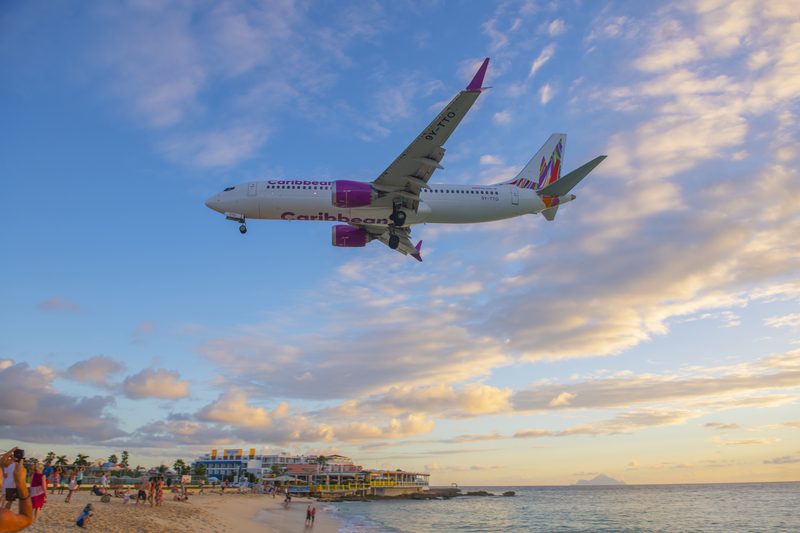
What should have been a routine Caribbean Airlines arrival into New York John F. Kennedy International Airport (JFK) turned into something far more extraordinary when a passenger went into labor and gave birth as the flight was nearing the end of its journey from Norman Manley International Airport (KIN) in Kingston.

The flight involved was Caribbean Airlines BW005, a Boeing 737 MAX 8 operating one of the carrier’s core Jamaica–New York sectors. As the aircraft approached JFK, the crew informed air traffic control that a pregnant passenger was in labor and requested priority handling into the airport.
That is the kind of moment that instantly changes the nature of a flight. What had been a standard trans-Caribbean arrival became a time-sensitive medical event, demanding coordination between the cockpit, controllers on the ground, cabin crew, and airport medical responders within minutes.
Read our stories in your inbox
Two aviation newsletters. Zero fluff.
The Crew and JFK Controllers Shifted Quickly
The most striking part of the incident is how quickly the system responded.
Air traffic control audio shows the Caribbean Airlines crew alerting controllers that a passenger was going into labor and asking for a more direct arrival. JFK controllers immediately asked whether medical personnel were needed at the gate, and the flight was brought in with that support already being arranged.
By the time the aircraft was taxiing after landing, the baby had already been delivered onboard. In the now widely shared exchange, ground control asked whether the baby had arrived yet, and after receiving confirmation, jokingly suggested the child should be named “Kennedy.”
It was a light moment, but it came after a highly professional response. The important point is that the crew kept the situation under control, the controllers reacted without delay, and medical personnel were ready on arrival.
The Aircraft and Route Add Useful Context
The aircraft involved was Boeing 737 MAX 8 registration 9Y-SUR, one of the newer narrowbodies in the Caribbean Airlines fleet. That matters because BW005 is not a fringe route or a one-off operation. Kingston (KIN) to New York-JFK is one of the airline’s most important U.S.-Caribbean city pairs, linking Jamaica with one of the largest diaspora and visiting-friends-and-relatives markets in the network.
For Caribbean Airlines, that route carries more than just leisure demand. It is a core community link, and incidents onboard a flight like this inevitably attract wider attention because of the route’s visibility and importance.

The Boeing 737 MAX 8 is also the right aircraft for the sector. It combines the range and economics Caribbean Airlines needs on dense North American routes with a modern cabin platform suited to medium-haul flying between the Caribbean and the northeastern United States.
Rare Events Like This Test the Human Side of an Airline
Births onboard commercial aircraft remain unusual, but when they do happen, they put unusual pressure on everyone involved.
Cabin crew are trained for medical emergencies, but childbirth at the end of a flight is still a uniquely demanding situation. It requires calm judgment, communication with the cockpit, rapid coordination with ground services, and the ability to manage the rest of the cabin while a life-changing event unfolds in confined conditions.
That is why stories like this resonate. They are not just unusual. They reveal the part of airline operations that passengers do not usually see: the transition from ordinary service to emergency response in a matter of seconds.
In this case, the flight appears to have reached JFK without a wider operational breakdown, without panic, and with the mother and newborn able to be handed over directly to medical personnel after arrival. That is about as controlled an outcome as an airline could realistically hope for in such circumstances.
More Than a Viral Moment for Caribbean Airlines
There is an understandable temptation to treat the incident as a charming viral story because of the “Kennedy” remark from the tower. But for Caribbean Airlines, the more meaningful takeaway is operational.
The airline was able to show clear crew communication, stable flight handling, and competent coordination with one of the busiest airports in the United States. In an era when airlines are often judged publicly by disruption, delay, or service failure, an event like this can leave a very different impression: one built around composure and professionalism.
That matters even more because JFK is one of the airline’s most strategically important gateways in North America. A positive public response on a core route into a major airport is not the sort of exposure carriers can plan for, but when it happens, it can reinforce trust in the human side of the operation.
Bottom Line
Caribbean Airlines BW005 from Kingston (KIN) to New York-JFK became an unforgettable flight not because of a diversion or a mechanical event, but because the crew had to manage one of the rarest onboard emergencies in commercial aviation: a birth on final approach.
The Boeing 737 MAX 8 reached JFK safely, the mother delivered before arrival at the gate, and the crew and controllers handled the situation with the kind of calm professionalism that stands out in real time.
The joking suggestion to name the baby “Kennedy” may be what many people remember. For airline professionals, though, the real story is simpler and more important: a frontline crew, an airport, and an air traffic system responded exactly as they needed to when an ordinary flight suddenly became anything but ordinary.
Keep reading FlyMag
Get the Daily Brief in the morning or the Route Watch weekly recap on Fridays. Or both.