Airlink has defended a formation flypast in which two of its Embraer E-Jets crossed Cape Town’s DHL Stadium at low altitude before the Springboks played the All Blacks on Saturday, August 29.

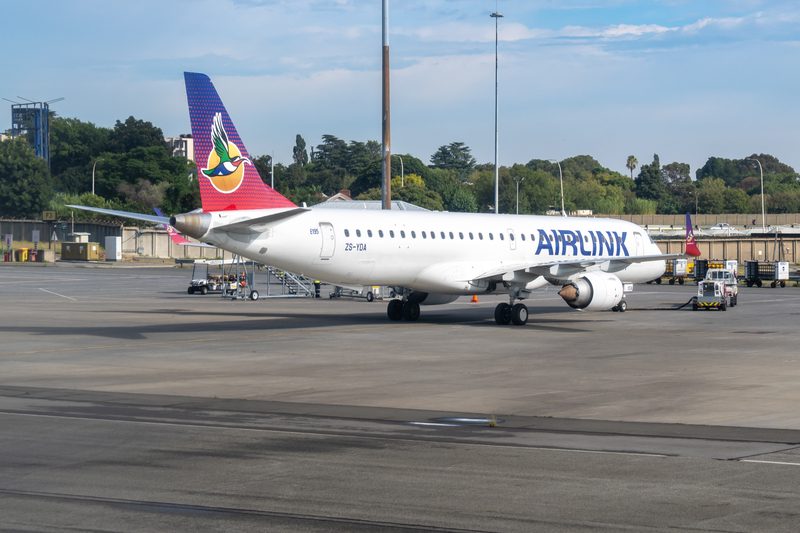
The airline’s green Embraer E190, registered ZS-YAE, and black Embraer E195, ZS-YDE, flew over the venue in formation before climbing away. Both aircraft carry special Rugby’s Greatest Rivalry liveries representing the competing teams.
Airlink promoted the display through an official video of the flypast, describing it as an exercise in planning, precision and performance. Other camera angles circulated online appeared to show the aircraft passing close to the stadium roof, prompting questions about the vertical clearance built into the maneuver.
Read our stories in your inbox
Two aviation newsletters. Zero fluff.
Tracking Data Indicates Less Than 50 Feet of Clearance
Flightradar24 calculated that the lead aircraft cleared the top of the stadium by approximately 41 to 46 feet, or 12.5 to 14 meters.
The calculation required more than reading the lowest altitude displayed by a tracking application. ADS-B equipment transmitted a minimum barometric altitude of 50 feet referenced to standard pressure. Flightradar24 adjusted that figure using the local QNH of 1019 hPa, producing an estimated altitude of 205 to 210 feet above mean sea level.
DHL Stadium is close to sea level and stands approximately 164 feet high. Subtracting the structure’s height produced the estimated roof clearance. The figure remains an ADS-B-based calculation rather than a measurement taken from either aircraft’s flight data recorder, but it explains why the pass appeared unusually close from several camera positions.
Tracking histories independently confirm that both aircraft operated local sorties from Cape Town (CPT) on August 29. The E195 returned to CPT after a flight lasting about 71 minutes, while the E190 completed a similar 74-minute sortie. Both aircraft resumed scheduled passenger operations afterward.
Planning. Precision. Performance. ✈️✈️
Spectacular scenes of Airlink’s double Embraer flyover at the DHL Stadium.
Airlink is Proud Official Sponsor of Rugby’s Greatest Rivalry, presented by Castle Double Malt 🏉#Airlink #FlyAirlink #FlyTheLink #Skybucks #RugbysGreatestRivalry pic.twitter.com/3tPNepftLS
— Airlink (@Fly_Airlink) August 29, 2026
Airlink Says Crews Remained Within Approved Limits
In a statement issued on August 30, Airlink said the flypast had required detailed planning and rehearsal because the aircraft were operating at low altitude and approximately 150 knots.
The airline said the South African Civil Aviation Authority and Air Traffic and Navigation Services provided guidance, approval and operational support. That account of the approval has so far come from Airlink.
Each aircraft carried three senior captains assigned as commander, co-pilot and safety or technical officer, according to the carrier. Airlink said recorded flight data confirmed that both crews remained within the altitude and speed limits approved and rehearsed for the display.
The response shifts the central issue away from an apparent unplanned altitude deviation and toward the safety margin accepted during the authorization and risk-assessment process. At an estimated clearance of less than 50 feet above a large occupied structure, relatively small changes in height would have represented a substantial proportion of the available vertical margin.
The aircraft were also operating over a stadium filled for a major international sporting event rather than along a conventional airport display line. That distinction has placed additional attention on the planning assumptions, approval process and positioning of the flight path relative to the roof.
The Same Aircraft Flew Over Ellis Park
The Cape Town display followed another formation pass by the same aircraft one week earlier. On August 22, ZS-YAE and ZS-YDE flew over Ellis Park in Johannesburg before the first Springboks-All Blacks Test in the series.
Airlink publicized the Johannesburg flypast as part of its sponsorship of Rugby’s Greatest Rivalry. The green and black liveries were produced specifically for the campaign, with the tour logo applied alongside the airline’s branding.
The activation supports a broader commercial agreement. Airlink became the tour’s exclusive domestic airline partner and is transporting the South African and New Zealand squads, coaches and support personnel between matches in South Africa.
The schedule includes further men’s and women’s Tests at FNB Stadium in Johannesburg on September 5, followed by a final Springboks-All Blacks match in Baltimore on September 12.
Two First-Generation Embraer E-Jets
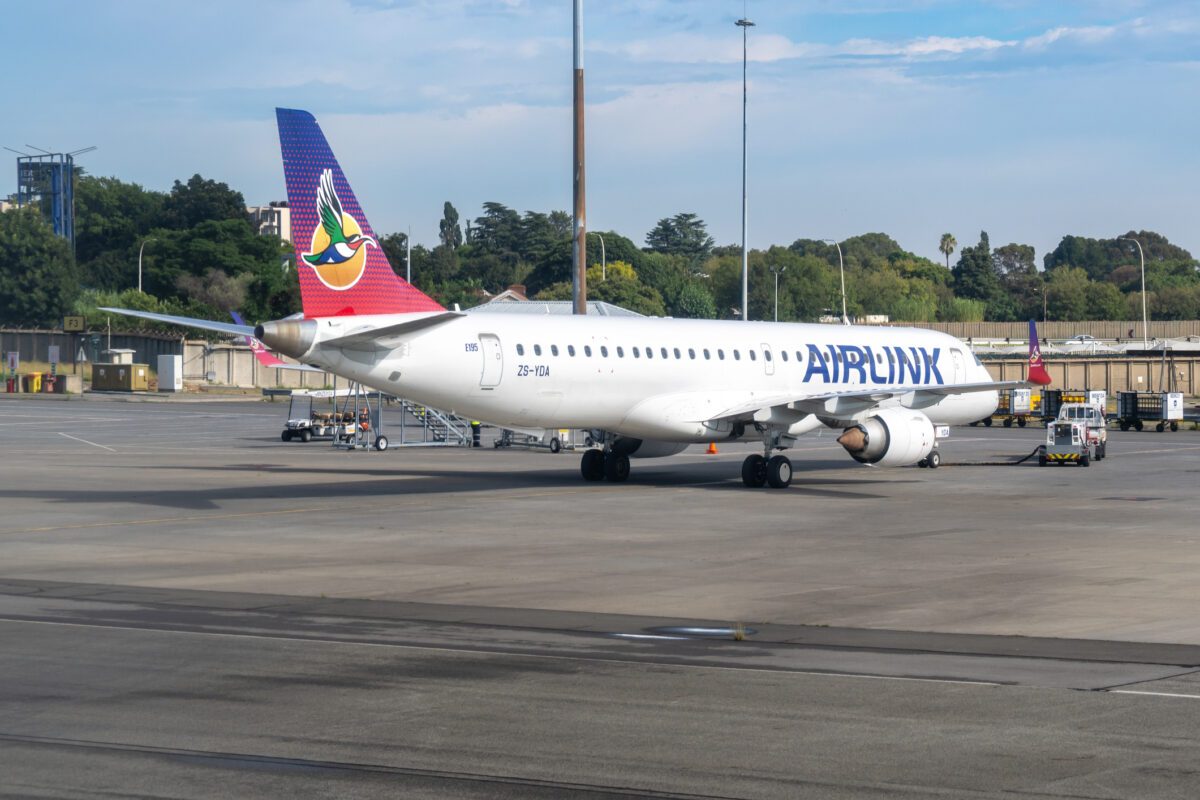
Both aircraft involved are first-generation Embraer E-Jets, not the larger E195-E2s now entering Airlink’s fleet.
Airlink’s Embraer E190 is 36.24 meters long, has a 28.72-meter wingspan and accommodates up to 98 passengers in the airline’s standard two-class configuration. Its size and economics make it a core type for Airlink’s domestic and regional network.
The Embraer E195 shares the E190’s wing but stretches the fuselage to 38.67 meters, providing greater capacity while retaining the family’s two-by-two economy cabin. Both types have a published maximum cruise speed of approximately Mach 0.82, although the flypast was conducted at a much lower speed consistent with a low-level display profile.
Airlink used the same two airframes for both stadium events, creating a matched visual presentation while accepting the added operational demands of formation flight between aircraft with different fuselage lengths and performance characteristics.
Bottom Line
The flypast delivered attention far beyond the audience inside DHL Stadium, but the conversation quickly moved from Airlink’s rugby sponsorship to its operational risk appetite. For an airline, that trade is rarely favorable: spectacle is temporary, while questions about decision-making and safety culture can persist even when a maneuver was authorized and completed without damage or injury.
The more consequential issue is the relationship between regulatory approval and the margin visible in the resulting flight profile. Airlink’s flight-data review may establish that its crews flew precisely what was planned. It does not end the wider discussion over whether a clearance measured in tens of feet was appropriate above an occupied stadium. An independent explanation from SACAA would carry more weight than the operator’s assurance alone.
Airlink’s rugby partnership continues through September, ensuring that its special-livery E-Jets will remain highly visible. Any further aerial activation will now attract close scrutiny, particularly over altitude, routing and separation from occupied structures. The Cape Town pass may therefore influence how both the airline and South African authorities assess promotional flypasts long after the tour ends.
Keep reading FlyMag
Get the Daily Brief in the morning or the Route Watch weekly recap on Fridays. Or both.