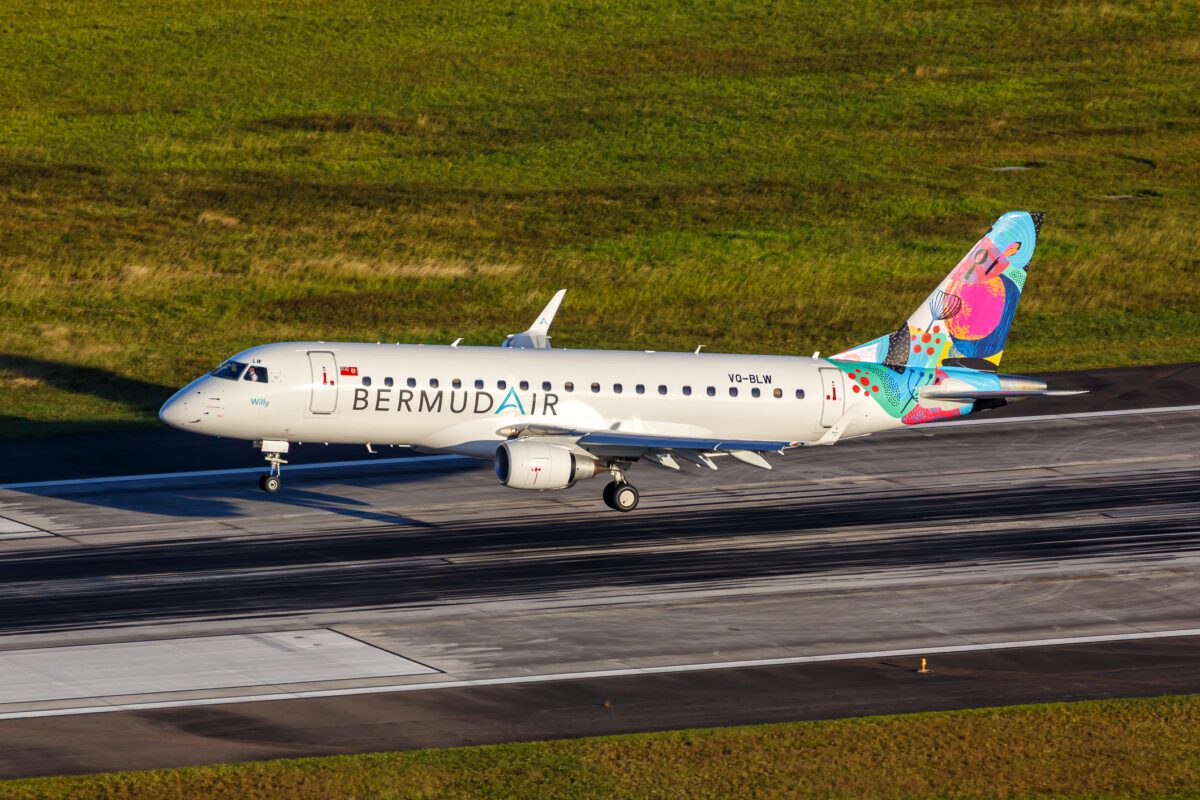
BermudAir will expand into dedicated freighter operations with a leased Embraer E190F, extending its business beyond passenger flying and the limited cargo service already offered across its scheduled network.
The aircraft will come from Regional One and will make BermudAir the second E-Freighter operator worldwide. It will also be the first example of Embraer’s passenger-to-freighter conversion deployed in the Americas, according to a September 16 announcement from Embraer and Regional One.
Regional One has placed five firm orders for E190F conversions. Two aircraft have already been delivered and entered service, giving the lessor an operating base from which to place the remaining jets with regional cargo carriers.
Read our stories in your inbox
Two aviation newsletters. Zero fluff.
“Cargo is a natural next step for us,” BermudAir founder and CEO Adam Scott said. He identified express shipments, e-commerce, local businesses and time-sensitive freight as the principal markets for the new operation.
A Step Beyond BermudAir’s Existing Cargo Product
BermudAir already sells cargo capacity on selected services to and from Bermuda (BDA), but the current product is built around relatively small consignments. The airline’s published cargo conditions limit individual pieces to 45 kilograms and complete shipments to 1,000 kilograms. Hazardous shipments are not accepted.
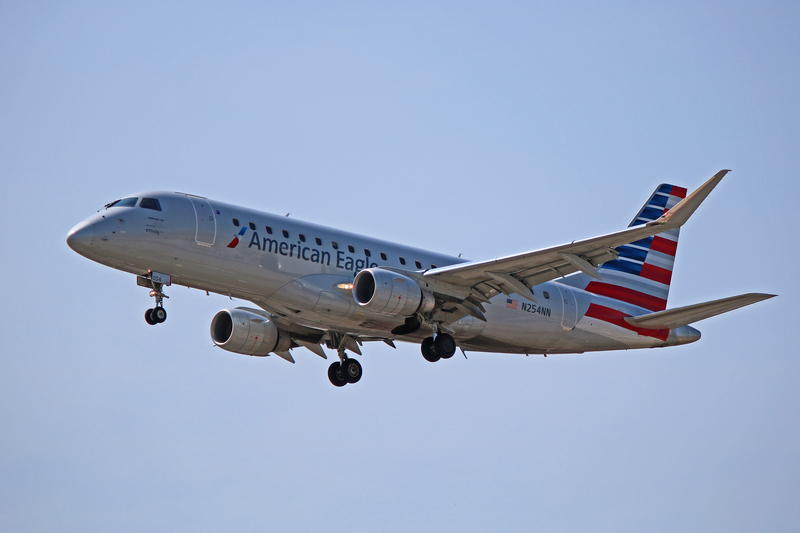
A dedicated freighter changes the scale and flexibility of that operation. Cargo flights can be timed around express distribution windows rather than passenger demand, while payload and available volume are no longer determined by passenger loads, checked baggage and the physical limitations of an E-Jet’s underfloor holds.
The freighter also gives BermudAir the option of using the network it has assembled among Bermuda, other Caribbean islands and North American gateways for cargo flows that do not necessarily mirror passenger demand. Scott said the aircraft would put the airline’s existing network to work carrying freight across the islands it serves.
BermudAir currently operates two Embraer E175s and two Embraer E190s and serves 10 destinations across the Caribbean, the United States and Canada. Adding another first-generation E-Jet therefore extends an aircraft family already present in the airline’s operation, although dedicated cargo flying brings its own loading, handling and scheduling requirements.
E190F Targets the Gap Below Larger Narrowbodies
The E190F is a converted passenger aircraft rather than a newly built freighter. Embraer developed the program to give first-generation E190 and E195 airframes a second operating cycle and to address the capacity gap between large cargo turboprops and Boeing 737-class freighters.
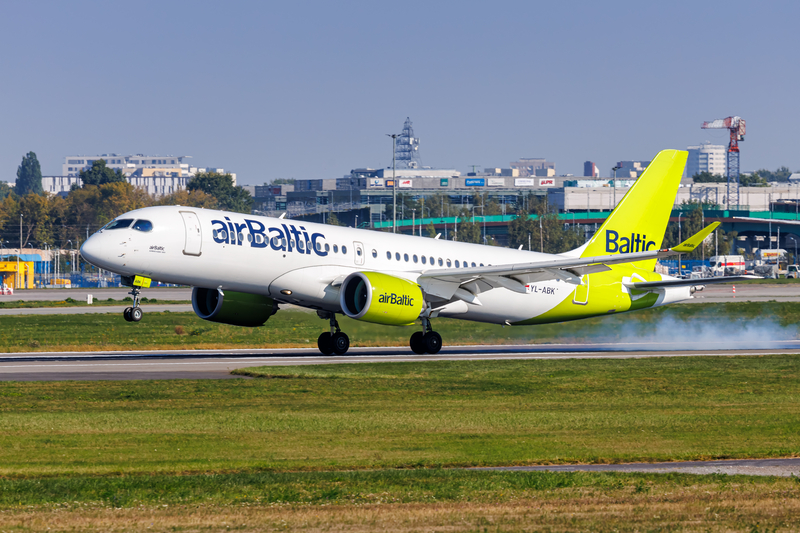
According to Embraer’s E-Freighter specifications, the E190F offers a maximum structural payload of 13,500 kilograms and 103 cubic meters of combined main-deck and underfloor volume. Its cargo loading system provides as many as nine unit load device positions.
The conversion installs a large main-deck cargo door and a rigid 9G barrier separating the flight deck from the freight compartment. Embraer gives the aircraft a volumetric range of up to 2,590 nautical miles at a cargo density of 104 kilograms per cubic meter, placing Bermuda-Caribbean and Caribbean-North America sectors comfortably within its intended regional mission.
That combination is more significant for BermudAir than maximum payload alone. Island freight markets can require jet speed and sufficient range to reach North American sorting points without generating enough daily volume for a larger narrowbody freighter. The E190F allows the carrier to pursue those flows with less capacity to fill on each departure.
Embraer says its converted E-Jets provide more cargo volume and substantially more range than large freighter turboprops, while producing operating costs as much as 30% below larger narrowbodies. Actual economics will depend on utilization, sector length, cargo density and the balance of traffic in each direction, particularly in markets where inbound and outbound freight volumes can differ sharply.

A New Operator for a Young Freighter Program
Embraer launched the conversion program in May 2022 and flew the E190F for the first time in April 2024. The aircraft received Brazilian approval in July 2024, followed by certification of the conversion and cargo loading system by the US Federal Aviation Administration in September of that year.
The FAA certification was an essential step toward placing the type with operators serving the United States. BermudAir’s selection now gives the program its first commercial foothold in the Americas and its second operator globally.
For Regional One, the placement advances a portfolio assembled around an emerging conversion type rather than a mature freighter market. Establishing multiple operators is important for residual values, technical support and wider acceptance among cargo customers considering an aircraft with only a short commercial record.
Cargo Added Alongside Passenger Fleet Growth
The freighter agreement comes as BermudAir prepares for a larger transformation of its passenger fleet. An affiliated company, Odyssey, placed a firm order for 10 Airbus A220-300s, with deliveries scheduled to begin in the fourth quarter of 2027. The airline has said it could operate as many as 20 A220s by 2030.
Those A220-300s will have 135 seats in three classes and are intended to support expansion across the Caribbean, Central America, North America and the wider Atlantic region. The E190F introduces a parallel cargo strategy before that passenger fleet transition begins.
The result is a broader operating model than the boutique passenger proposition with which BermudAir launched in 2023. Passenger services will remain the airline’s core business, but the freighter provides a separate source of revenue and a way to use the geographic reach, airport relationships and operating infrastructure already developed around its island network.
Bottom Line
The E190F gives BermudAir an aircraft sized for freight markets where frequency and timing matter more than the lowest possible unit cost on a fully loaded large narrowbody. Bermuda businesses, express operators and freight forwarders stand to gain if the airline can create direct or one-stop links that reduce dependence on routings built around passenger schedules and distant cargo hubs.
The larger test will be commercial rather than technical. A single freighter needs consistent anchor traffic, productive overnight scheduling and enough directional balance to avoid carrying empty capacity on return sectors. Integrator contracts, the first route pattern and the extent to which BermudAir connects its different island markets through common North American gateways will show whether the aircraft becomes a network tool or a more narrowly focused contract operation.
For Embraer and Regional One, the placement is also a useful demonstration of the E190F’s intended role. Success in BermudAir’s geographically dispersed network would strengthen the case for converted E-Jets as replacements for aging regional freighters and oversized narrowbodies. The next indicators will be the aircraft’s entry into service, its initial utilization and whether BermudAir’s first dedicated freighter leads to a larger cargo fleet.
Keep reading FlyMag
Get the Daily Brief in the morning or the Route Watch weekly recap on Fridays. Or both.