Biman Bangladesh Airlines has placed a firm order for four Airbus A350-900 widebody aircraft and six A321neo single-aisle jets, adding another 10 aircraft to a fleet expansion program that already includes substantial Boeing commitments.
Airbus announced the order on October 7, saying the aircraft will support Biman’s plans to expand from Dhaka (DAC) to North America and strengthen its European and Middle Eastern networks.
The agreement brings Airbus back into Biman’s active fleet plan. The Bangladeshi flag carrier previously operated Airbus A310-300s, but its current jet fleet is built around Boeing 737s, 777s and 787s. Biman Chairman Rumee A. Hossain described the expansion as a measured response to the country’s growing travel market and its large overseas population.
Read our stories in your inbox
Two aviation newsletters. Zero fluff.
A350 Adds Another Long-Haul Platform
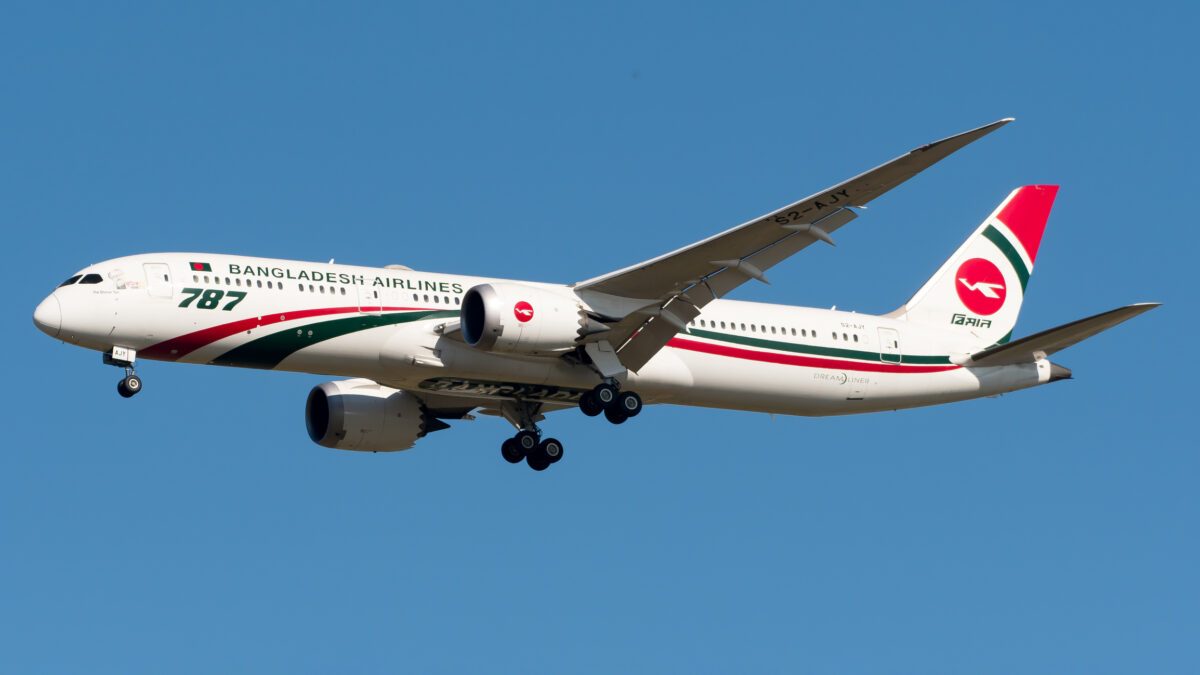
The A350-900 will join a long-haul fleet that currently includes four Boeing 787-8s, two 787-9s and four 777-300ERs. According to Biman’s published fleet information, its 787-8s have 271 seats, its 787-9s carry 298 passengers and its 777-300ERs are configured with 419 seats.
Airbus lists the A350-900 with typical three-class capacity of 332 to 352 passengers and a range of up to 8,600 nautical miles. The aircraft is powered exclusively by the Rolls-Royce Trent XWB-84 and uses a composite-intensive airframe designed for long sectors.
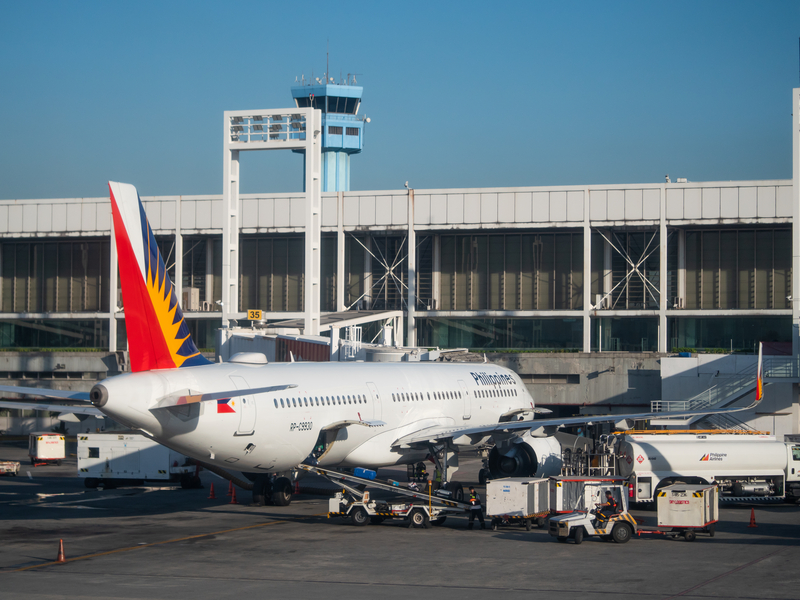
That places the A350 between Biman’s 787-9 and high-capacity 777-300ER in typical seating terms, although the airline’s eventual interior will determine its precise role. Its payload-range capability is sufficient for nonstop operations from Bangladesh to North America, as well as services to Europe and East Asia.
Biman currently lists Toronto, London, Manchester, Rome and Tokyo among the long-haul cities in its network. Its Toronto Pearson (YYZ) service operates via Istanbul, according to Boeing’s description of the carrier’s network when it announced Biman’s separate aircraft order in April. An A350 operation would give the airline the technical capability to restructure some of its longest services as nonstop flights if traffic, airport access and operating economics support them.
A321neo Broadens the Regional Fleet
The six A321neos represent a more pronounced change at the other end of Biman’s jet fleet. The airline now uses Boeing 737-800s on regional and medium-haul sectors, with its published configuration seating 12 business-class and 150 economy-class passengers.
The A321neo typically accommodates 180 to 220 passengers in two classes and has a range of up to 4,000 nautical miles. Its additional capacity over Biman’s 737-800s would suit dense services from Bangladesh to the Gulf, India and Southeast Asia without requiring the airline to deploy a widebody.
Biman’s published destination network includes Abu Dhabi, Dammam, Doha, Dubai, Jeddah, Kuwait, Muscat and Riyadh, alongside regional points including Bangkok, Chennai, Delhi, Guangzhou, Hong Kong, Kuala Lumpur and Singapore. Those markets give the A321neo a broad potential mission set, from shorter South Asian sectors to flights of several hours into the Middle East and Southeast Asia.
The larger single-aisle could also allow Biman to add capacity in smaller increments. That matters on routes where a 737-800 may be too small at peak times but where the carrier does not require the capacity, cargo volume or trip cost of a 787.
Airbus Order Follows Major Boeing Purchase
The Airbus deal comes less than six months after Biman placed the largest aircraft order in its history. On April 30, Boeing announced an order for 14 aircraft: eight 787-10s, two 787-9s and four 737-8s.
Boeing said the 787-10s were intended for high-demand Middle Eastern services, while the additional 787-9s would support long-haul flying to Europe and North America. The 737-8s were selected for services to the Middle East, India and Southeast Asia — broadly the same market segments that the newly ordered A321neos can address.
The two 2026 agreements therefore give Biman firm commitments for 24 Airbus and Boeing jets. For comparison, the airline’s current fleet history lists 21 aircraft: six 787s, four 777-300ERs, six 737-800s and five Dash 8-400 turboprops.
The orders point to expansion as well as replacement. The 787-10 and A350-900 add substantial widebody capacity, while the 737-8 and A321neo create two new-generation single-aisle fleets. Biman will also operate competing Airbus and Boeing products in both major jet categories, rather than consolidating around one manufacturer.
That strategy gives Biman access to different aircraft sizes and performance profiles. The 787-10 offers high capacity and commonality with its existing Dreamliners, while the A350-900 brings greater long-range capability than the largest 787 variant. In the single-aisle fleet, the 737-8 provides continuity with the 737-800, while the longer A321neo offers more seats and cargo volume.
Bottom Line
Biman’s decision is more than a return to Airbus. It establishes a dual-manufacturer fleet strategy immediately after the airline made a major commitment to Boeing. The carrier is effectively choosing additional capacity and mission flexibility over the simpler training, maintenance and spare-parts structure that would come from staying with one aircraft family in each market segment.
The A321neo may prove particularly important. Biman’s network contains numerous routes with strong labor, family and religious travel demand, often accompanied by substantial checked baggage. A larger single-aisle aircraft gives the airline room to grow those markets without putting a widebody on every busy Gulf or Southeast Asian service. The A350-900, meanwhile, provides an aircraft sized for long-haul growth without the 419-seat commitment of Biman’s 777-300ER configuration.
The scale of the combined order book will put the emphasis on execution. Biman must absorb four new aircraft variants — the A350-900, A321neo, 787-10 and 737-8 — while determining how quickly older 777s and 737-800s leave the fleet. If deliveries, financing and network development remain aligned, the result will be a substantially larger carrier with enough fleet depth to increase frequencies and pursue nonstop North American flying. It will also be a considerably more complex airline to operate.
Keep reading FlyMag
Get the Daily Brief in the morning or the Route Watch weekly recap on Fridays. Or both.