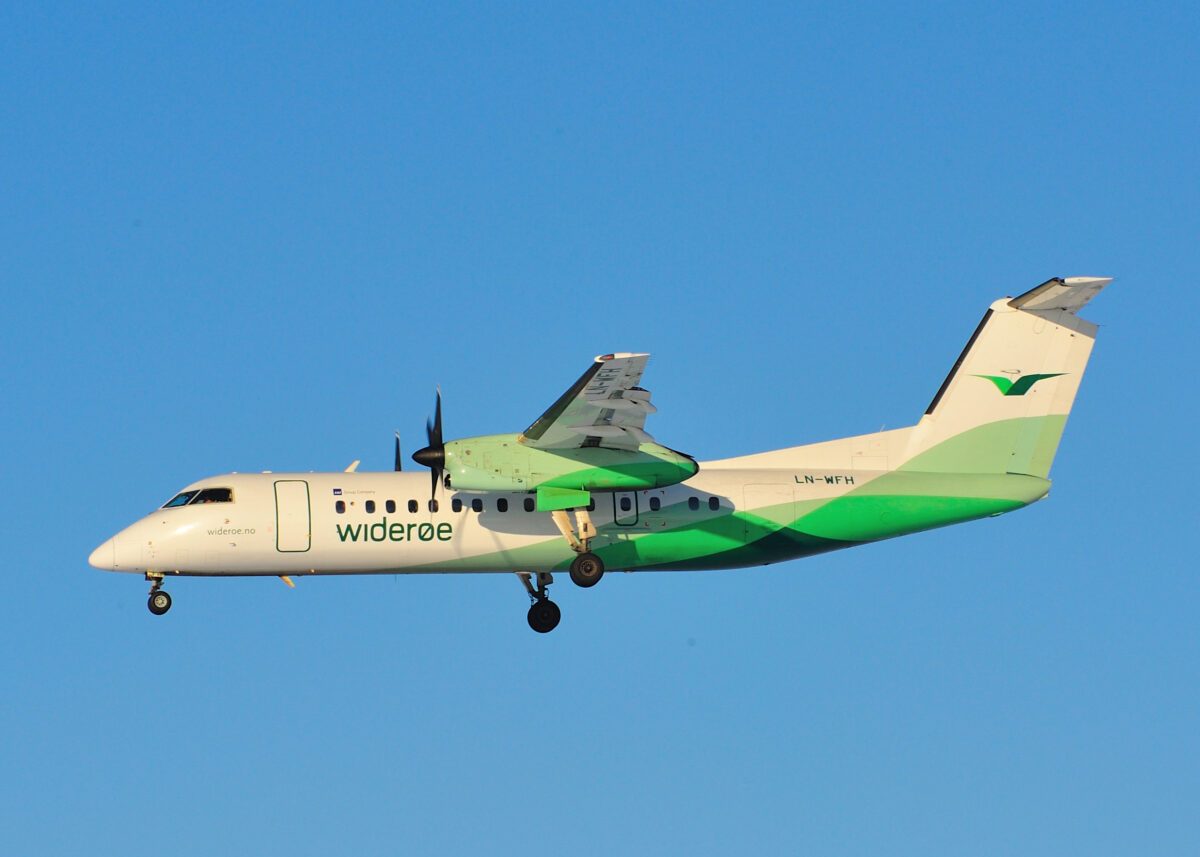
Widerøe has added four De Havilland Dash 8-100s to an airframe life extension program, increasing the number of aircraft covered by the agreement from 10 to 14.

The expansion forms part of Widerøe’s effort to retain the 39-seat turboprops for Norway’s short-runway network while the airline waits for a viable successor. Under De Havilland Canada’s Extended Service Program Plus, or ESP+, the approved life of each participating aircraft rises from 120,000 to 160,000 flight cycles.
De Havilland Canada confirmed the additional four aircraft on July 20, 2026, during the Farnborough International Airshow. Widerøe now has six options remaining from the original agreement covering up to 20 Dash 8-100s.
Read our stories in your inbox
Two aviation newsletters. Zero fluff.
Airframe Limit Doubles From the Original Design Life
Widerøe became the launch customer for ESP+ in 2022, initially committing 10 Dash 8-100s and securing options for another 10. The latest agreement exercises part of that option package rather than establishing a separate program.
The aircraft were originally limited to 80,000 flight cycles. An earlier Extended Service Program raised that threshold to 120,000 cycles, while ESP+ adds another 40,000. The final 160,000-cycle limit is therefore twice the Dash 8-100’s original approved life.
A flight cycle represents one takeoff-and-landing sequence, making the measure particularly important for aircraft assigned to multiple short sectors each day. A regional turboprop can accumulate cycles far more quickly than an aircraft flying a smaller number of longer sectors, even when the two record similar annual flight hours.
The work is more extensive than an adjustment to the maintenance paperwork. According to the manufacturer’s original ESP+ program description, the approval followed structural engineering, fatigue-test and in-service data analysis. Operators incorporate a service bulletin and a new maintenance program supplement, with specified structural and aircraft-system components replaced as required.
De Havilland Canada estimated when it launched ESP+ that the two successive life extensions could add more than 30 to 40 years to an airframe’s operational life. The calendar outcome for an individual aircraft will depend on its existing cycle count and future utilization, but the higher limit gives Widerøe considerably more flexibility in allocating its remaining Dash 8-100 capacity.
Few Alternatives for Norway’s Shortest Runways
The Dash 8-100 and Dash 8-200 occupy a specialized position in Widerøe’s fleet. The airline configures both types with 39 seats and uses them extensively at airports where runway length, terrain and operating conditions restrict the choice of replacement aircraft.
A Norwegian government planning document identifies 21 airports with runways shorter than 1,199 meters, all served within the country’s public-service-obligation network by Widerøe’s Dash 8-100/200 fleet. The same assessment describes the aircraft as the only current pressurized type with more than 30 seats able to use those runways without major payload or range restrictions.
That combination of cabin capacity and runway performance is difficult to replace. A government-commissioned study of regional air services counted 26 Dash 8-100/200s in Widerøe’s fleet and noted that the type can operate from runways as short as 800 meters. It also linked Widerøe’s position in several public-service tenders to its access to a substantial fleet of these aircraft.
The life-extension decision therefore supports more than the residual value of an aging fleet. It protects the availability of aircraft around which parts of Norway’s regional schedule and airport infrastructure are effectively designed.
Widerøe Is Investing Beyond the Airframe Structure
ESP+ is one element of a broader program to keep the Dash 8 fleet supportable. Widerøe is also the launch customer for a new Dash 8-100 and Dash 8-200 flight deck developed by De Havilland Canada with Universal Avionics and JANA.

The Universal InSight installation replaces older cathode-ray-tube equipment with five high-resolution displays, synthetic vision and digital engine indications. Beyond improving situational awareness, the upgrade addresses the increasingly important problem of sourcing and repairing legacy avionics components.
Widerøe and De Havilland Canada are also extending maintenance intervals elsewhere in the fleet. In a separate agreement announced at Farnborough, Widerøe became the launch operator for a Dash 8-400 A-check escalation program, increasing the interval from 800 to 1,200 flight hours across 17 aircraft.
Taken together, the structural, avionics and maintenance initiatives show that Widerøe is treating the Dash 8 fleet as a continuing production asset rather than simply holding the aircraft until an immediate replacement arrives. The carrier described the original ESP+ agreement as a bridge between conventional turboprops and a future aircraft suitable for the Norwegian short-runway network.
Bottom Line
The immediate beneficiary is Norway’s regional network. Extending additional Dash 8-100s reduces the risk of an aircraft shortage forcing capacity cuts, smaller cabins or changes to operating requirements at the country’s shortest airports. It also gives Widerøe more control over fleet planning instead of tying the retirement of individual aircraft to their original structural limits.
For De Havilland Canada, Widerøe’s decision strengthens the aftermarket case for supporting legacy Dash 8 variants long after production ended. Airframe life extensions, replacement avionics, component support and revised maintenance programs can sustain a commercially useful installed fleet even without restarting production of the smaller models.
The next indications to watch are whether Widerøe exercises its six remaining ESP+ options and how quickly the upgraded flight deck moves through certification and fleet installation. Those decisions will show how far the airline intends to carry the existing short-runway fleet into the next decade—and how much time emerging regional-aircraft programs have to produce a credible replacement.
Keep reading FlyMag
Get the Daily Brief in the morning or the Route Watch weekly recap on Fridays. Or both.