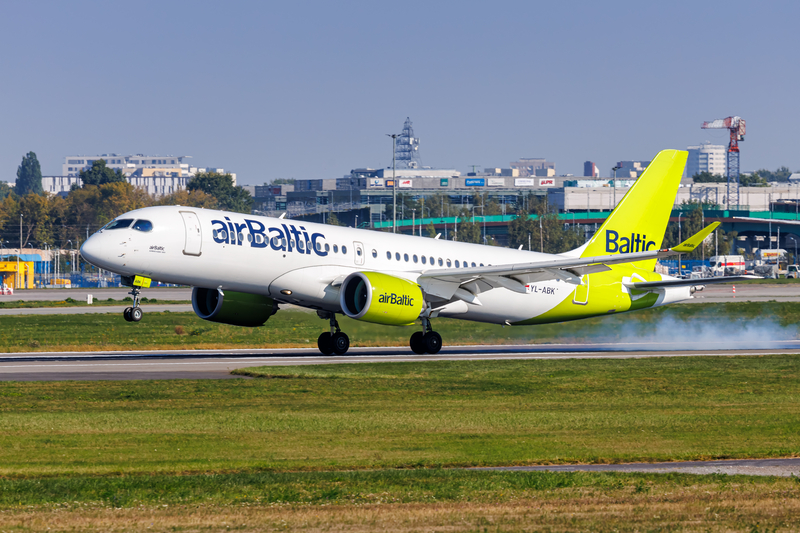
Latvia’s flag carrier airBaltic (BT) has kicked off its 2026 deliveries with a factory-new Airbus A220-300 registered YL-BTC, welcomed into service at its main base in Riga (RIX) in early February. The aircraft is the 53rd A220-300 in the airline’s fleet—another step in airBaltic’s long-running bet on running an all-A220 operation at scale, and a reminder that the carrier has quietly built one of Europe’s most standardized narrowbody fleets.
For airBaltic, the delivery is less about “one more airplane” and more about maintaining the cadence required to support two businesses at once: a scheduled network linking the Baltics to dozens of destinations, and a growing ACMI operation that places airBaltic capacity into other European markets when seasonal demand swings.
Why the A220-300 is the center of airBaltic’s business model
airBaltic was an early A220 operator and has spent nearly a decade refining the type into a true multi-mission platform. The A220-300 sits in a sweet spot: it’s large enough to be productive on trunk regional routes, but efficient enough to make thinner city pairs work without needing aggressive fares to fill bigger jets.
Read our stories in your inbox
Two aviation newsletters. Zero fluff.
From an operational standpoint, the A220-300 is powered by Pratt & Whitney PW1500G geared turbofan engines and is designed for the 100–150 seat segment, typically seating roughly 130–160 passengers depending on layout. Airbus lists A220-family range capability up to about 3,600 nautical miles (6,700 km), which gives operators wide latitude to mix short-haul high-frequency flying with longer sectors where aircraft economics and comfort still matter.
That range and efficiency profile is a major reason airBaltic can run a broad network from RIX while also redeploying aircraft for ACMI flying elsewhere in Europe, where aircraft can be utilized hard during peaks and then shifted as demand patterns change.

A single-type fleet: training, spares, and utilization advantages
Running one aircraft type is an airline ops manager’s dream—when you have the scale to make it work. With the A220-300 as its only fleet type, airBaltic can standardize nearly everything that drives reliability and cost control:
-
Pilot and cabin crew training stays consistent across the operation
-
Maintenance planning and inventory is simplified, with common parts pools and fewer specialty tooling requirements
-
Scheduling flexibility improves because aircraft are interchangeable across routes, reducing “right aircraft, wrong place” issues during disruptions
-
ACMI readiness becomes easier—one fleet, one set of procedures, one operational playbook

This kind of standardization is particularly valuable for a carrier based at RIX, where network resilience and smart utilization can matter as much as pure market size.
The numbers behind airBaltic’s A220 experience
airBaltic’s own cumulative operating figures highlight how deeply the airline has built around the type. Since introducing the A220-300 in 2016, the carrier says it has carried more than 24 million passengers on the aircraft, operating roughly 250,000 flights and logging over 551,000 flight hours. Those are “maturity” numbers—evidence that the fleet is not just new, but thoroughly embedded into daily operations and reliability planning.

Cabin and passenger experience: why the A220 sells well on short and medium haul
The A220’s passenger appeal is often understated in the narrowbody world. Airbus markets the A220 cabin as “widebody-like” for its category, driven by the aircraft’s cross-section and 2-3 seating layout. In practical terms, that translates into:
-
a high share of window and aisle seats (fewer middles)
-
larger windows and a brighter cabin feel
-
overhead bin designs aimed at improving carry-on capacity versus older regional narrowbodies
On the sustainability and community-noise side, Airbus also positions the A220 as significantly quieter and more efficient than previous-generation aircraft, citing improvements in noise footprint and per-seat fuel/CO₂ performance—attributes that can support airport access and operating economics, especially on routes where margin is made in small increments.
Connectivity as a differentiator: Starlink rollout across the A220 fleet
airBaltic has also leaned into onboard connectivity as a brand marker, rolling out free high-speed SpaceX Starlink internet across its A220 fleet. The airline has positioned itself as the first European carrier to bring free Starlink connectivity into service, with installations continuing as the fleet grows.
For airline professionals, the strategic value is straightforward: reliable, fast connectivity is increasingly part of the product—especially for business travelers who will choose an itinerary based on whether they can stay online from gate to gate.
Connecting the Baltics through Riga: what the extra aircraft enables
airBaltic describes its network today as linking the Baltic States to around 80 destinations across Europe and nearby regions. Additional A220 deliveries support three key levers from RIX:
-
More frequencies on business-critical routes where schedule choice matters
-
More seasonal flying to leisure markets when demand spikes
-
More ACMI capacity to monetize aircraft during off-peak periods and protect utilization
That blend—network plus ACMI—works best when aircraft are abundant, standardized, and easy to rotate between missions, which is exactly what a 53-aircraft single-type fleet is designed to do.
Bottom Line
With the arrival of A220-300 YL-BTC at Riga (RIX), airBaltic has opened 2026 by growing its all-A220 fleet to 53 aircraft—a scale that reinforces why the carrier remains one of the most committed A220 operators anywhere. The strategy is clear: a single-type fleet that can handle both scheduled network flying and high-utilization ACMI work, backed by a cabin product that passengers generally like and a connectivity story built around free Starlink. For airBaltic, each additional A220 isn’t just capacity—it’s another interchangeable unit that strengthens resilience, utilization, and network flexibility from RIX.
Keep reading FlyMag
Get the Daily Brief in the morning or the Route Watch weekly recap on Fridays. Or both.