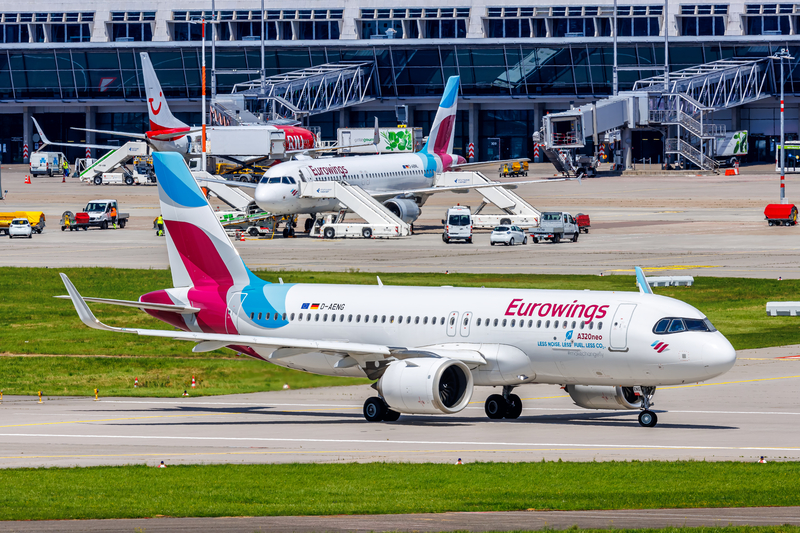
For decades, European medium-haul has lived with the same compromise: a 3–3 single-aisle cabin where “business class” is often just an economy seat with the middle blocked. Eurowings is now breaking that mold.
After a market trial, the Lufthansa Group leisure carrier will fit its Airbus A320neo fleet with a dedicated Premium BIZ zone that replaces the standard 2×3 layout with a 2×2 layout in the first two rows—eight seats total. It’s a small footprint, but a big statement: Eurowings is betting that there’s real demand for “true” premium space on three- to six-hour sectors, without jumping to a widebody.
The hardware: Geven “Comoda” seats and a deliberate capacity trade
The Premium BIZ seat chosen is the “Comoda” model from Italian manufacturer Geven. The promise is straightforward: fewer seats up front, more room per passenger, and a premium service flow that feels closer to long-haul than intra-Europe.
Read our stories in your inbox
Two aviation newsletters. Zero fluff.
What Eurowings is adding to those first two rows:
-
2×2 layout (no middle seats, and fewer neighbors)
-
Adjustable footrest and noticeably increased personal space
-
USB power at-seat
-
Pillow, blanket, and amenity kit
-
A service upgrade including an aperitif, hot meal served on porcelain, and a broader beverage selection
There’s also an economics angle airline planners will recognize immediately. Converting the first two rows from 3–3 to 2–2 reduces capacity by four seats in that zone (12 → 8). Eurowings is willingly giving up seat count for yield—essentially trying to capture premium demand without turning the rest of the cabin into a higher-fare product.
Proof point: Berlin (BER)–Dubai (DXB) was the testbed
Eurowings first put the concept into the market on its Berlin Brandenburg (BER)–Dubai (DXB) route, a longer medium-haul sector where comfort and space matter more than on a 90-minute hop. The airline began flying BER–DXB in October 2023, building the route from an initial four weekly flights to a much denser seasonal schedule—exactly the type of market where premium upsell has room to breathe.
That BER–DXB trial produced the feedback Eurowings wanted to see: higher customer satisfaction tied to personal space, privacy, and the service concept. The result is a commitment to install Premium BIZ across all eight of Eurowings’ A320neo aircraft—meaning the entire A320neo subfleet becomes eligible to operate with the 2×2 front zone.

Where the Premium BIZ seats are likely to show up next
Eurowings hasn’t published a final route list yet, but its stated target is clear: longer medium-haul flying where travelers are most willing to pay for comfort.
Routes being eyed include:
-
Business-heavy links such as London Heathrow (LHR)
-
High-demand leisure markets such as Palma de Mallorca (PMI) and the Canary Islands—think Tenerife (TFS) and Gran Canaria (LPA)
This is a smart allocation pattern. Premium BIZ only works if the airline can consistently sell those eight seats—either to true business travelers or to leisure passengers who will pay for a “special trip” upgrade on flights long enough to feel it.
Why this matters in Europe: a real premium seat, not just a blocked middle
The significance here isn’t that Eurowings added a new fare bundle. It’s that it changed the physical cabin standard.
In the European market, most single-aisle “business class” products keep the same seat shell and rely on service, lounge access, and the blocked middle seat to justify the fare. Eurowings is moving closer to what U.S. travelers would call domestic First: a physically distinct forward product, even if it’s only eight seats.
It also positions the airline neatly in the “value carrier” lane it keeps talking about: not a full-service network airline like Lufthansa at Frankfurt (FRA) or Munich (MUC), and not an ultra-dense low-cost operator. Instead, Eurowings is trying to sell an upgrade that feels meaningful—while keeping the base fare and core cabin economics intact.
What to watch operationally
Airline professionals will be watching a few practical details as the rollout spreads beyond BER–DXB:
-
Conversion and consistency: how quickly the eight A320neos are standardized and how reliably Premium BIZ appears on the routes it’s sold on
-
Service flow and crew workload: premium meals and porcelain service on a single-aisle changes galley sequencing and can affect turn performance at busy stations
-
Revenue performance: whether the higher yield from eight seats offsets the lost seat count and the heavier premium service cost
-
Competitive response: whether other European carriers move beyond blocked-middle business class on longer medium-haul sectors
Bottom Line
Eurowings is making one of the more interesting narrowbody cabin moves in Europe: installing eight true 2×2 Premium BIZ seats on all eight of its Airbus A320neo aircraft after a successful trial on Berlin (BER)–Dubai (DXB). It’s a calculated trade—fewer seats up front in exchange for higher-yield comfort on routes where passengers actually feel the difference.
If Eurowings can place the product on the right longer sectors—think London (LHR) and premium-heavy leisure markets like PMI, TFS, and LPA—this could become a template for how European “business class” evolves on single-aisle aircraft: less symbolism, more substance.
Keep reading FlyMag
Get the Daily Brief in the morning or the Route Watch weekly recap on Fridays. Or both.