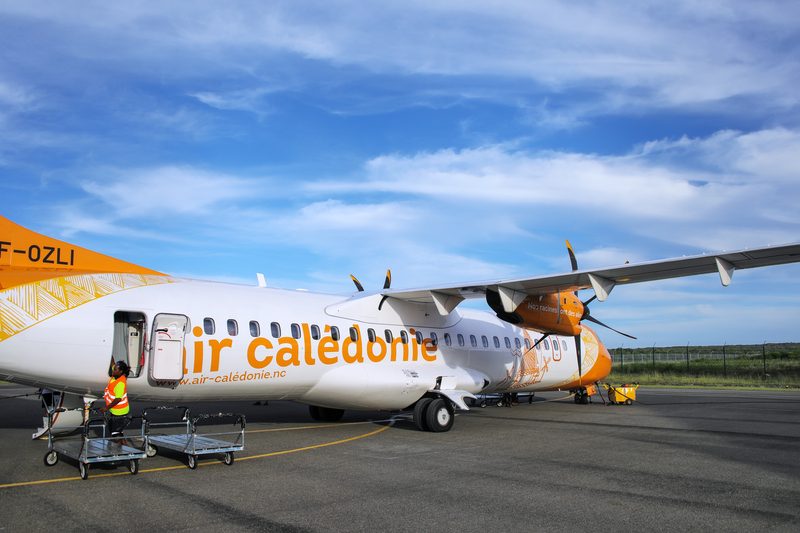
Air Calédonie has furloughed nearly half of its workforce after two weeks of network paralysis caused by airfield blockades across New Caledonia, pushing the carrier into what now looks less like a temporary operational dispute and more like a genuine solvency crisis.

The airline says about half of its 220 employees have been placed on reduced-hours furlough as it tries to conserve cash while flights remain suspended. That is an extraordinary step for a small domestic carrier whose role in the archipelago goes far beyond commercial air service. Air Calédonie is a lifeline airline. And right now, that lifeline is effectively cut.
This Is A Blockade Crisis, But Also A Structural Crisis
The immediate trigger is clear enough.
Read our stories in your inbox
Two aviation newsletters. Zero fluff.
Flights have been grounded since March 2 as local groups, including customary leaders and residents from affected communities, have blockaded access to key airfields. The protests are tied to Air Calédonie’s controversial plan to move its operations from Nouméa Magenta Airport (GEA) to La Tontouta International Airport (NOU), around 40 kilometers away.
On paper, the relocation is a rational financial measure. New Caledonia’s Congress backed the shift as part of a wider reform package, and public reporting says the move could save around 500 million CFP francs annually. For a financially fragile domestic carrier, those savings are significant.
But on the ground, the proposal has run directly into local resistance. For island communities, the move is not just an airport transfer. It is a question of access, travel time, affordability, and whether essential domestic air service becomes harder to use.
That is why the dispute has become so intractable. One side is focused on airline survival economics. The other is focused on real-world accessibility and the social cost of centralizing operations farther from Nouméa.
The Airline Is Running Out Of Time
What turns this from a labor-and-politics story into a serious aviation survival story is the cash position.
Air Calédonie has warned that without a resolution, its cash reserves could be exhausted by early April. That is only weeks away. Once a regional airline reaches that point, the options narrow brutally fast: emergency state support, bridge financing, or insolvency proceedings.
At that stage, even if flights eventually resume, the financial damage may already be deep enough to permanently weaken the carrier.
That is why the furlough decision matters so much. It is not a symbolic gesture. It is a liquidity defense measure. Airlines do not cut half their workforce to reduced hours unless management believes the business is entering a genuinely dangerous phase.
Magenta Versus La Tontouta Is About More Than Geography
The airport issue deserves closer attention.
Nouméa Magenta Airport (GEA) has long functioned as the practical domestic gateway for New Caledonia. It is closer to the city and more naturally aligned with short-hop inter-island flying. La Tontouta (NOU), by contrast, is New Caledonia’s main international airport and sits farther from the urban center.
From an airline-cost standpoint, consolidating at NOU may make sense. From a passenger-convenience and public-service standpoint, it is much more contentious.
That tension is especially acute in a place like New Caledonia, where domestic aviation is not a discretionary luxury for many residents. It is part of the connective tissue between communities, especially for the Loyalty Islands and the Isle of Pines. Any change that makes those journeys longer, more expensive, or more cumbersome quickly becomes political.
This Is Happening After Years Of Weakening Resilience
Air Calédonie is not entering this crisis from a position of strength.
The airline was already under heavy strain following the pandemic period and the severe unrest that hit New Caledonia in 2024. That matters because airlines with stronger balance sheets can sometimes absorb a two-week stoppage and still retain room to negotiate. Air Calédonie does not appear to have that luxury.
That is what makes the present situation so precarious. The blockades may be the immediate cause, but the airline’s vulnerability was already there. The current shutdown is exposing how little resilience remained in the system.
Employees Are Now Caught In The Middle
The workforce impact is also significant.
With around half of the airline’s staff furloughed, employees are now directly absorbing the cost of a dispute they do not control. That helps explain why the crisis has become so emotionally charged. For workers, this is no longer about abstract network reform. It is about jobs, pay continuity, and whether the airline they work for will still exist in recognizable form if the standoff drags on much longer.
This is one reason small regional airline crises can become politically sharper than larger-airline restructurings. In a place like New Caledonia, the airline is not just a company. It is a public utility in all but name.
Even A Partial Restart Would Matter
Air Calédonie has said it is ready to resume operations gradually if the blockades are lifted.
That point should not be overlooked. The airline is not talking about an all-or-nothing relaunch. It is signaling willingness to rebuild flight activity incrementally, which likely reflects the operational realities of getting aircraft, staff, airport access, and passenger handling back into sync after such a prolonged stoppage.
But readiness is not enough. Unless the access dispute is broken politically, the airline cannot restart itself.
And that is the uncomfortable heart of the story: this is now less an airline operations problem than a governance and negotiation failure with aviation consequences.
Bottom Line
Air Calédonie’s decision to furlough nearly half its workforce after two weeks of airfield blockades shows just how close the airline is to the edge.
The carrier’s flights have been suspended since March 2 because of blockades linked to its proposed move from Nouméa Magenta Airport (GEA) to La Tontouta International Airport (NOU). The airline says cash could run out by early April, and insolvency proceedings may become unavoidable if the standoff is not resolved quickly.
For aviation readers, the larger significance is clear. This is no longer just a route disruption story in a remote market. It is a case study in how fragile regional air connectivity becomes when financial weakness, political tension, and essential-service geography all collide at once.
Keep reading FlyMag
Get the Daily Brief in the morning or the Route Watch weekly recap on Fridays. Or both.