Major U.S. airlines have challenged Air China’s attempt to operate two additional roundtrips between Beijing and the U.S. East Coast, arguing that temporary, event-related flying should not be added to the scheduled-service framework governing the restricted U.S.-China market.


Air China submitted a schedule supplement to the U.S. Department of Transportation on September 14 covering extra flights from Beijing Capital (PEK) to New York JFK (JFK) and Washington Dulles (IAD). The carrier said the capacity would support travel connected with high-level meetings in the United States.
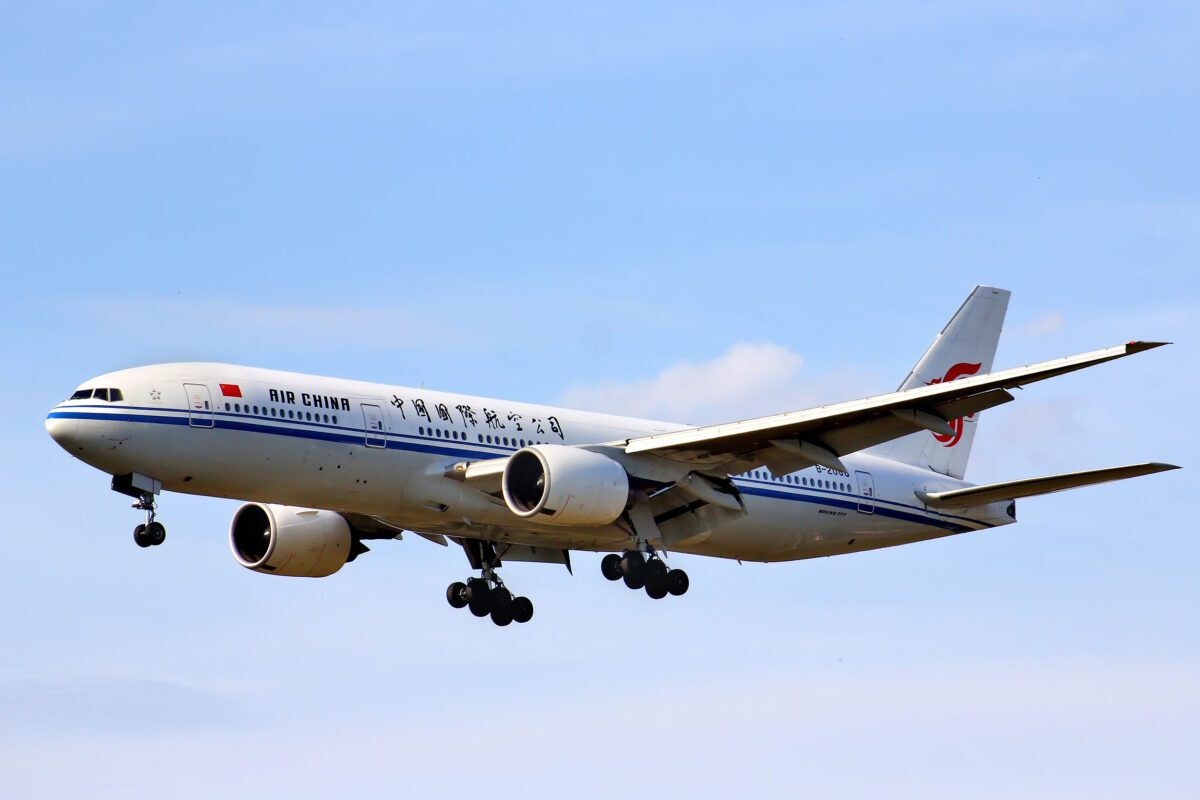
The New York roundtrip was scheduled for September 19, while the Washington operation was set for September 25. The JFK flight operated separately from Air China’s normal CA981 service, using a Boeing 777-300ER.
Read our stories in your inbox
Two aviation newsletters. Zero fluff.
Airlines for America filed an objection on September 17 on behalf of its participating passenger-airline members, which include American Airlines, Delta Air Lines and United Airlines. The association asked DOT for expedited treatment, although the objection did not prevent the New York flight from operating.
A4A Wants the Flights Treated as Charters
The dispute is not primarily over Air China’s ability to move passengers connected with a temporary diplomatic event. It concerns the regulatory category under which those passengers are carried.
Air China filed the additions as supplements to its scheduled operations under Part 213, the mechanism DOT uses to review and approve schedules filed by certain Chinese carriers. A4A argues that a pair of flights tied to a specific event is fundamentally different from recurring scheduled service and should instead be handled as extraordinary or charter flying under Part 212.
The association warned that accepting event-specific flights as schedule supplements could create a route for Chinese airlines to add capacity incrementally above the aggregate level set by DOT. A carrier could then point to the accepted supplemental operation when seeking similar treatment for later additions.
The distinction matters because Chinese airline schedules remain subject to a ceiling rather than the full capacity rights available under the bilateral air services agreement. In Order 2024-2-21, DOT authorized the designated Chinese passenger carriers to operate an aggregate 50 weekly roundtrips from March 31, 2024. The department retained the requirement that individual schedules be filed and expressly approved.
A4A’s position is that short-term demand can be accommodated without altering that scheduled allocation. Treating the flights as charters would allow the operation while keeping them outside the baseline used to measure recurring Chinese carrier capacity.
Russian Airspace Remains Central to the Dispute
The objection also revives the unresolved competitive divide over Russian airspace. Chinese airlines can use Russian territory on some services between China and the United States, while U.S. operators do not. The resulting geography is especially important for flights linking northern China with New York and Washington.
Routing through or near Russia can reduce distance, block time, fuel consumption and crew-related costs. Avoiding that airspace can add enough time and fuel burn to affect payload, crew planning and the commercial viability of an East Coast nonstop.
American, Delta and United have consequently concentrated much of their current mainland China flying on gateways farther west. Air China, by contrast, can sustain nonstop Beijing links to both JFK and IAD under operating conditions that U.S. airlines say they cannot match economically.
This is not a new argument. In an April 2024 letter to the secretaries of State and Transportation, A4A and several airline labor groups urged the U.S. government to pause further China frequency increases until U.S. airlines and their employees received equal market access. The groups specifically identified Chinese carriers’ continued access to Russian airspace as a competitive advantage.
The latest objection applies that broader policy argument to two individual flights. A4A contends that the U.S. government should not expand Chinese scheduled capacity, even temporarily, in East Coast markets where the airspace disparity is most consequential.
The 777-300ER Fits Air China’s East Coast Network
The Boeing 777-300ER used for the New York addition is Air China’s principal high-capacity long-haul type for several intercontinental markets. Air China’s published fleet information lists 311-seat and 392-seat versions of the aircraft, allowing the airline to match a premium-heavy layout or a denser configuration to demand.
Boeing lists the 777-300ER with a range of up to 7,500 nautical miles and typical two-class capacity of 350 to 425 passengers. Its combination of range, belly capacity and passenger volume makes it well suited to Beijing-East Coast missions, although the commercial performance of those flights remains sensitive to routing and seasonal winds.
That capacity also explains why the regulatory classification of only two roundtrips has drawn attention. A single additional 777 operation can place several hundred seats in the market in each direction. More importantly for A4A, approving the flights as scheduled service could carry implications beyond the immediate seat increase.
DOT Faces a Question of Precedent
The New York flight’s operation before DOT resolved the objection limits the practical effect of any subsequent decision on that sector. The Washington flight, however, remained scheduled for September 25 when A4A lodged its challenge.
DOT can allow the operation without necessarily accepting Air China’s preferred classification. It could determine that the flights belong under the charter rules, or otherwise make clear that the event-related additions do not enlarge Air China’s recurring scheduled entitlement.
The department’s response will be watched for how it defines the boundary between schedule adjustments and extraordinary flying in a market still governed by post-pandemic capacity controls. A narrow decision would preserve flexibility for one-off operations. A broader acceptance of supplemental scheduled flights could invite similar filings from Chinese carriers whenever temporary demand exceeds their approved timetable.
Bottom Line
Air China gains immediate flexibility from treating the flights as scheduled supplements: it can deploy a large widebody within its established passenger operation without creating a separate charter structure. For the U.S. carriers, however, the issue is cumulative. A series of individually small supplements could gradually weaken a capacity regime designed around explicit aggregate limits and approved schedules.
The dispute also shows that restoring flight numbers alone will not normalize the U.S.-China market. Russian airspace has changed the economics of northern transpacific routes, leaving Chinese airlines with a structural advantage in Beijing-East Coast markets. Until governments resolve that difference, American, Delta and United are likely to oppose additional Chinese capacity more aggressively than the headline number of flights might suggest.
The point to watch is whether DOT separates permission to operate from recognition as scheduled service. A decision preserving the flights while excluding them from Air China’s recurring baseline would meet the immediate transportation requirement without establishing the precedent A4A fears. Acceptance without such a limitation would give Chinese airlines a potentially important mechanism for adding capacity around the edges of the 50-frequency framework.
Keep reading FlyMag
Get the Daily Brief in the morning or the Route Watch weekly recap on Fridays. Or both.