Breeze Airways is moving into the next phase of its international expansion, with seven route launches spread across Tampa, Pittsburgh, Columbus and Richmond between October 2026 and January 2027.

The program began October 3 with Tampa-San José service and continues with new links to Cancun and Montego Bay in December. January will bring four more routes: Pittsburgh to Cancun and Punta Cana, Columbus to Punta Cana, and Richmond to Cancun.
The schedule concentrates on leisure markets that fit Breeze’s point-to-point model while giving the airline several opportunities to test international demand without committing to daily service. Every route operates between two and three times weekly, limiting the initial capacity risk while still supporting conventional vacation stays.
Read our stories in your inbox
Two aviation newsletters. Zero fluff.
The Seven-Route International Rollout
The seven routes and their published schedules are:
- Tampa-San José: Service between Tampa (TPA) and San José (SJO) began October 3, operating twice weekly on Wednesdays and Saturdays.
- Tampa-Cancun: TPA-CUN begins December 19, operating Wednesdays and Saturdays.
- Tampa-Montego Bay: TPA-MBJ is scheduled to begin December 19. The twice-weekly route was initially planned for February but was delayed following the effects of Hurricane Melissa in western Jamaica.
- Pittsburgh-Cancun: PIT-CUN begins January 7, 2027, with three weekly flights.
- Pittsburgh-Punta Cana: PIT-PUJ also begins January 7 and operates three times weekly.
- Columbus-Punta Cana: CMH-PUJ begins January 8 with twice-weekly seasonal service.
- Richmond-Cancun: RIC-CUN begins January 8 and operates on Mondays and Fridays during the winter and spring season.
The first route in the sequence has already entered service. Tampa International Airport said the October 3 launch to San José restored a nonstop connection between Tampa and Costa Rica after an absence of more than 25 years. Breeze is the only airline flying the city pair.
The published schedule gives Breeze a morning departure from TPA and an afternoon return from SJO. That pattern keeps the aircraft within a same-day rotation while accommodating the longer northbound block time caused by winds and the one-hour time difference during daylight saving time.
Tampa Becomes Breeze’s International Focus City
Tampa accounts for three of the seven route starts and has become the clearest focal point for Breeze’s overseas growth. The airline began TPA-Punta Cana service in July, added Nassau in June and followed with San José in October. Cancun and Montego Bay will take its international portfolio at TPA to five destinations by the end of 2026.
The Cancun schedule begins December 19, with flights leaving Tampa at 7 a.m. and returning from CUN at 9:55 a.m. local time. Breeze is also launching TPA-St. Thomas on December 16, although the U.S. Virgin Islands service is domestic for immigration purposes and is not part of the seven international routes.
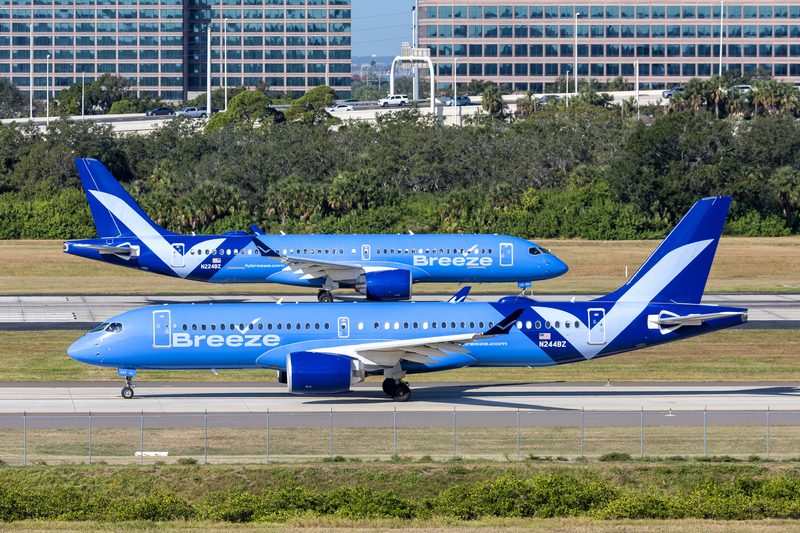
Montego Bay begins on the same date as Cancun. The Jamaican service had originally been positioned as Breeze’s first international route from Tampa, but its postponement changed the sequence. Nassau ultimately became the airline’s first international destination from TPA, followed by Punta Cana and San José.
For Tampa, the five-country network is more significant than the number of weekly departures suggests. Breeze is applying its domestic strategy to international markets: using limited frequencies to open nonstop links where local traffic exists but may not support daily narrowbody capacity.
Pittsburgh Gets Two Routes on the Same Day
Pittsburgh will receive the largest international expansion outside Tampa. The airport’s published destination schedule lists Breeze flights to Cancun and Punta Cana beginning January 7, with each route operating three times weekly.
Launching both routes together gives Breeze a six-flight weekly international operation at PIT. Cancun and Punta Cana are established leisure markets from Pittsburgh, but Breeze will enter alongside a mix of scheduled airlines and vacation-package operators rather than creating entirely new destinations for the airport.
That makes Pittsburgh a different proposition from markets such as Richmond. Breeze will compete for an existing pool of winter leisure traffic at PIT, using its bundled low-fare product and premium seating option rather than relying solely on the novelty of a new nonstop.
Columbus and Richmond Gain New Nonstops
Columbus-Punta Cana will be Breeze’s first international route from John Glenn Columbus (CMH). The airport says the flight will begin January 8 and operate twice weekly on a seasonal basis. Columbus has not had a nonstop link to Punta Cana for more than a decade.
The airport lists a scheduled flight time of approximately five hours and 30 minutes, making CMH-PUJ one of the longer sectors in Breeze’s network. Its twice-weekly pattern is tailored to leisure traffic and avoids adding more capacity than the local market is likely to absorb during the first season.
Richmond’s new Cancun service also begins January 8. According to Richmond International Airport, flights will operate on Mondays and Fridays, returning a Cancun nonstop to the region for the first time in more than 10 years.
The Monday-Friday pattern permits three-, seven- and 10-night trips without requiring Breeze to operate more than two weekly rotations. It is a typical schedule for an origin-focused leisure route where the carrier expects most passengers to begin their journeys in Richmond.
The Airbus A220 Makes the Network Possible
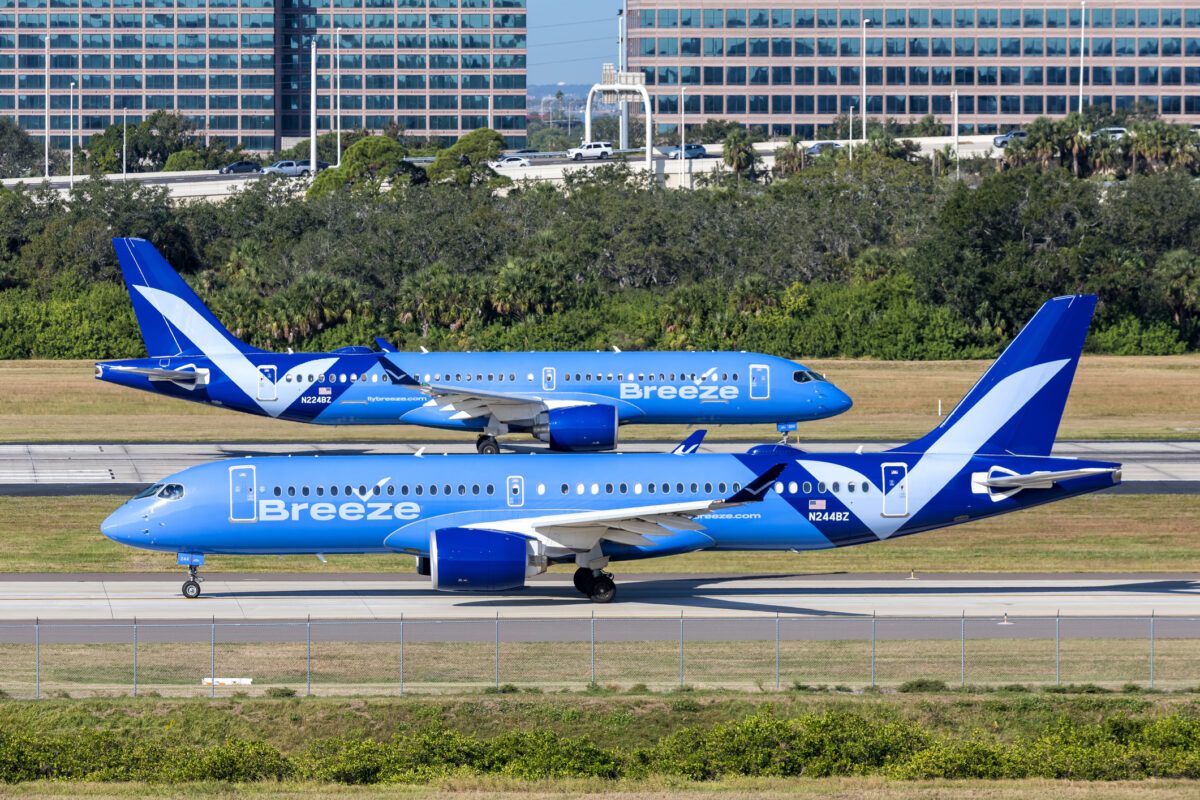
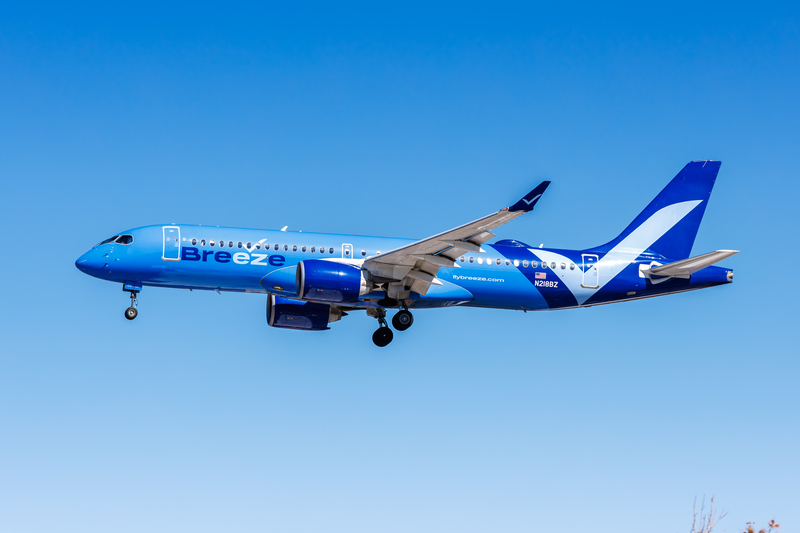
Breeze’s international strategy is built around the Airbus A220-300. The airline has operated international services with a 137-seat configuration, including premium Ascent seating at the front and a five-abreast economy cabin behind it.
The A220’s capacity is central to the economics of these routes. It provides substantially fewer seats than the 180- to 190-seat configurations common on larger single-aisle aircraft while retaining the range needed for sectors such as Columbus-Punta Cana.
Airbus lists the A220-300 with a maximum range of about 3,450 nautical miles and typical seating for 120 to 160 passengers. That combination allows Breeze to pursue thin international markets without stepping up to the capacity of an Airbus A320 or Boeing 737.
The aircraft’s two-three cabin layout also supports Breeze’s differentiated onboard product. The airline can sell a small premium section while retaining a low base fare in the main cabin, an important revenue feature on vacation routes where demand ranges from price-sensitive families to travelers purchasing resort packages.
Bottom Line
The international buildout is a logical extension of Breeze’s domestic model rather than a move toward a conventional hub-and-spoke network. Tampa is emerging as the airline’s strongest gateway, but even there Breeze is spreading capacity across several destinations at low weekly frequencies. That gives the carrier broad market coverage without tying multiple aircraft to daily international rotations.
The A220-300 is what makes the strategy credible. Its range permits Breeze to serve the Caribbean and Central America from cities as far north as Pittsburgh and Columbus, while its 137-seat configuration lowers the passenger volume required to support a flight. The same aircraft can return to domestic flying between international rotations, preserving the fleet flexibility on which Breeze has built its network.
The next test will be frequency growth and seasonal retention. If Tampa, Pittsburgh, Columbus and Richmond support the initial schedules, Breeze has room to add departures before it adds destinations. Sustained service through the following summer would provide a stronger signal than a large route count alone, particularly in markets where several airlines already compete for the same winter leisure passengers.
Keep reading FlyMag
Get the Daily Brief in the morning or the Route Watch weekly recap on Fridays. Or both.