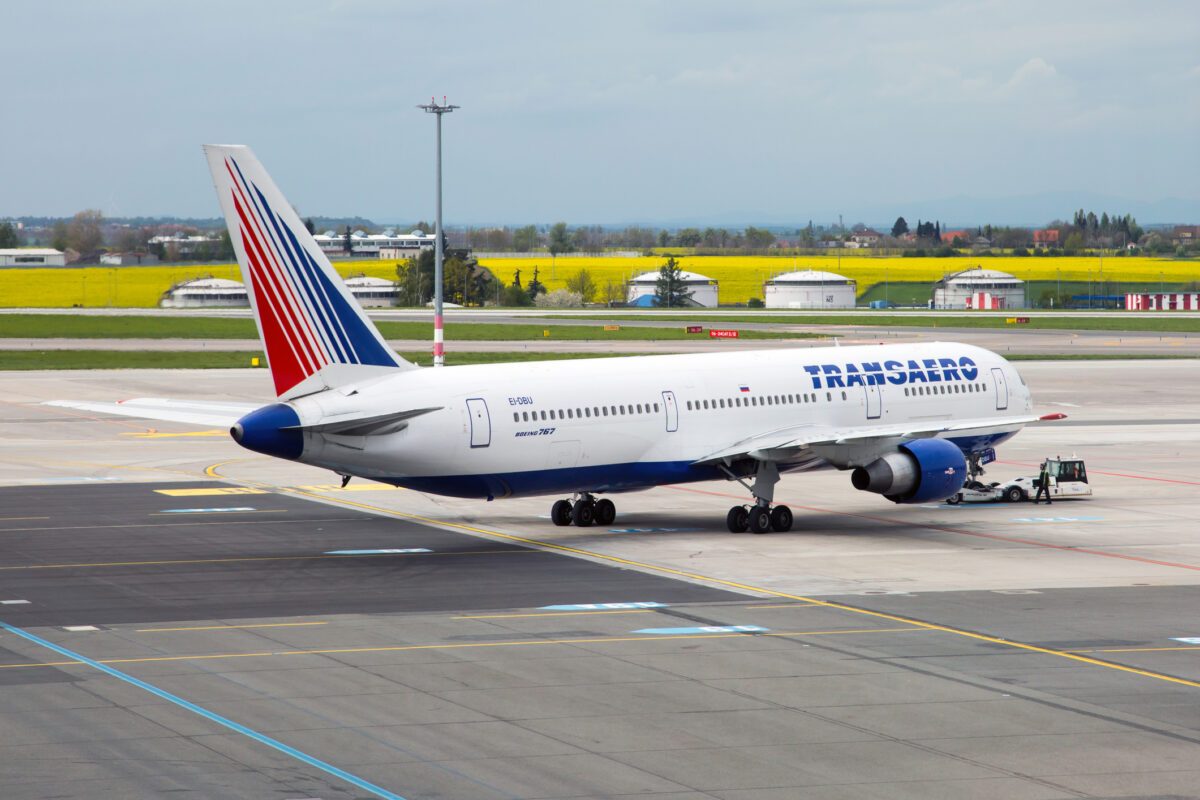
Transaero’s bankruptcy administrator has put a RUB174.03 billion claim against former chief executive Alexander Burdin up for sale, opening another phase in the liquidation of the Russian airline nearly 11 years after it stopped flying.
The electronic sale notice describes the asset as a claim arising from Burdin’s subsidiary liability for Transaero’s obligations. It comprises RUB171.49 billion, $31.63 million and €1,128, with the foreign-currency amounts valued at the exchange rate in effect on August 4, 2026.
The initial price is RUB174.03 billion. Applications open on September 21 and the public-offer process is scheduled to close on November 19.
Read our stories in your inbox
Two aviation newsletters. Zero fluff.
Price Can Fall to RUB17.4 Million
The sale is structured as a descending-price public offer rather than a conventional auction in which bidders raise the price. The claim will remain available at its opening valuation through October 23. If it does not sell, the price will fall through a succession of intervals beginning on October 24.
The first reductions are in 10% increments. The price drops to RUB156.62 billion, then RUB139.22 billion, RUB121.82 billion and RUB104.42 billion. It reaches RUB87.01 billion at the beginning of November and continues falling through shorter two-day bidding windows.

The scheduled price then declines much more sharply. It falls to RUB17.40 billion for November 9-10, RUB1.74 billion for November 11-12 and RUB174.03 million for November 13-14. The final interval, running from November 15 through November 19, values the claim at just RUB17.40 million.
That final price is approximately 0.01% of the opening figure. The structure does not change the amount legally claimed from Burdin; it changes what a buyer would pay to acquire the right to pursue collection. The eventual sale price will therefore provide a market assessment of the claim’s enforceability, the assets available for recovery and the time and legal expense required to realize any proceeds.
Bankruptcy administrator Alexey Belokopyt is listed as the organizer. Under the published terms, the successful bidder must sign the sale agreement within five days of receiving the administrator’s offer. A bidder that refuses or fails to complete the agreement forfeits its deposit.
Claim Follows Subsidiary Liability Proceedings
Subsidiary liability allows creditors or a bankruptcy estate to pursue a company’s controlling persons when the debtor’s own assets cannot cover its obligations and the legal conditions for personal liability have been met. The asset on sale is not an airline business, aircraft or operating certificate. It is the estate’s right to seek payment from Burdin under the liability established in the Transaero proceedings.
Burdin’s tenure needs to be distinguished from the period in which Transaero built its network and accumulated most of the obligations that preceded its collapse. According to the airline’s own corporate history, he served as chief executive from December 2015 until September 2017. Transaero had already ceased flying in October 2015.
His work centered on the carrier’s post-operational affairs, including staff reductions, ticket refunds, asset sales and debt collection. In a June 2016 company statement, Transaero said management under Burdin had directed RUB3.02 billion toward wage and leave-compensation payments while reducing the workforce from 10,600 people to 239. A later company announcement described the sale of technical equipment, ground-support assets, vehicles and office property through electronic auctions.
The claim now being sold arises from the subsequent bankruptcy litigation rather than from Burdin’s management of an operating airline. Transaero was formally declared insolvent in September 2017, with the court opening liquidation proceedings under case A56-75891/2015, according to the carrier’s bankruptcy notice.
The September sale also includes a second lot: a RUB469.16 million claim against former chief accountant Andrey Kovalev. The overall offering notice lists both claims as Transaero assets, although bidders can pursue them separately.

Fleet Complexity Framed Transaero’s Collapse
Transaero was Russia’s second-largest airline by passenger traffic before its failure and had built an unusually broad fleet spanning short-haul narrowbodies and large long-haul aircraft. Russian civil aviation records listed Boeing 737-300, 737-400, 737-500, 737-700 and 737-800 variants alongside Boeing 747-400s, 767s and 777s, as well as Tupolev Tu-204 and Tu-214 aircraft.
The Boeing 747-400 became the most visible type associated with the carrier. Transaero said it became the first Russian airline to operate the passenger 747 and later deployed the 747-400 on domestic services as well as high-density international leisure routes. The four-engine widebody gave the airline substantial capacity, but its economics depended on strong load factors and access to the financing, maintenance and foreign-currency revenue needed to support long-haul operations.
At the point of shutdown, Russia’s Federal Air Transport Agency said Transaero had 106 aircraft. The regulator cited the cost of maintaining airworthiness across a large, mixed fleet as one of the pressures created by the airline’s shortage of working capital.
Rosaviatsiya revoked Transaero’s air operator certificate effective October 26, 2015. Its inspection concluded that the airline could no longer independently service its debt or fully finance ongoing operations. The regulator also raised concerns over funding for crew training, aircraft maintenance and repairs.
Almost 2 million passengers held Transaero bookings during the managed shutdown, according to Rosaviatsiya’s account of the closure. Aeroflot Group airlines and other Russian carriers absorbed much of the remaining traffic, while leased aircraft were redistributed or returned to their owners.
Bottom Line
The sale converts a court-backed claim into a test of recoverability. Its headline value is enormous, but the scheduled descent from RUB174.03 billion to RUB17.40 million shows that the bankruptcy estate is prepared to accept a steep discount in exchange for transferring the cost and uncertainty of enforcement. A buyer would be acquiring litigation and collection exposure, not a predictable stream of payments.
For Transaero’s creditors, any completed sale would bring cash into an estate that has remained open since 2017 and remove one more contested asset from the administrator’s books. The amount recovered may be modest compared with the carrier’s liabilities, but the process marks a shift from establishing responsibility to attempting to monetize it.
The key point to watch is not simply whether a bidder appears at the opening price. Interest at one of the later intervals would reveal how specialist investors value the prospect of recovering assets from a former executive across a long-running Russian bankruptcy. If the claim reaches the final RUB17.40 million stage without a buyer, it would underline the gap between a liability recorded in court proceedings and the cash value the market assigns to enforcing it.
Keep reading FlyMag
Get the Daily Brief in the morning or the Route Watch weekly recap on Fridays. Or both.