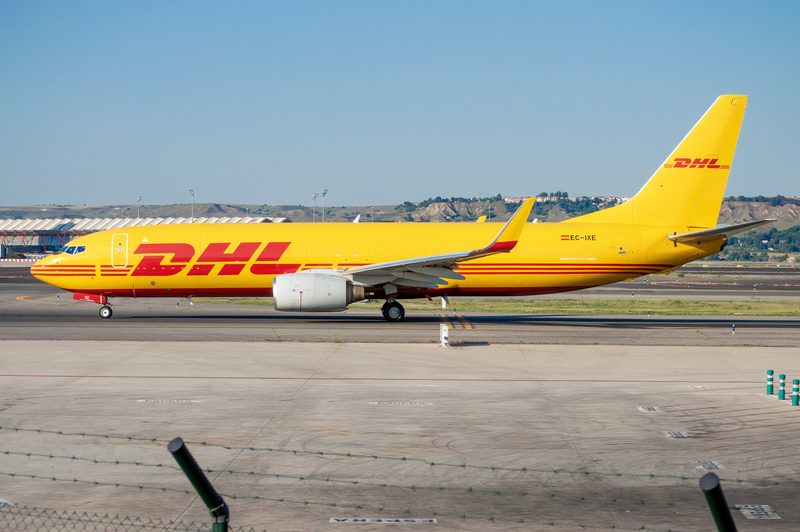
DHL Aviation has reinforced its Sub-Saharan Africa air network with the introduction of two dedicated Boeing 737-400 freighters, unveiled in Lagos at Murtala Muhammed International Airport (LOS). For West Africa’s time-critical shippers, the move is less about a headline aircraft count and more about what dedicated lift changes operationally: tighter cut-off times, more predictable uplift, and fewer failure points when volumes spike.
For an integrator, capacity isn’t just “more tonnes.” It’s network elasticity—having the right gauge aircraft in the right place so cargo can keep moving even when roads slow, flights misconnect, or demand surges in a single lane overnight. Positioning two 737 freighters at LOS targets exactly that problem set in one of the region’s most important commercial gateways.
Why Lagos (LOS) is a High-Impact Place to Add Dedicated Lift
Lagos is an anchor market for West Africa: population scale, business density, and cross-border trade all converge in a way that quickly exposes logistics bottlenecks. When export and import flows are peaky—think perishables, healthcare shipments, and fast-turn e-commerce—reliability becomes as valuable as raw capacity.
Read our stories in your inbox
Two aviation newsletters. Zero fluff.
A dedicated freighter presence at LOS helps stabilize the system in three practical ways:
-
Frequency and recoverability: A scheduled freighter rotation is easier to protect and recover than ad-hoc uplift, especially when volumes require firm capacity commitments.
-
Better lane control: Integrators can shape flows to match sort windows and downstream linehaul connections, rather than inheriting whatever belly capacity happens to exist.
-
Service consistency beyond the largest cities: Dedicated lift supports more dependable feeder patterns, which matters when smaller stations are sensitive to missed connections.
In short, basing more aircraft at LOS isn’t just a Nigeria play—it’s a West Africa connectivity play.
The Aircraft Choice: Why the Boeing 737-400 Freighter Fits This Mission
The Boeing 737-400 freighter is a proven workhorse for short-to-medium haul cargo, sized for dense regional sectors while still offering jet speed and strong dispatch reliability. Most 737-400 freighters in today’s market are passenger-to-freighter conversions, built around the Classic-series platform with CFM56-3 engines—an ecosystem with deep maintenance familiarity and wide global support.
From an operator’s perspective, the type sits in a “sweet spot” between turboprops and widebodies:
-
Right-gauge payload: Typical payload capability is around the 20-tonne class, ideal for nightly express and high-priority commercial freight without oversupplying thinner lanes.
-
Pallet-friendly main deck: The 737-400F layout supports standard pallet positions on the main deck, accelerating turn times when ground handling is properly tooled.
-
Airport flexibility: Compared with widebodies, the aircraft is well suited to airports that may have operational constraints—whether runway, ramp congestion, or limited widebody-compatible infrastructure.
For West Africa’s air cargo network design, the 737-400F is the kind of asset that enables “many lanes, many frequencies”—the exact recipe integrators prefer when service promises are time-definite and penalties for missed connections are real.
What Improves for Shippers: Transit Time, Predictability, and Network Reach
DHL’s stated objective with the Lagos (LOS) additions is straightforward: improve transit times and delivery reliability while extending network reach across West Africa and into key intercontinental trade lanes.
The big operational win is schedule integrity. When cargo is injected into a network at a predictable time, sort operations can run cleaner, misconnect rates fall, and downstream uplift can be planned rather than improvised. That’s especially relevant for commodities where minutes matter:
-
Perishables that require dependable cold-chain handoffs and minimal dwell time
-
Life sciences and healthcare shipments that are time- and temperature-sensitive
-
E-commerce volumes that surge unevenly and punish networks that can’t flex quickly
-
Energy and industrial parts that need reliable uplift to avoid costly downstream delays
Dedicated lift doesn’t eliminate disruption, but it gives the network more ways to recover without breaking service commitments.
Digitalization and Sustainability: The Network Layer Above the Aircraft
Modern express networks are increasingly differentiated by what happens around the aircraft. DHL has tied the Lagos (LOS) expansion to broader themes it has been pushing globally: digital tools to improve planning and visibility, and sustainability initiatives aimed at reducing operational waste and emissions.
In practical terms, that typically means:
-
Better shipment visibility and exception management (the difference between “it’s delayed” and “we know where it is, why, and what the recovery plan is”)
-
Smarter routing and load planning to reduce empty space and unnecessary repositioning
-
Incremental emissions improvements through operational efficiency and, where available, lower-carbon energy inputs
For aviation professionals, this is the key point: adding aircraft is only half the solution. The bigger performance gains come when lift, sort capacity, linehaul timing, and data all align into a system that behaves predictably at scale.
Bottom Line
Two Boeing 737-400 freighters based in Lagos (LOS) may sound like a modest fleet note, but in integrator economics, location and mission profile matter more than headline numbers. This is a targeted capacity play aimed at improving schedule integrity, recoverability, and service consistency across West Africa—exactly where demand growth is exposing the limits of ad-hoc capacity. If the network is the product, these aircraft are a meaningful upgrade to the part of the system that determines whether “on-time” is a promise or a guess.
Keep reading FlyMag
Get the Daily Brief in the morning or the Route Watch weekly recap on Fridays. Or both.