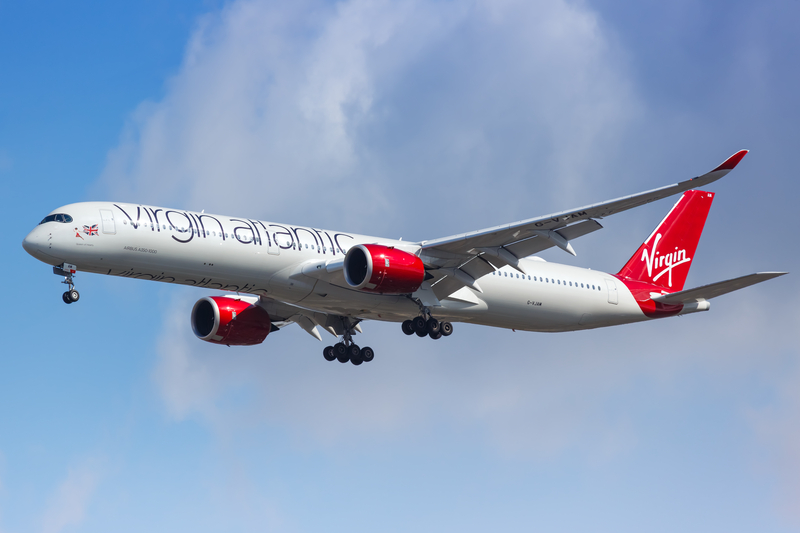
Virgin Atlantic flight VS8 from Los Angeles International Airport (LAX) to London Heathrow Airport (LHR) declared a general emergency while approaching the United Kingdom, after a serious onboard medical incident prompted the crew to request priority handling into Heathrow.

The aircraft involved was an Airbus A350-1000, registration G-VPRD, one of the flagship long-haul types in Virgin Atlantic’s fleet. While cruising at around 39,000 feet, the crew transmitted Squawk 7700, the internationally recognized transponder code for a general emergency, before beginning a more rapid descent toward Heathrow.
For aviation readers, the most important point is that this was not a technical diversion or a flight-control issue. Everything currently indicates that the emergency was medical in nature, with the aircraft continuing safely to its planned destination rather than diverting elsewhere.
Read our stories in your inbox
Two aviation newsletters. Zero fluff.
The Emergency Happened Late In The Flight
The timing of the event is notable.
Virgin Atlantic flight VS8 had already completed almost all of its transatlantic crossing from Los Angeles International Airport (LAX) to London Heathrow Airport (LHR) when the emergency was declared. By the time the Squawk 7700 code was set, the Airbus A350-1000 was already over the United Kingdom and within reach of its destination airport.
That matters operationally because crews facing a serious onboard medical event late in a long-haul sector often have to make a fast but highly structured decision: divert immediately to the nearest suitable airport or continue to the planned destination if it offers the quickest practical access to medical care. In this case, Heathrow was close enough that continuing to LHR while securing priority handling appears to have been the most efficient option.
Why Squawk 7700 Matters
When an aircraft squawks 7700, it is signaling to air traffic control that it is dealing with a general emergency.
That code does not identify the exact nature of the problem on its own. It can be used for a broad range of events, from a medical emergency in the cabin to a technical issue on the flight deck. What it does do is immediately elevate the aircraft’s priority within the air traffic system.
For VS8, the use of Squawk 7700 meant controllers could clear the aircraft more directly toward London Heathrow Airport (LHR), reduce delays in its arrival path, and coordinate emergency services in advance of landing. In a serious medical case, time on the ground often matters more than anything else, so using the emergency code is not unusual when the crew believes rapid arrival is necessary.
The Airbus A350-1000 Is Well Suited To Managing Such Events
The aircraft involved, the Airbus A350-1000, is one of the most advanced widebody airliners in commercial service.
In Virgin Atlantic’s fleet, the A350-1000 is used on premium long-haul routes and is equipped for modern long-range operations, including advanced communications systems that can support contact between the crew and medical support on the ground. While no aircraft can eliminate the seriousness of an onboard medical emergency, the A350’s systems and cabin environment do give crews a strong platform for managing non-routine events during long-haul flying.
That is especially relevant on routes such as Los Angeles International Airport (LAX) to London Heathrow Airport (LHR), where the aircraft may be carrying several hundred passengers for around 10 hours or more, making medical incidents a realistic possibility simply through the scale and duration of the operation.
Priority Handling At Heathrow Was The Right Move
Once the emergency was declared, air traffic control reportedly gave the Virgin Atlantic Airbus A350-1000 priority handling into London Heathrow Airport (LHR), with emergency services placed on standby ahead of arrival.
That is standard procedure, but it remains a crucial part of the response chain.
For a medical emergency, priority handling can save valuable minutes by reducing vectors, shortening approach sequencing, and ensuring ambulances or airport medical teams are in position as soon as the aircraft reaches stand. In many cases, the speed of the handoff from aircraft door to trained responders is exactly why crews choose to declare an emergency even when the airplane itself is operating normally.
This is one of the clearest examples of how the air traffic system supports safety beyond navigation alone. Controllers are not just moving aircraft efficiently. They are helping crews get urgent situations onto the ground as fast as possible.
A Medical Emergency Does Not Mean The Aircraft Was In Danger
Headlines involving a Squawk 7700 can sometimes make an event sound more dramatic than it actually was from an aircraft-handling perspective.
In this case, the emergency declaration appears to have been related to a serious passenger medical issue rather than any problem with the Airbus A350-1000 itself. That distinction matters. The aircraft was not reported to have suffered a systems failure, structural issue, or flight-control malfunction. Instead, the crew used the emergency framework available to them in order to expedite the arrival and get medical assistance to the affected person as quickly as possible.
That is exactly how the system is supposed to work.
Heathrow Remains The Obvious Destination For Westbound-To-Eastbound Medical Cases Near The UK
Because the aircraft was already over the United Kingdom, London Heathrow Airport (LHR) was the natural place to continue.
Heathrow offers full emergency response capability, extensive ground medical access, and the handling infrastructure expected of one of the world’s busiest long-haul hubs. For a Virgin Atlantic flight already nearing London, diverting elsewhere would likely only have made sense if the situation had deteriorated so sharply that the nearest possible runway mattered more than the quality of post-landing support.
Since the aircraft continued to Heathrow, it strongly suggests that the crew judged LHR to be the fastest and most suitable endpoint once the seriousness of the incident became clear.
Bottom Line
Virgin Atlantic flight VS8 from Los Angeles International Airport (LAX) to London Heathrow Airport (LHR) declared a general emergency over the United Kingdom after a serious onboard medical incident, prompting the Airbus A350-1000 to squawk 7700 and receive priority handling into Heathrow.
From an aviation standpoint, the event appears to have been handled exactly as it should have been: the crew used the emergency code, air traffic control cleared the way, and medical services were readied on the ground. The aircraft itself was not reported to have any technical issues. Instead, this was a reminder that emergency declarations are not only about airplanes in distress. They are also one of the most important tools crews have when a medical emergency makes every minute count.
Keep reading FlyMag
Get the Daily Brief in the morning or the Route Watch weekly recap on Fridays. Or both.