New Mexico just got a much faster way to reach the state’s most famous underground attractions—and a notable upgrade in air service size and sophistication along the way.
Starting Sunday, March 1, 2026, Contour Airlines begins daily nonstop service between Albuquerque International Sunport (ABQ) and Cavern City Airport in Carlsbad (CNM). It’s one round trip per day, but the implications are bigger than the frequency suggests: CNM shifts from very small-gauge commuter flying to a 30-seat regional jet operation, with schedules designed to support both local trips and onward connections.
For Albuquerque (ABQ), the launch is also a milestone. Contour is debuting at the Sunport, bringing ABQ’s airline count to eight and adding another in-state link that strengthens connectivity beyond the traditional hub-and-spoke pattern most New Mexico travelers rely on.
Read our stories in your inbox
Two aviation newsletters. Zero fluff.
The operation: one daily round trip, built around workable day travel
Contour’s published timings for the ABQ–CNM leg are structured like a classic in-state “turn” that can serve two very different passenger profiles—day-trip travelers and those connecting onward at ABQ:
-
CNM → ABQ: departs 08:30, arrives 09:45 (daily)
-
ABQ → CNM: departs 11:45, arrives 13:00 (daily)

That’s about 1 hour 15 minutes in each direction—turning what is typically a multi-hour drive across the state into a same-morning arrival, with enough spacing to keep the aircraft productive and the schedule resilient.
The aircraft: why a 30-seat Embraer changes the economics
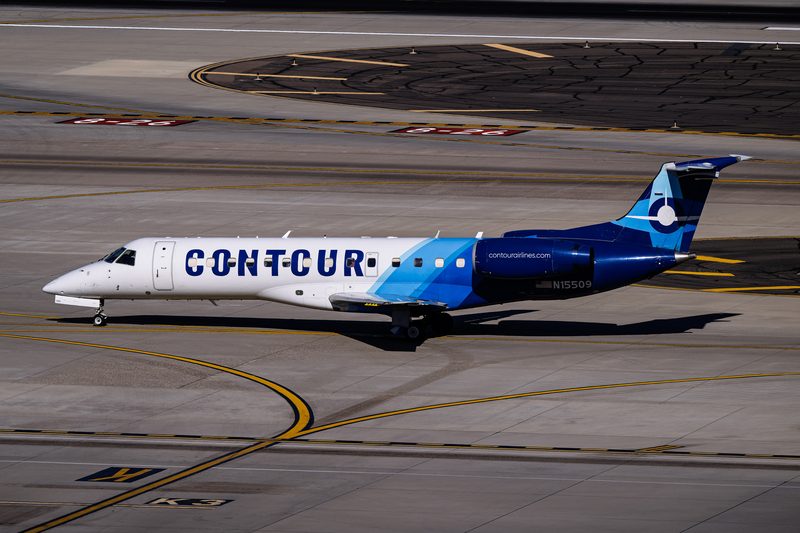
Contour is using a 30-seat regional jet on the route—an important detail because aircraft size is often the difference between “service exists” and “service is actually usable.”
Contour’s 30-seat flying is typically performed with Embraer ERJ-family regional jets configured down to 30 seats (commonly the Embraer ERJ-135 in Contour’s fleet). In airline terms, this is a “right-sized jet”: large enough to provide meaningful capacity and a real cabin experience, but small enough to make thin, state-level markets viable without relying on unsustainably high fares.

The operational advantages are tangible:
-
More seats without losing schedule discipline. A 30-seat jet can absorb demand spikes (tourism weekends, business cycles, university travel) without forcing the carrier into a bigger aircraft with a higher break-even load.
-
Better reliability and fewer constraints. Moving to a jet platform typically reduces some of the operational limitations that can come with very small-gauge aircraft, especially when weather or performance margins tighten.
-
Passenger experience closer to “mainline.” Contour markets extra legroom, complimentary snacks and beverages, and at least one free checked bag—small touches that matter when the alternative has often been minimal service on very small aircraft.

Carlsbad (CNM): from niche access point to a true gateway
CNM sits roughly five miles southwest of Carlsbad, and it’s the front door for a travel segment that doesn’t behave like typical regional demand: destination tourism anchored by Carlsbad Caverns National Park and the region’s bat flights, plus industrial and energy-sector travel tied to southeastern New Mexico.
That mix is exactly what Essential Air Service (EAS) communities often need: not a high-frequency shuttle, but a dependable link to a larger airport where travelers can connect to the rest of the network.
The EAS handoff: bigger aircraft, more total flying
The ABQ–CNM service continues the market’s role as an Essential Air Service (EAS) link—subsidized to ensure small communities maintain access to scheduled air travel.
Previously, the route had been operated with a much smaller aircraft. With Contour taking over, CNM’s total scheduled footprint grows in a way that matters for regional planners and airline strategists: 12 weekly flights are planned from Carlsbad, including daily ABQ service and five-days-per-week service to Denver (DEN).
That Denver (DEN) add is strategically important. DEN is a high-connectivity hub with strong domestic and international reach, and pairing it with ABQ gives CNM travelers two different connection engines—one in-state (ABQ) and one major hub (DEN)—without forcing a drive to El Paso (ELP) or a long surface journey to larger metro airports.
Contour’s agreement with the City of Carlsbad is structured as a four-year contract, giving the route time to mature and giving the airport a clearer runway to build demand.
Why ABQ benefits: diversification, connectivity, and a statewide network play
Albuquerque (ABQ) is not a traditional hub, but it behaves like one for much of New Mexico. Adding commuter-style intrastate lift helps ABQ in three ways:
-
Improves statewide access to ABQ’s network. Even one daily flight can meaningfully compress travel time for southern New Mexico residents connecting onward.
-
Adds resiliency through carrier mix. Sunport leadership has been consistent that diversifying airline partners is healthy—especially in a market where a few large carriers drive most capacity.
-
Creates a platform for future route growth. Commuter links are often the first step; if loads build and the EAS structure holds, secondary in-state markets become easier to justify later.
Bottom Line
Contour’s new daily Albuquerque (ABQ)–Carlsbad (CNM) nonstop, launching March 1, 2026, is more than a convenience flight. It’s a meaningful upgrade in aircraft gauge and network utility for southeastern New Mexico—moving CNM into 30-seat regional jet service with schedules designed for both local travel and connections. Paired with five-day Carlsbad (CNM)–Denver (DEN) flying, the result is a stronger, more flexible air link for tourism, business travel, and essential connectivity across the state.