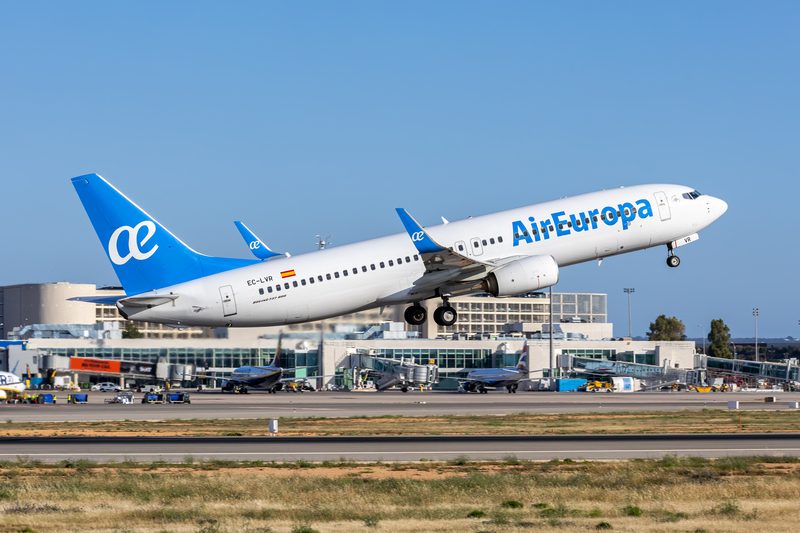
An Air Europa Boeing 737-800 suffered a serious landing incident at Palma de Mallorca Airport (PMI) after reportedly losing one of its wheels during touchdown, leaving the aircraft tilted on the runway and triggering an immediate emergency response.

The aircraft, registered EC-OBP and operating as flight UX6097 from Adolfo Suárez Madrid-Barajas Airport (MAD) to Palma, came to a stop at around 20:20 local time. Emergency crews were deployed quickly, and passengers were evacuated after the aircraft could no longer be handled through a normal arrival sequence.
For aviation readers, the key point is that this was not a routine hard landing or a minor tire issue. A wheel-loss event on touchdown is a serious landing-gear occurrence that can rapidly escalate into a runway-blocking emergency, especially at a high-volume airport such as Palma during busy traffic periods.
Read our stories in your inbox
Two aviation newsletters. Zero fluff.
The Incident Appears To Have Happened On Touchdown
Early reporting indicates that the problem occurred during the landing itself, when one of the aircraft’s wheels was reportedly lost during touchdown.
That matters because landing gear events tend to become especially critical at the exact moment when the aircraft is transitioning from flight to ground roll. At that stage, the loads on the landing gear are at their highest, directional control is essential, and any asymmetry can quickly turn a normal landing into a runway incident.
Iberia Celebrates 50 Years of the Iconic Barcelona-Madrid Air Shuttle, ‘Puente Aéreo’
The fact that the aircraft came to rest tilted on the runway strongly suggests the landing gear issue had a direct effect on the aircraft’s post-touchdown stability.
Emergency Services Responded Immediately
Once the aircraft stopped, airport emergency procedures were activated.
Firefighters, medical teams, and ground staff were sent to the scene to secure the aircraft and assist passengers. That is exactly how such an event should be handled. Even when there is no visible fire or structural breakup, a landing-gear incident has to be treated as a potentially unstable situation until responders confirm the aircraft is secure and passengers can be moved safely.
At airports like Palma, where traffic volume is high and turnarounds are constant, a runway event like this becomes both a safety issue and an immediate operational disruption.
Passenger Disembarkation Could Not Proceed Normally
One of the more important practical details is that passengers were not able to leave the aircraft in the normal way.
That reflects the seriousness of the stop position. When an aircraft is tilted or resting abnormally after a landing-gear problem, standard stairs or jet bridge access may not be immediately possible or safe. In those situations, evacuation or controlled deplaning must be managed according to the aircraft’s condition on the ground.
Even when there are no major injuries, this kind of irregular disembarkation usually signals that the airport and airline considered the aircraft’s post-landing condition serious enough to require special handling.
The Boeing 737-800 Is A Mature Type, So The Focus Will Be Narrow And Technical
The aircraft involved was a Boeing 737-800, one of the most widely used narrowbody aircraft in commercial aviation.

That matters because incidents like this are usually investigated as specific technical or maintenance events rather than as broad aircraft-type concerns. In other words, the presence of a wheel failure does not in itself suggest a wider issue with the 737-800 fleet. Investigators will instead be looking closely at the particular landing gear assembly, wheel condition, maintenance history, and touchdown sequence of this aircraft.
For Air Europa, the immediate task is likely to be preservation of evidence, detailed engineering inspection, and full reporting to the relevant authorities.
Palma’s Operations Were Likely Affected
Although the immediate priority was the aircraft and its passengers, the operational effect on Palma de Mallorca Airport (PMI) is also significant.
A runway incident involving a disabled aircraft can create knock-on delays very quickly, particularly at an airport that sees heavy leisure traffic and a dense schedule. Even a temporary runway blockage or restricted movement area can disrupt arrivals, departures, stand allocation, and ground handling for multiple airlines.
That is one reason these incidents matter beyond the aircraft itself. Their operational footprint is often much larger than the event that triggers them.
The Investigation Will Focus On The Landing Gear Event, Not Just The Missing Wheel
The obvious question is what caused the wheel to separate.
But investigators will likely go further than simply asking why a wheel was lost. They will examine whether the failure began with the wheel assembly, the axle area, the landing gear structure, or another mechanical issue that only became visible at touchdown. They will also look at the landing itself, including any abnormal loads or handling that may have contributed.
That is important because in aviation, what appears to be a wheel-loss event can sometimes be part of a broader landing gear or touchdown sequence issue.
No Confirmed Injuries Have Been Reported So Far
At the time of the initial reporting, no confirmed injuries had been publicly detailed.
That is the most encouraging element in the story. A landing-gear incident severe enough to leave a 737-800 tilted on the runway can easily produce injuries during the stop or evacuation. The absence of confirmed injury reports so far suggests the aircraft remained sufficiently intact and controllable for a survivable outcome.
Still, even when passengers walk away safely, the event remains serious. The difference between a contained landing gear failure and a much worse runway accident can be very small.
Bottom Line
Air Europa flight UX6097 from Madrid (MAD) to Palma de Mallorca (PMI) suffered a serious landing incident when its Boeing 737-800 reportedly lost a wheel during touchdown, leaving the aircraft tilted on the runway and forcing an emergency response.
The most important fact is that the aircraft stopped on the runway in an abnormal position, which immediately turned the event into both a safety emergency and an airport-operations disruption. The investigation will now focus on exactly how the landing gear failure developed and whether the wheel-loss event was an isolated component problem or part of a broader landing sequence issue.