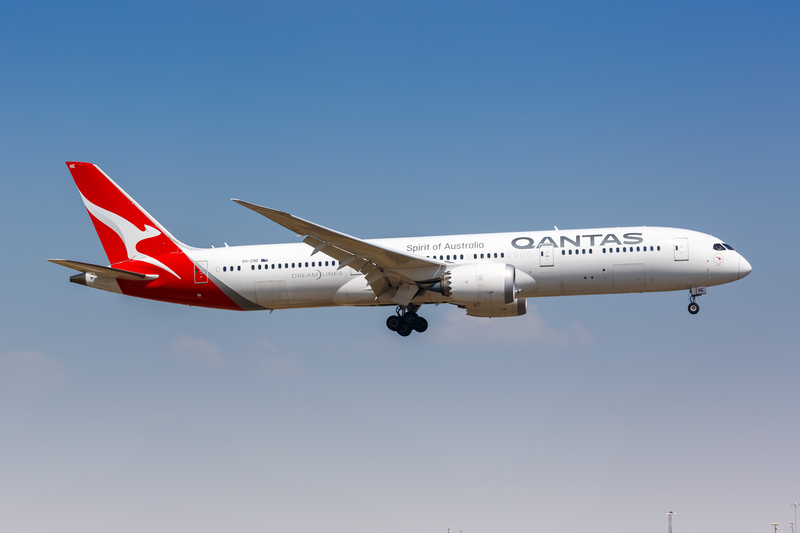
Qantas (QF) is adding a new long-haul headline to its network map: the airline will launch the first-ever nonstop scheduled service between Australia and Las Vegas (LAS), linking Sydney Kingsford Smith (SYD) with Harry Reid International (LAS) on a seasonal basis.

It’s a route that has existed in the demand data for years—Australians have long visited Las Vegas in big numbers—but until now it’s been a connection-heavy journey via Los Angeles (LAX), San Francisco (SFO), Dallas/Fort Worth (DFW), or other U.S. gateways. Qantas has also flown the sector as charters in recent seasons, but December 2026 will mark the first time the city pair appears as a scheduled Qantas service.
The basics: dates, aircraft, and flight numbers
Qantas will operate the service three times weekly on a Boeing 787-9 Dreamliner (B789), running from 29 December 2026 through 12 March 2027, timed to capture the southern-hemisphere summer peak and a run of major Las Vegas events.
Read our stories in your inbox
Two aviation newsletters. Zero fluff.
The flights are scheduled as:
-
QF55: Sydney (SYD) 21:00 → Las Vegas (LAS) 15:55 (same day), block time approx. 13h 55m
-
QF56: Las Vegas (LAS) 20:20 → Sydney (SYD) 06:35 +2 days, block time approx. 15h 15m
That “+2” arrival is the international date line in action—an important detail for connection planning, crew rostering, and passenger expectations.
Economy return fares have been advertised from AUD $1,099 (pricing will vary by date and availability). The route remains subject to government and regulatory approval, but tickets are already on sale.
Why the 787-9 is the right tool for a Vegas mission
This is where the aviation nerds can lean in. Great-circle distance between SYD and LAS is roughly 6,700 nautical miles, placing it in the long-range sweet spot of the 787-9—far enough to require true long-haul planning (ETOPS, dispatch alternates, payload discipline), but still within a reliable performance envelope for the type.
Qantas’ 787-9 configuration is also well suited to this kind of seasonal demand pattern: 236 seats total, split 42 Business, 28 Premium Economy, and 166 Economy. That’s a premium-heavy widebody by global standards, and it matters on a route like SYD–LAS where demand isn’t purely budget leisure. Las Vegas pulls a mix of convention traffic, events travel, higher-spend leisure, and premium holiday demand—exactly the segments that tend to populate Premium Economy and Business when the schedule is right.
Operationally, the 787 also gives Qantas flexibility that older widebodies don’t: lower trip costs relative to larger aircraft, strong range margins, and an ability to deploy capacity for a defined season without forcing an all-year commitment.
The schedule is built for network utility, not just novelty
The SYD departure at 21:00 is classic Qantas long-haul patterning: it’s late enough to gather feed from the domestic evening bank, then push across the Pacific to arrive mid-afternoon in Las Vegas—useful for hotel check-ins and same-day leisure plans.
On the return, the 20:20 LAS departure is a true long-haul overnight, arriving back into Sydney (SYD) at 06:35 two days later—an arrival that typically plays well with Qantas’ morning domestic bank for onward connections within Australia and across the Tasman.
For Qantas, the timing also helps with aircraft utilisation. A seasonal service that turns a widebody into productive overnight flying during peak demand months is the kind of deployment that protects overall network economics—especially when the airline is juggling high-demand U.S. trunk routes and other seasonal long-haul flying.
Why Las Vegas (LAS) now—and why it’s seasonal
Qantas is positioning this route in the same strategic bucket as its seasonal long-haul services to destinations like Rome (FCO) and Sapporo (CTS): places that spike hard at specific times of year and reward direct access when demand is concentrated.
Las Vegas fits that model well. The service window brackets a period when the city hosts major global draws—especially CES and the now-established NRL Las Vegas season-opening event that has already proven it can fill aircraft. Qantas’ recent NRL-linked charters to Las Vegas have reportedly sold out repeatedly, giving the airline real-world demand signals beyond the spreadsheets.
There’s also the macro picture: Las Vegas has become a stronger long-haul destination market than many people assume. Beyond the Strip, it’s the gateway to the Grand Canyon, Hoover Dam, Lake Mead, Red Rock Canyon, and the broader American Southwest—meaning the route isn’t just “Vegas weekenders.”
And from the Las Vegas side, Australia is a high-value inbound market. Tourism officials have been vocal that Australians already travel to Las Vegas in significant numbers, despite the lack of a nonstop.
What this means for Qantas’ Americas footprint
With LAS added, Qantas continues to broaden its presence across the Americas, where it already serves destinations including Los Angeles (LAX), San Francisco (SFO), Dallas/Fort Worth (DFW), Honolulu (HNL), New York (JFK) (via Auckland), plus Vancouver (YVR) and Santiago (SCL).
Las Vegas is a different proposition from the airline’s existing U.S. points. It’s not a traditional hub-and-spoke mega-connector like LAX or DFW. Instead, it’s a high-demand destination with strong event-driven peaks—exactly the kind of market where a carefully timed, seasonal widebody can outperform year-round “thin” flying.
Qantas also has a short-term incentive play attached: frequent flyers can earn double Qantas Points on eligible Qantas Hotels and holiday packages to Las Vegas booked within a limited early booking window—an example of how the airline is using loyalty economics to seed demand quickly for a new long-haul route.
Bottom Line
Qantas is launching a seasonal, three-times-weekly Boeing 787-9 Dreamliner service between Sydney (SYD) and Las Vegas (LAS) from 29 December 2026 to 12 March 2027, marking the first nonstop scheduled air link between Australia and Las Vegas. With a near 6,700 nm stage length, a premium-heavy 236-seat 787-9 cabin, and timings built around major Las Vegas events and Sydney hub connectivity, this is a deliberate capacity play—not a stunt.
If the loads follow the demand signals already seen on sold-out charters and peak-season travel patterns, SYD–LAS has the potential to become one of Qantas’ most strategically “modern” routes: seasonal, right-sized, and engineered to capture concentrated demand when it’s at its most profitable.
Keep reading FlyMag
Get the Daily Brief in the morning or the Route Watch weekly recap on Fridays. Or both.