Qantas will launch nonstop flights between Sydney and London from October 2027. The route will be the first scheduled nonstop service between Australia’s east coast and the United Kingdom.

The new service will connect Sydney Kingsford Smith Airport (SYD) with London Heathrow Airport (LHR). It will operate under Qantas’ long-awaited Project Sunrise program.
For Qantas, this is more than a new route. It is the final step in reshaping the Kangaroo Route, one of the most famous long-haul markets in aviation.
Read our stories in your inbox
Two aviation newsletters. Zero fluff.
A Daily Nonstop Link From SYD To LHR
Qantas says the Sydney (SYD)–London (LHR) service will begin in October 2027. Tickets are expected to go on sale in February 2027.
The airline plans to operate the route daily, subject to final aircraft certification and regulatory approvals. The nonstop flight will run alongside Qantas’ existing London services via Perth (PER) and Singapore (SIN).
That is important. Qantas is not replacing its current network. Instead, it is adding a faster, nonstop option for passengers who want to avoid a stopover.
The new flight is expected to cut up to four hours from the total journey time compared with current one-stop services. On a market as long as Australia–Europe, that is a major schedule advantage.
Project Sunrise Finally Has Its Launch Route
Qantas first announced Project Sunrise in 2017. The goal was simple but difficult: connect Australia’s east coast directly with London and New York.
London is now confirmed as the first route. That choice makes sense.
The Sydney (SYD)–London (LHR) market is central to Qantas history. The airline first flew between Sydney and London in 1947. Back then, the journey took four days and required seven stops.
Every new aircraft generation reduced the number of stops. Now Qantas is preparing to remove the last one.
For airline planners, that is the real story. Project Sunrise is not just about range. It is about turning a historic one-stop or multi-stop market into a true nonstop city pair.
The Aircraft: Airbus A350-1000ULR
The route will use the Airbus A350-1000ULR, a special ultra-long-range version of the A350-1000 built for Qantas.
Airbus developed the aircraft to fly from Sydney to London and New York nonstop. The type can cover almost 10,000 nautical miles, with flight times of up to 22 hours.
The key change is an additional rear centre fuel tank. Airbus says that tank increases the aircraft’s range by around 1,000 nautical miles.
Qantas says the aircraft will also carry an extra 20,000 litres of fuel. That makes the A350-1000ULR capable of operating more extra 20,000 litres of fuel. That makes the A350-1000ULR capable of operating more than 16,000 kilometres nonstop.
This is not a standard high-density A350-1000. Qantas has configured the aircraft around range, comfort and premium demand.
Only 238 Seats Across Four Cabins
Qantas has ordered 12 A350-1000ULR aircraft for Project Sunrise. Each aircraft will have 238 seats across four cabins.
That is a low seat count for an A350-1000. Many operators use the type with more than 300 seats.
Qantas made a different choice. The airline designed the aircraft for ultra-long-haul comfort rather than maximum density.
More than 40% of seats will be in premium cabins. The aircraft will include First, Business, Premium Economy and Economy.
The cabin will also feature a Wellbeing Zone, located between Premium Economy and Economy. It is designed for stretching, movement and hydration during the long flight.
That detail matters on a 20- to 22-hour sector. At this stage length, the onboard product becomes part of the route’s economics.
Passengers are not only buying speed. They are buying a more manageable version of ultra-long-haul travel.
A Cabin Designed Around Jet Lag
Qantas has worked with specialists on the Project Sunrise cabin. The airline says the onboard experience uses lighting, meal timing and cabin design to help reduce jet lag.
The A350 will include custom lighting scenes based on circadian-rhythm research. The goal is to help passengers adjust to the destination time zone before arrival.
That may sound like a passenger comfort story. However, it also has commercial value.
Ultra-long-haul flights require passengers to accept a very long time onboard. Qantas needs the experience to feel better than a one-stop journey, not just faster.
That is why Project Sunrise is different from a normal route launch. The aircraft, cabin and schedule all need to work together.
Why Qantas Chose London First
London was the natural first choice for Project Sunrise.
The United Kingdom remains one of Australia’s most important long-haul travel markets. It has strong demand from business travelers, leisure passengers, students, and visiting-friends-and-relatives traffic.
London Heathrow (LHR) also gives Qantas access to one of the world’s most important international gateways. Heathrow remains slot constrained, high yielding and highly competitive.
For Qantas, the nonstop Sydney (SYD)–London (LHR) service strengthens its position against one-stop competitors. That includes airlines routing passengers through the Middle East, Asia and other European hubs.
The new flight will also build on Qantas’ experience with nonstop Perth (PER)–London (LHR) service. That route helped prove that passengers would pay for a nonstop Australia–Europe option.
The Kangaroo Route Enters A New Era
The Kangaroo Route has changed dramatically since 1947.
The original Qantas service from Australia to the UK stopped in Darwin, Singapore, Calcutta, Karachi, Cairo, Castel Benito and Rome. It was a long journey by modern standards, but it was a major achievement at the time.
Today, Qantas can fly Perth (PER)–London (LHR) nonstop with the Boeing 787-9 Dreamliner. However, Sydney (SYD)–London (LHR) is a much longer challenge.
That is why Project Sunrise matters. It moves nonstop Europe service from Western Australia to the country’s largest aviation market.
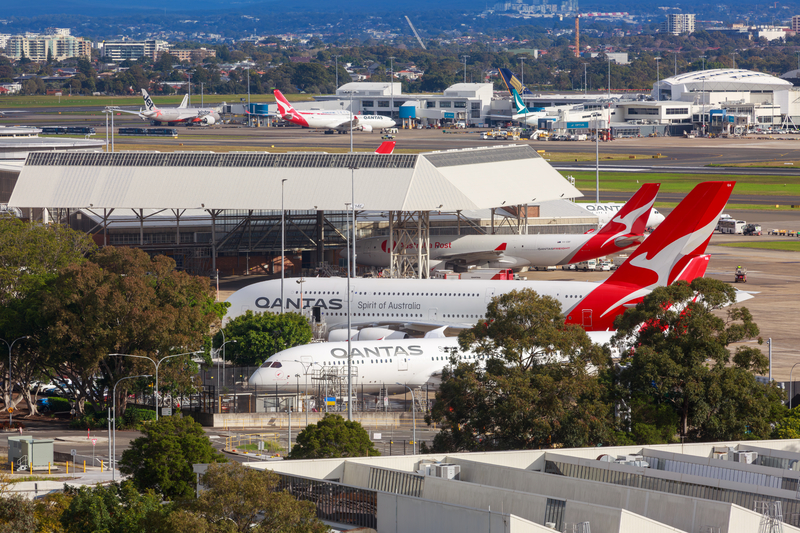
Sydney is Qantas’ main international hub. A nonstop London link from SYD gives the airline a stronger premium product from Australia’s east coast.
Sydney–New York Comes Next
Qantas also confirmed that Sydney–New York will be the next Project Sunrise route after London.
The airline has not announced the exact launch timing yet. More details are expected next year.
The likely airport pairing is Sydney (SYD) and New York John F. Kennedy International Airport (JFK), which has long been central to Qantas’ New York strategy.
That route would be another major milestone. It would give Qantas a nonstop link between Australia’s largest city and the largest U.S. premium travel market.
Together, Sydney–London and Sydney–New York show the larger aim of Project Sunrise. Qantas wants to make Australia’s east coast a true nonstop long-haul platform.
Strong Demand For Nonstop Ultra-Long-Haul Travel
Qantas says demand for nonstop ultra-long-haul flying is increasing.
The airline’s research found that 70% of Australian travelers would consider booking nonstop long-haul flights. Among premium travelers, that figure rises to 80%.
Those numbers explain why Qantas is willing to invest in a specialized fleet.
Ultra-long-haul flying is expensive to operate. The aircraft carries extra fuel, fewer seats and a premium-heavy cabin. Therefore, the revenue mix has to be strong.
That is where Sydney (SYD)–London (LHR) has an advantage. The route has deep premium demand and strong brand value. It also gives Qantas a product few competitors can match.
Operationally, This Will Be One Of Aviation’s Toughest Routes
A 22-hour scheduled flight is not simple.
Qantas must manage crew duty, aircraft utilization, fuel planning, alternates, passenger comfort and regulatory requirements. It must also train a large group of pilots, cabin crew and engineers for a new aircraft type.
The airline says more than 360 pilots and 1,200 cabin crew will be trained to operate the Project Sunrise A350 fleet by the time all 12 aircraft arrive.
That scale shows how much work sits behind the launch. This is not just a marketing milestone. It is a major operational program.
For Airbus, the aircraft is also important. The A350-1000ULR gives the manufacturer a showcase for the outer limits of modern long-haul aircraft performance.
Bottom Line
Qantas’ nonstop Sydney (SYD)–London Heathrow (LHR) service will be one of the most important route launches in modern aviation.
The daily Project Sunrise flight will use a specially designed Airbus A350-1000ULR with 238 seats, an added rear centre fuel tank and a cabin built for extreme long-haul travel.
It will also close the last gap on the Kangaroo Route. What once took four days and seven stops will become a single nonstop flight from Sydney to London.
For passengers, the appeal is simple: no stopover and a shorter journey. For Qantas, the route is much bigger. It is a flagship product, a premium network play and a statement about the future of ultra-long-haul flying.