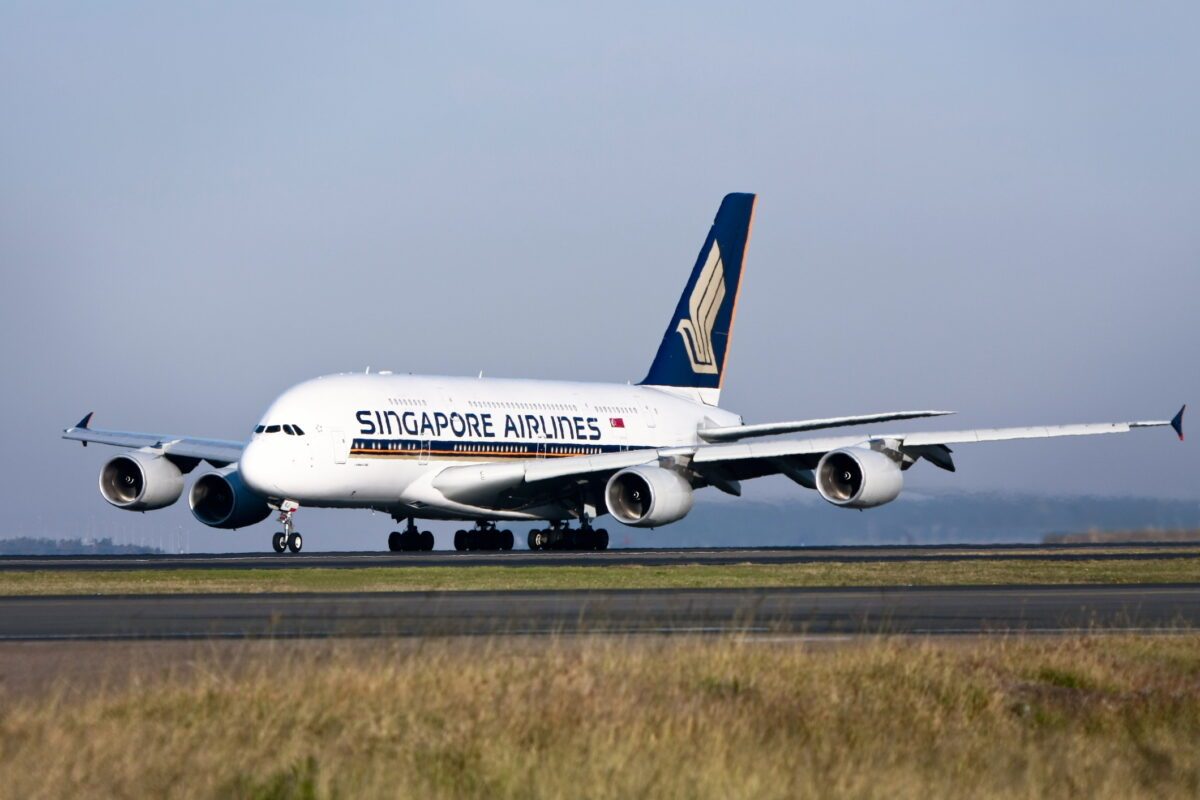
Singapore Airlines’ Airbus A380 network reaches 10 city pairs during 2026, although the aircraft does not serve all 10 destinations at the same time.
The year’s footprint combines the airline’s core A380 markets — notably London, Sydney, Delhi and Mumbai — with seasonal assignments and shorter deployments to Auckland, Dubai, Frankfurt, Hong Kong, Melbourne and Shanghai. Every route originates at Singapore Changi (SIN).
The distinction matters. The list describes destinations appearing in the A380 program at some point during the year, rather than a snapshot of the fleet on a single day. Aircraft assignments remain subject to change as Singapore Airlines moves capacity between markets and accommodates maintenance requirements across a fleet of only 12 superjumbos.
Read our stories in your inbox
Two aviation newsletters. Zero fluff.
The 10 A380 routes
A review of Singapore Airlines’ published flight schedule, route information and network announcements establishes the following 2026 A380 city pairs:
- Singapore Changi (SIN)-Auckland (AKL)
- Singapore Changi (SIN)-Delhi (DEL)
- Singapore Changi (SIN)-Dubai (DXB)
- Singapore Changi (SIN)-Frankfurt (FRA)
- Singapore Changi (SIN)-Hong Kong (HKG)
- Singapore Changi (SIN)-London Heathrow (LHR)
- Singapore Changi (SIN)-Melbourne (MEL)
- Singapore Changi (SIN)-Mumbai (BOM)
- Singapore Changi (SIN)-Shanghai Pudong (PVG)
- Singapore Changi (SIN)-Sydney (SYD)
London and Sydney form the backbone of the operation, with two daily A380 rotations scheduled to each city during substantial parts of the year. Those four round trips alone require four aircraft before accounting for maintenance cover or the remaining network.
Singapore Airlines’ own Sydney schedule published in March lists SQ221/222 and SQ231/232 as daily A380 services. The carrier supplements those flights with Boeing 777-300ER and Airbus A350-900 departures, allowing it to offer different departure banks and cabin products on the route.
At London, the airline’s route information identifies the A380 alongside the Boeing 777-300ER and Airbus A350-900. Heathrow’s slot constraints and the volume of connecting traffic available over Changi make London a natural market for the airline’s largest aircraft.
India and Australia remain central
Delhi and Mumbai give Singapore Airlines two shorter A380 sectors than its European and Australian trunk routes. Both are served with a mix of the superjumbo and the Boeing 787-10.
The airline’s current material confirms the A380 on services to both Delhi and Mumbai. The deployment adds Suites and Premium Economy inventory that is not available on the two-class 787-10, while also concentrating a large number of seats into one of each route’s daily departures.
Melbourne returned to the A380 map on selected services from March 31, 2026. Singapore Airlines’ Melbourne route page now lists the A380 alongside the A350-900 and 777-300ER. Together with Sydney, that gives Australia four scheduled A380 round trips on days when Melbourne receives the type and Sydney operates twice daily.
Auckland joins the program for the Northern Winter 2026 season. Under the Singapore Airlines-Air New Zealand schedule, SQ285 and SQ286 are due to operate daily with the A380 from October 25, replacing the 777-300ER on that rotation. Singapore Airlines will simultaneously reduce its own Auckland frequency from three daily services to two, trading frequency for gauge while Air New Zealand adds capacity under the partners’ joint venture.
Seasonal flying broadens the map
Frankfurt remains the second European point in the year’s A380 program. Singapore Airlines sells the route with a combination of the A380 and 777-300ER, according to its Frankfurt route information. The assignment gives the German market both Suites on the A380 and First Class on the 777, depending on the selected departure.
Hong Kong and Shanghai account for the limited-period East Asian deployments in the 10-route total. These shorter sectors offer Singapore Airlines a way to use an aircraft between longer overnight missions while placing substantial capacity into dense regional markets. They should not be read as uninterrupted, year-round A380 commitments: both appear only during defined parts of the schedule.
Dubai also needs qualification. Singapore Airlines originally announced that SQ494 and SQ495 would move from the 777-300ER to a daily A380 between March 29 and October 24, citing demand for premium cabins in its Northern Summer 2026 network plan. The airline’s current Dubai route information, however, lists the 777-300ER. Dubai therefore belongs in the aircraft’s 2026 published network footprint, but travelers should verify the operating type for their date rather than assume the original seasonal plan remains intact.
A 471-seat capacity tool
Singapore Airlines operates 12 A380-800s, a figure shown in its fleet development plan. Each aircraft has 471 seats: six Suites, 78 Business Class seats, 44 Premium Economy seats and 343 Economy seats.
The configuration is unusually premium-heavy for an aircraft of this size. Suites and Business Class occupy the upper deck, together accounting for 84 seats, while the main deck carries the large Economy cabin. The layout allows Singapore Airlines to add both premium inventory and total seat capacity when replacing a 777-300ER, A350-900 or 787-10.
The A380 has an advertised range of about 8,000 nautical miles, according to Airbus, comfortably covering every route in Singapore Airlines’ 2026 program. Its real value to the carrier is not range but concentration: 471 seats and four cabins can be placed into one slot at airports where additional frequencies are difficult, expensive or commercially unnecessary.
Bottom Line
The 10-route footprint shows Singapore Airlines using the A380 as a flexible capacity asset rather than rebuilding the broad superjumbo network it operated before the pandemic. London and Sydney justify multiple daily rotations, while Delhi, Mumbai and Melbourne provide regular high-volume work. The remaining markets absorb aircraft during seasonal peaks or selected schedule windows.
That strategy benefits premium-heavy routes because an A380 substitution does more than add Economy seats. It introduces six Suites and a 78-seat Business Class cabin, creating a significant change in both capacity and revenue mix. For Auckland, Singapore Airlines is explicitly exchanging one daily frequency for a larger aircraft while its joint-venture partner fills out the combined schedule.
The point to watch is aircraft availability. With 12 A380s supporting a program that can require most of the fleet on peak days, maintenance or operational disruption can quickly produce substitutions. The route count is therefore a useful measure of the A380’s reach during 2026, but London, Sydney and the established India flying remain the clearest indicators of where Singapore Airlines considers the aircraft strategically indispensable.
Keep reading FlyMag
Get the Daily Brief in the morning or the Route Watch weekly recap on Fridays. Or both.