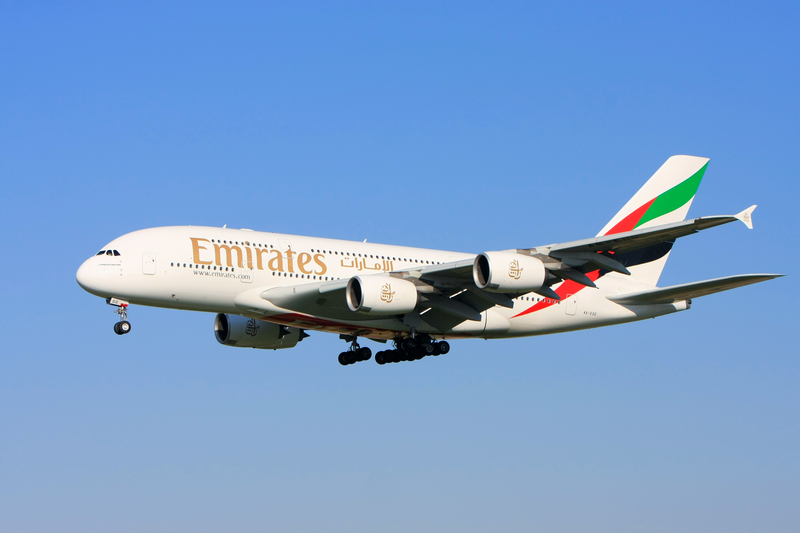
Emirates will begin regularly operating the Airbus A380 between Dubai International Airport (DXB) and Indira Gandhi International Airport in Delhi (DEL) on October 25, 2026, adding the world’s largest passenger aircraft to one of the airline’s busiest Indian routes.

The daily A380 service will operate as EK512 from Dubai (DXB) to Delhi (DEL) and EK513 from Delhi (DEL) to Dubai (DXB). The double-deck aircraft will replace a four-class Boeing 777-300ER on that rotation, while Emirates’ three other daily flights between the two cities will continue to use retrofitted four-class 777s.
The change gives Emirates four-cabin service—including Premium Economy—on every daily departure between Dubai (DXB) and Delhi (DEL). It also represents the first time the airline has scheduled regular A380 operations to the Indian capital.
Read our stories in your inbox
Two aviation newsletters. Zero fluff.
Emirates’ A380 Returns to Delhi After 16 Years
The October launch will not technically be the first appearance of an Emirates A380 at Delhi (DEL).
On July 15, 2010, Emirates operated a special A380 flight to celebrate the opening of Terminal 3 at Indira Gandhi International Airport (DEL). Flight EK516 arrived from Dubai (DXB), becoming the first commercial passenger flight to use the newly opened terminal.
That operation was ceremonial rather than the beginning of scheduled A380 service. The aircraft returned to Dubai (DXB) later that day, and Emirates continued serving Delhi (DEL) with Boeing 777 aircraft.
The new deployment therefore marks the A380’s return to Delhi almost exactly 16 years after that one-time visit, but this time as a permanent part of the published schedule.
Full Emirates Dubai-Delhi Schedule
Emirates plans to continue operating four daily round trips between Dubai International Airport (DXB) and Indira Gandhi International Airport (DEL). The A380 will be assigned to the late-night departure from Dubai and the early-morning return from Delhi.
The following schedule is filed for November 2026. All times are local and remain subject to operational or seasonal changes.
| Flight | Route | Departure | Arrival | Aircraft |
|---|---|---|---|---|
| EK510 | Dubai (DXB)-Delhi (DEL) | 4:20 a.m. | 8:55 a.m. | Boeing 777-300ER |
| EK516 | Dubai (DXB)-Delhi (DEL) | 9:55 a.m. | 2:40 p.m. | Boeing 777-300ER |
| EK514 | Dubai (DXB)-Delhi (DEL) | 3:10 p.m. | 7:55 p.m. | Boeing 777-300ER |
| EK512 | Dubai (DXB)-Delhi (DEL) | 9:30 p.m. | 2:10 a.m. +1 | Airbus A380 |
| EK513 | Delhi (DEL)-Dubai (DXB) | 4:10 a.m. | 6:35 a.m. | Airbus A380 |
| EK511 | Delhi (DEL)-Dubai (DXB) | 10:35 a.m. | 1:00 p.m. | Boeing 777-300ER |
| EK517 | Delhi (DEL)-Dubai (DXB) | 4:15 p.m. | 6:35 p.m. | Boeing 777-300ER |
| EK515 | Delhi (DEL)-Dubai (DXB) | 9:30 p.m. | 11:59 p.m. | Boeing 777-300ER |
Emirates has formally confirmed EK512 and EK513 as the A380-operated flights. Passengers should still consult the airline’s current Dubai-Delhi flight schedule before traveling because aircraft assignments and seasonal times can change.
Why Emirates Selected EK512 and EK513
The timing of the A380 rotation is commercially important.
EK513 is scheduled to arrive at Dubai International Airport (DXB) at 6:35 a.m. That places connecting passengers at the Emirates hub shortly before one of the airline’s largest departure waves to Europe, North America, Africa, and other parts of the Middle East.

The return flight, EK512, leaves Dubai (DXB) at 9:30 p.m. after numerous long-haul services have arrived from Europe, Africa, the Americas, and the Middle East. Passengers can connect through Dubai and continue to Delhi (DEL) without an extended overnight wait.
Assigning the A380 to this rotation allows Emirates to add seats where connecting demand is strongest without introducing a fifth daily flight. The strategy is less about the relatively short Dubai-Delhi sector itself and more about feeding Emirates’ wider global network.
It is a classic hub-and-spoke deployment: place the highest-capacity aircraft on the flight that connects with the greatest number of valuable long-haul markets.
A Major Upgrade Over the Boeing 777-300ER
Emirates has confirmed that the Delhi (DEL) service will use a four-class A380 with First Class, Business Class, Premium Economy, and Economy Class.
The airline has not specified the exact seating layout or aircraft subfleet that will be permanently assigned to the route. Emirates’ published specifications list 484 seats for its four-class ultra-long-range A380, although individual aircraft configurations within the fleet may differ.
A retrofitted four-class Emirates Boeing 777-300ER generally accommodates approximately 324 to 332 passengers, depending on whether the aircraft has six or eight First Class suites and the particular Business and Economy Class layout installed.
Replacing one of those aircraft with a 484-seat A380 would add approximately 152 to 160 seats per departure. That represents a capacity increase of roughly 46% to 49% on the selected flight.
The increase is not limited to Economy Class. Compared with the refurbished 777, the four-class A380 provides considerably more Business Class capacity and more than twice as many Premium Economy seats. It also offers Emirates’ signature A380 products, including the upper-deck onboard lounge for First and Business Class passengers and two shower spas for First Class customers.
Emirates’ upgraded four-class 777 remains a competitive aircraft, particularly after the introduction of direct-aisle-access Business Class seating. However, it cannot match the A380’s combination of total capacity, premium seating, cabin space, and passenger appeal.
The Airbus A380 Remains Emirates’ Flagship
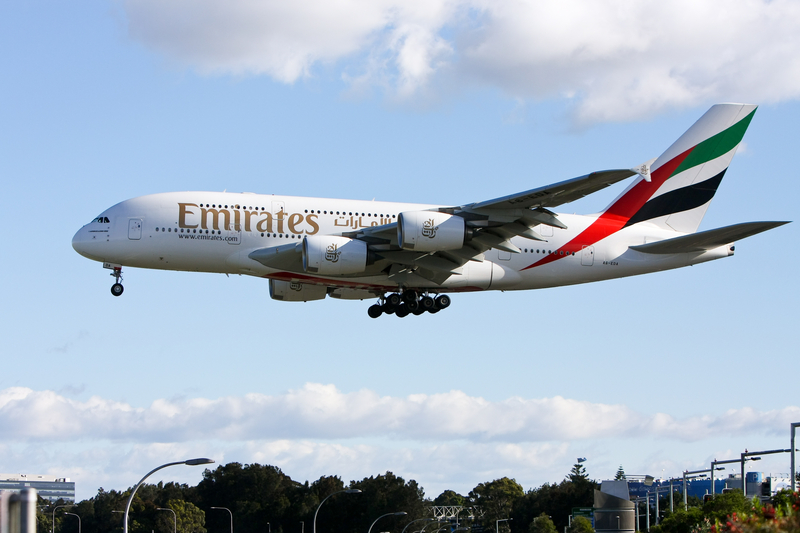
The Airbus A380-800 is the largest commercial passenger aircraft ever placed into mass production.
The aircraft measures approximately 238 feet, 6 inches long and has a wingspan of 261 feet, 8 inches. Its two full-length passenger decks give operators far more usable floor space than a conventional widebody, although no airline has approached the type’s theoretical maximum certified capacity of more than 800 passengers.
Emirates operates the world’s largest A380 fleet. Its aircraft are powered by either Engine Alliance GP7200 or Rolls-Royce Trent 900-series turbofans, depending on the individual airframe and delivery batch.
The airline uses several different A380 cabin arrangements, ranging from premium-heavy four-class layouts to high-density aircraft designed for heavily traveled routes. Emirates’ largest two-class version seats 615 passengers, while its four-class aircraft carry substantially fewer passengers to provide room for First Class suites, Premium Economy, the onboard lounge, and other premium facilities.
Delhi (DEL) will receive the four-class version rather than one of the airline’s high-density layouts. That choice indicates that Emirates sees significant demand not only for additional seats, but also for higher-yield premium traffic traveling between India and destinations beyond Dubai (DXB).
Delhi Will Have A380 Service From Three Airlines
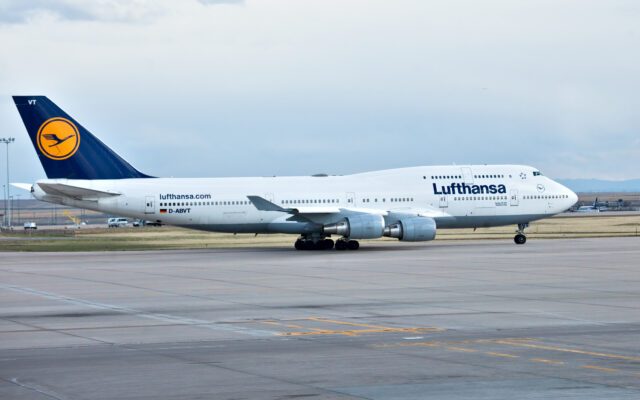
Emirates’ arrival will give Indira Gandhi International Airport (DEL) scheduled A380 service from three operators: Emirates, Lufthansa, and Singapore Airlines.
Published schedules indicate that Delhi (DEL) will receive one daily A380 from each carrier, potentially producing a record three daily superjumbo operations at the airport.
Lufthansa uses the A380 between Munich Airport (MUC) and Delhi (DEL), while Singapore Airlines deploys the aircraft between Singapore Changi Airport (SIN) and Delhi (DEL). Emirates will add Dubai International Airport (DXB) as the third A380 hub connected to the Indian capital.
The three airlines use notably different configurations.
Singapore Airlines’ A380s accommodate 471 passengers and include six enclosed Suites, while Lufthansa operates layouts with approximately 509 passengers. Emirates’ four-class aircraft typically carry fewer passengers than Lufthansa’s version but place a greater emphasis on First Class facilities and onboard social spaces.
Having three daily operators is significant because relatively few airports receive regular A380 service from multiple airlines. Delhi’s position reflects the enormous scale of India’s international market and the continuing importance of one-stop travel through Dubai (DXB), Munich (MUC), and Singapore (SIN).
Delhi Becomes Emirates’ Third Regular A380 Destination in India
Delhi (DEL) will become the third Indian airport with regular Emirates A380 service, joining Chhatrapati Shivaji Maharaj International Airport in Mumbai (BOM) and Kempegowda International Airport in Bengaluru (BLR).
Emirates began scheduled A380 flights between Dubai (DXB) and Mumbai (BOM) in July 2014. Mumbai was the airline’s only regular Indian A380 destination for several years.
Bengaluru (BLR) joined the network in October 2022, when Emirates introduced the A380 on flights EK568 and EK569. Emirates became the first carrier to provide scheduled A380 passenger service at Kempegowda International Airport (BLR).
With Delhi added, Emirates’ regular Indian A380 schedule for November 2026 will be:
| Route | Outbound Flight | Return Flight | Frequency |
| Dubai (DXB)-Bengaluru (BLR) | EK568 | EK569 | Daily |
| Dubai (DXB)-Mumbai (BOM) | EK500 | EK501 | Daily |
| Dubai (DXB)-Delhi (DEL) | EK512 | EK513 | Daily |
All three flights leave Dubai (DXB) during the late-evening departure wave and return early the following morning.
That pattern allows the A380s to spend only a short period on the ground in India while maximizing their availability at Dubai (DXB). It also places passengers into the hub in time for Emirates’ morning long-haul departures.
The schedule is an efficient use of high-capacity aircraft: the A380s leave Dubai when demand is concentrated, complete overnight out-and-back rotations, and return to the hub early enough to support additional flying or scheduled maintenance.
Connecting Traffic Drives the Business Case
The Delhi-Dubai market is large in its own right, but connecting traffic appears to be the central reason for placing the A380 on EK512 and EK513.
Industry booking data cited in the original route analysis estimates that nearly 590,000 Delhi passengers connected to or from another Emirates flight at Dubai (DXB) during the 12 months ending in April 2026. That equates to more than 1,600 connecting passengers per day.
Approximately 44% of those passengers were traveling between Delhi (DEL) and Europe, while North America accounted for an estimated 29%. Africa and the Middle East each represented approximately 12%, with the remaining traffic linked to Latin America and Australasia.
These figures are modeled booking estimates rather than audited Emirates passenger totals, but they illustrate the scale and geographic diversity of the connecting market.
The United States was reportedly the largest connecting country market, followed by the United Kingdom and Canada. Leading city markets included London, Toronto, San Francisco, New York, Milan, Seattle, Los Angeles, Paris, Manchester, and Johannesburg.
Five of those 10 cities are in North America. That helps explain why Emirates selected a schedule that provides access to the airline’s morning departure bank from Dubai (DXB), including long-haul services to the United States and Canada.
The A380 also gives Emirates room to accommodate group travel, visiting-friends-and-relatives demand, business passengers, premium leisure traffic, and passengers connecting between India and markets that have limited or no nonstop Delhi service.
Premium Economy Expands Across Emirates’ Indian Network
The Delhi A380 announcement is part of a larger expansion of Emirates’ Premium Economy product in India.
Beginning October 25, all four daily Delhi-Dubai services will offer Premium Economy. The A380 will operate EK512 and EK513, while the remaining flights will use retrofitted four-class Boeing 777-300ERs.
By the end of October, Emirates expects to offer Premium Economy on flights serving six Indian cities:
Delhi (DEL), Mumbai (BOM), Ahmedabad (AMD), Bengaluru (BLR), Kolkata (CCU), and Kochi (COK).
Emirates will also introduce the Airbus A350-900 on its daily service between Dubai (DXB) and Netaji Subhas Chandra Bose International Airport in Kolkata (CCU). The A350 deployment will complement additional four-class Boeing 777 services on the route.
Across its wider Indian network, Emirates serves nine airports and operates approximately 167 weekly flights to Dubai (DXB). The airline’s Indian destinations also include Chennai (MAA), Hyderabad (HYD), and Thiruvananthapuram (TRV).
The Premium Economy rollout is strategically important. India has a substantial passenger segment willing to pay more than Economy Class fares but unable or unwilling to purchase Business Class, particularly on long connecting itineraries to Europe and North America.
A four-class product gives Emirates another pricing level and helps the airline compete for passengers who might otherwise choose premium economy on European, Asian, or North American carriers.
The Deployment Shows Why the A380 Still Matters
The aviation industry largely moved away from four-engine widebodies because modern twin-engine aircraft such as the Airbus A350 and Boeing 787 provide lower fuel consumption and greater route flexibility.
The A380 nevertheless remains valuable on routes where an airline can consistently fill a very large number of seats during a concentrated departure window.
Emirates’ Dubai hub is particularly well suited to the aircraft. Large groups of connecting passengers arrive and depart during defined banks, creating enough demand to fill an A380 without relying entirely on local traffic between two cities.
Delhi (DEL) is a strong example. Emirates already operates four daily frequencies, maintains a sizable connecting customer base, and offers onward service to destinations across six continents. Upgrading one strategically timed flight generates a major capacity increase without changing the overall frequency.
The aircraft also has considerable marketing power. For some passengers, the opportunity to travel on an A380—particularly in a premium cabin—can influence airline selection even when competing itineraries have similar schedules and fares.
Bottom Line
Emirates’ decision to introduce daily Airbus A380 service between Dubai International Airport (DXB) and Indira Gandhi International Airport (DEL) is a carefully targeted capacity increase rather than a simple aircraft substitution.
Beginning October 25, 2026, the four-class A380 will operate EK512 from Dubai (DXB) to Delhi (DEL) and EK513 on the return journey. Emirates’ other three daily flights will continue to use retrofitted four-class Boeing 777-300ERs, giving the route Premium Economy on every departure.
Depending on the exact aircraft configurations assigned, replacing the 777 with an A380 could add approximately 150 to 160 seats per flight—a capacity increase approaching 50%.
More importantly, the schedule places the additional capacity directly into Emirates’ strongest connecting banks. Passengers arriving from Delhi (DEL) at 6:35 a.m. will have access to a broad morning wave of departures from Dubai (DXB), particularly to Europe and North America.
The addition also elevates Delhi’s position in the remaining global A380 network. With Emirates joining Lufthansa and Singapore Airlines, Indira Gandhi International Airport (DEL) is expected to receive scheduled superjumbo service from three carriers.
For Emirates, the aircraft offers more Economy, Premium Economy, Business, and First Class capacity at precisely the time of day when the airline can use it most effectively. For Delhi passengers, it brings substantially greater seat availability and the full Emirates A380 experience to a route that has been served almost exclusively by Boeing 777s since the airline’s ceremonial A380 visit in 2010.