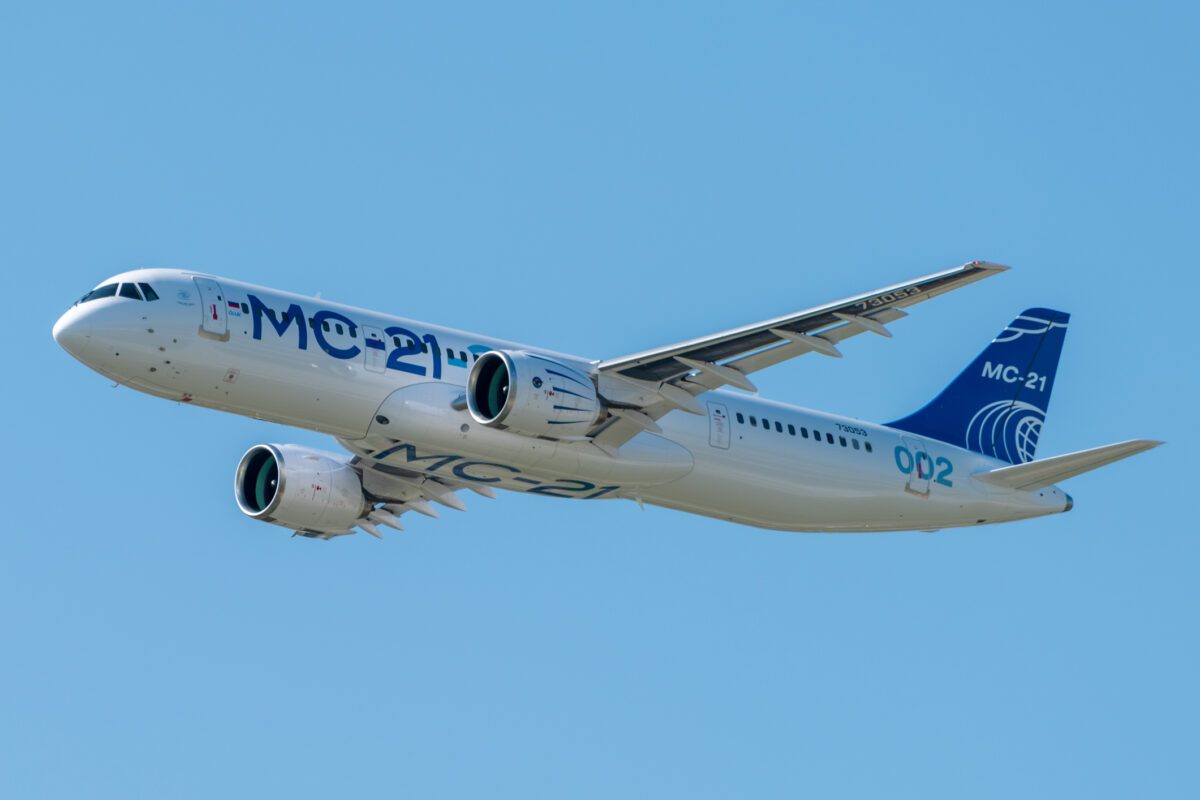
Russia is laying the groundwork to offer the MC-21-310 to airlines in countries it regards as friendly, extending the narrowbody program beyond its initial role as a replacement for Western-built aircraft in the domestic fleet.

The export effort remains behind certification and deliveries to Russian operators in the program’s sequence. Russia’s Ministry of Industry and Trade has previously identified the MC-21 as the country’s most promising civil aircraft for export, while saying a broader international market program would need to address certification, financing and overseas maintenance support.
In a plan published by the Russian Ministry of Transport, the government said it expected to prepare measures for taking domestically produced aircraft onto international markets in 2027 and 2028. That work would include internationally recognized certification centers and maintenance bases outside Russia.
Read our stories in your inbox
Two aviation newsletters. Zero fluff.
Production Aircraft Moves Into Flight Testing
The prospect of foreign sales has become more tangible as the first MC-21-310 manufactured using series-production processes enters the flight-test program.
The aircraft, serial number MC.0014, made its first flight from the Irkutsk aircraft plant on August 3, 2026. During the one-hour, 23-minute sortie, the crew reached 19,700 feet and an indicated airspeed of about 324 knots while checking handling, stability and the operation of Russian-built systems.

Rostec said the flight demonstrated the readiness of the supply and assembly system for an initial batch of 18 aircraft. The manufacturer is building aircraft while certification work continues, rather than waiting for the test campaign to finish before establishing the production flow.
According to Rostec’s account of the production aircraft’s first flight, the MC-21-310 had completed more than half of its certification flight program by August. The aircraft is powered by Aviadvigatel PD-14 turbofans and incorporates Russian replacements for systems and equipment that were originally sourced abroad.
The change is more extensive than an engine substitution. Russian industry has replaced avionics, flight-control components, brakes, electrical equipment, air-conditioning systems, landing gear elements and other equipment affected by sanctions and the withdrawal of Western suppliers. The aircraft also uses a wing manufactured from Russian composite materials.
Rostec told President Vladimir Putin earlier in 2026 that it expected to complete the MC-21 certification campaign during the year and begin series deliveries in 2027. The group’s industrial plan calls for production to reach 36 MC-21s annually by 2030.
A Narrowbody With a 3,830-Kilometer Range
The MC-21-310 addresses the same broad single-aisle market as the Airbus A320neo and Boeing 737 MAX 8, although the present aircraft’s published range places it primarily in short- and medium-haul networks.
United Aircraft Corporation lists the MC-21-310 with 163 seats in a typical two-class layout and up to 211 seats in a maximum-density cabin. Maximum takeoff weight is 85 metric tons, while the published range in two-class configuration is up to 3,830 kilometers, or about 2,070 nautical miles.
That performance would cover a large share of domestic Russian flying and many international sectors within Eurasia, Central Asia, the Middle East and parts of South and East Asia. It also gives potential operators enough capacity for trunk routes without moving into widebody economics.
Yakovlev conducted a series of performance demonstrations in 2026, including a flight of more than 3,800 kilometers with a payload representing 175 passengers. The manufacturer said the aircraft landed with a remaining fuel reserve, using the sortie to substantiate the revised performance of the import-substituted configuration.

The aircraft’s 4.06-meter fuselage is wider than those of the A320 and 737 families. The passenger cabin measures 3.81 meters across, allowing airlines to trade additional aisle width against seat width. UAC also promotes the larger cross-section as a means of speeding boarding and cabin service, considerations that matter on high-frequency sectors where ground time is central to utilization.
More than 30% of the structure consists of composite materials, including the high-aspect-ratio wing. For prospective customers, however, the commercial case will depend on dispatch reliability, maintenance intervals, engine durability and the availability of components rather than aerodynamic and cabin specifications alone.
Russian Airlines Remain First in Line
Domestic demand will absorb the first phase of MC-21 production. Russia needs the aircraft to begin replacing Airbus and Boeing narrowbodies whose long-term support has become more difficult under Western sanctions.
Aeroflot is intended to become the principal operator, giving the program a large launch fleet around which Yakovlev, UAC and Russian maintenance organizations can build operating experience. That domestic introduction will also provide the utilization and reliability data needed to support a credible export campaign.
The strategy reflects lessons from the original Sukhoi Superjet program. Russia secured overseas operators for the regional jet, but the program struggled to provide the parts availability, maintenance coverage and technical response expected by airlines outside its home market. Russian officials have consequently placed after-sales infrastructure alongside certification in their planning for the MC-21’s international introduction.
Foreign certification will be another central issue. An aircraft can operate internationally under approvals issued or accepted by its state of registry, but an export customer must be satisfied that its own regulator can validate the type, oversee continuing airworthiness and maintain access to the technical information needed to supervise the fleet.
Russia’s likely export approach will therefore involve bilateral regulatory work with individual partner states rather than a rapid return to the broad validation process once envisaged with the European Union Aviation Safety Agency. Government-backed leasing, export credit and spare-parts inventories are also likely to form part of any offer, particularly for smaller airlines taking a new aircraft type in limited numbers.
Export Push Follows Other International Partnerships
UAC has already begun rebuilding international civil-aircraft cooperation through other programs. In January 2026, the company reached agreements connected with Indian production and sales of the SJ-100 and Il-114-300, showing that Moscow is prepared to use local assembly and industrial participation to open markets.
A similar structure could eventually support the MC-21. Local maintenance, component work or assembly would reduce an operator’s dependence on a supply chain centered entirely in Russia and could help secure government support in the purchasing country. It would also make the program more complex at a time when UAC is still increasing output for Russian airlines.
The first export transactions are consequently more likely to follow a proven period of domestic operation than to run alongside the initial Russian deliveries. The immediate industrial tests are completing certification, delivering the first aircraft and demonstrating that the production system can sustain the planned rate.
Bottom Line
The MC-21-310 gives Russia an exportable product in the largest segment of the commercial aircraft market, but its first task is more defensive: preserving narrowbody capacity for Russian airlines as their Airbus and Boeing fleets age. Foreign orders would improve production economics and spread development costs across a larger fleet, yet diverting early aircraft away from domestic operators would work against the program’s central policy purpose.
The strongest potential customers will be airlines whose route structures fit the aircraft’s approximately 3,830-kilometer range and whose governments are willing to establish direct regulatory, financing and technical relationships with Russia. For those operators, acquisition price will be only one part of the decision. Engine support, spare-parts positioning, training, residual-value protection and the speed of technical assistance will determine whether the MC-21 can become more than a politically supported purchase.
The next indicators will be completion of the import-substituted aircraft’s certification, the timing of its first airline delivery and the reliability achieved by the initial Russian fleet. Only after those steps will prospective foreign customers have the operating evidence needed to evaluate the MC-21-310 as an airline asset rather than an industrial program.
Keep reading FlyMag
Get the Daily Brief in the morning or the Route Watch weekly recap on Fridays. Or both.